Live data from Hacker News

Too much money and too few places to invest it

axios.com

61–70 of 104 posts

Re: Too much money and too few places to invest it

#61

and literally every asset class exploded. Isn't this the very definition of inflation...? Another view would be that money is simply losing value. a million is not what it used to be.

That holds for houses, but most inflation measures index housing on rent, not house price, possibly to account for the sensitivity of house prices to interest rates.

From another angle, look at consumer goods a year ago compared to today. This year you can get a better car/tv/phone/computer for the same price, or the same one for less. Isn't that the very definition of deflation? Another view is that money is simply gaining in value -- a thousand bucks is worth a lot more than it once was :-).

(Funnily enough, I'd agree with you at a million because of house prices, and at a hundred because of food, haircuts, clothing etc. 1k-100k is weirdly different though.)
Re: Too much money and too few places to invest it

#62
post #15

Earlier quoted context omitted.

Companies then have to build cars to provide to your workers, instead of building you a factory. We have a limited amount of capital. There's an economic opportunity cost from higher wages and more consumer spending.

What kind of messed up thinking is this? More consumer spending has an opportunity cost? What’s a capitalist supposed to do if nobody can afford their stuff?

Capitalists building ever fancier yachts for each other. I mean hypothetically.

Re: Too much money and too few places to invest it

#63

Earlier quoted context omitted.

Wouldn't it just make the automation viable more quickly?

It could boost per worker automation, but there will be fewer workers, and less economic output to reinvest into capital (which is essentially automation), so there will be less automation in general. So higher automation per worker but lower automation per capita.

Capital isn't "essentially automation" in general. It includes a lot of other things like land and art and government bonds.

If you have a job which can be automated at a cost equivalent to a $10/hour wage, it doesn't get automated when the wage is $9 and does when it's $11. The money doesn't inherently come at the cost of some other automation, it may (and if the other automation is profitable, more likely does) come from selling some bonds or other assets you own, or by borrowing it from a bank which just creates the new money from nothing as banks do.

You're also ignoring a number of other effects like the higher demand for automation allowing fixed costs to be spread over more units and lowering the purchase price of the automation equipment.

A lot of these things are actually good -- if people sell real estate to buy automation equipment then housing prices come down. If four people get replaced by four machines and one person to look after them, the person who knows how to look after the machines may get paid more than any of them would have before the automation.

But the other three are still out of a job, and are then in a wasteful competitive signaling game with all the other newly unemployed to overpay for degrees and credentials because none of them are allowed to compete by accepting lower compensation anymore.

Re: Too much money and too few places to invest it

#64

What about investing it in the planet. Fund lobby groups. Fund companies working on alternative energy tech. There was a (YC funded?) startup on here recently looking to turn air and water into fuel in an efficient enough way. That sort of stuff. Unless the goal is purely to maximise gains of course. Announce "I am investing 10Bn in climate change startups over 50 years", so that people can plan their career around t…

I don't think there's too much money: there are not enough GOOD ways to spend it.

Investors don't refuse to fund ethical businesses or finance saving the planet, if it can make them money. It's just that there's no good opportunity on the market.

When investors can make more money saving the planet that destroying it, the planet will be saved.

Re: Too much money and too few places to invest it

#66

> "How we got here: The Fed's quantitative easing program pushed the cost of borrowing money to next to nothing for nearly a decade, allowing companies to splurge on debt for mergers and acquisitions and to boost revenue." Put another way, the Fed made the rich richer, and the lack of significant "trickle down" has created a socio-political Charlie Foxtrot; of which the Fed is not accountable for.

The Fed is against raising the minimum wage because it will make inflation increase above the allowed 2% per year. Which kind of makes sense because paying workers more will make things more expensive especially service businesses. But, they should still raise the minimum since most service businesses are heading for automation and the bump will help workers have a better job transition.

To the best of my knowledge, the Federal Reserve has no official position in favor of or against raising the minimum wage. Claiming otherwise is speculation and likely misinforming people.

Disclosure: Former researcher at the Federal Reserve Board

Re: Too much money and too few places to invest it

#67

Earlier quoted context omitted.

The Fed is against raising the minimum wage because it will make inflation increase above the allowed 2% per year. Which kind of makes sense because paying workers more will make things more expensive especially service businesses. But, they should still raise the minimum since most service businesses are heading for automation and the bump will help workers have a better job transition.

To the best of my knowledge, the Federal Reserve has no official position in favor of or against raising the minimum wage. Claiming otherwise is speculation and likely misinforming people. Disclosure: Former researcher at the Federal Reserve Board

They may not take an official position, but their actions do lead to wages not increasing. Here's one example: https://www.axios.com/economists-federal-reserve-wages-708b9...

Re: Too much money and too few places to invest it

#68

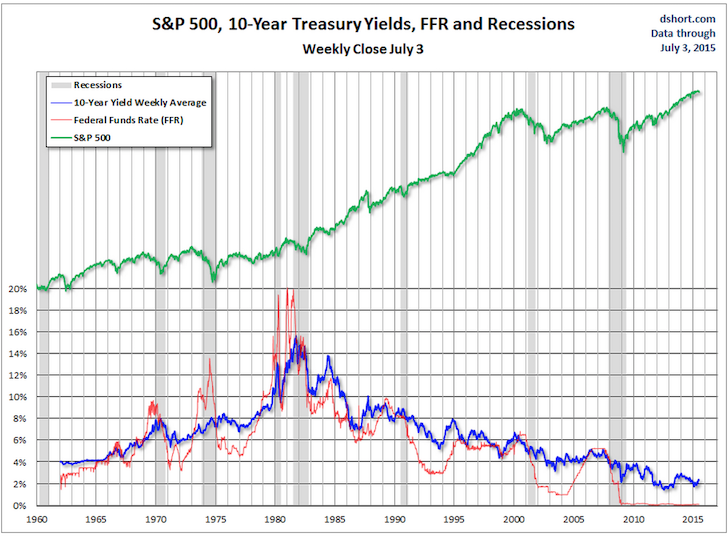
Ugh. These sort of pseudo-intellectual articles that mix economics and politics are my least favorite things to see on this site. They are super misleading and play towards people's biases about how they view the world while selectively interpreting the sparse data they present to do so. An example: If there was too much money, you would think that bond yields would go down. Look here: https://www.cnbc.com/quotes/?sy…

I urge you to look at this chart: https://www.financialsamurai.com/wp-content/uploads/2015/07/...

There's a strong correlation there. Fed funds rate seems to lead a bit.

I agree with you about the all the bad writing. It's pernicious.

Re: Too much money and too few places to invest it

#69

and literally every asset class exploded. Isn't this the very definition of inflation...? Another view would be that money is simply losing value. a million is not what it used to be.

That holds for houses, but most inflation measures index housing on rent , not house price, possibly to account for the sensitivity of house prices to interest rates. From another angle, look at consumer goods a year ago compared to today. This year you can get a better car/tv/phone/computer for the same price, or the same one for less. Isn't that the very definition of deflation? Another view is that money is simply…

prices of "houses" is really mostly land. the replacement of the building itself is a very small fraction in most in-demand locations.

So yes, land went up. All other examples you are citing are depreciating, non-scare items. It's not that it's "better" or anything, but we can make way more of iphones/etc.

However, there is only one Switzerland and only one Manhattan.

Re: Too much money and too few places to invest it

#70

Earlier quoted context omitted.

and QE is just kicking the can down the road a little further. We are the new Japan.

in some ways, yes, but one difference is that our population is not shrinking. another is that our debt to GDP ratio is something like 90-100%, but Japan's is more like 200%. yet another is that we don't have the sort of nationalized healthcare system Japan has. also, Japan's been playing the "managed trade" game for decades now and they know how to do it well, whereas the US has been practicing a consumer driven eco…

Debt/GDP ratio doubled in 20 years, and the bulk of that change in the in 10 years or so. It won't take much longer to get to 200%, we are going to see it.

I'm not sure what you are trying to say in the last two paragraphs? That we are somehow so fundamentally different, that the fiscal picture is not comparable?

Post reply on HN