Live data from Hacker News

We Need to Save What Made Linux and FOSS Possible

linuxjournal.com

61–70 of 264 posts

Re: We Need to Save What Made Linux and FOSS Possible

#61
post #37

Earlier quoted context omitted.

> Why have users chosen those environments? Because they don't give a rat's ass about the freedom aspect of free software. If software A requires four clicks to do something, but B has a way to do it in 3, they are on B without a second thought. But in this case, those users are not just any old end users; the are actually supposed to be FOSS developers, so there is a heavy irony there. I think what is doing on is th…

>> Why have users chosen those environments? > Because they don't give a rat's ass about the freedom aspect of free software. If software A requires four clicks to do something, but B has a way to do it in 3, they are on B without a second thought. Convenience always wins. Always. Users do care about free (as in beer) and they care if the product or service will disappear without warning (hello Google!). But the defi…

Traditional free software developers do not use the most convenient program without caring about freedom.

Otherwise, for instance, nobody would be debugging with gdb, rather than Visual Studio or what have you.Nobody would be LaTeXing instead of using MS Word or Adobe Illustrator.

GIMP isn't as good as Photoshop (if I believe what people say), yet people still use it. (I've only ever used GIMP since 1996; I have no idea about Photoshop and don't care; it's not free, won't use it.)

People went through all sorts of inconveniences to use free software, like manually figuring out monitor clock timings to stick into their X configuration, building their own custom kernels and whatnot.

You can't say "convenience wins" with a straight face; that's like saying free software doesn't exist.
Re: We Need to Save What Made Linux and FOSS Possible

#62
post #18

Yeah, I'm often puzzled by some FOSS developers not using open communication tools and not running Linux on their actual day to day work computers.

I've seen (and also not understood) the use of Slack/Gitter/etc. but the "not running Linux" part is a surprise to me, personally. I've used Linux or BSD on all of my personal machines for a long time, and assumed, wrongly I guess, that most other people were in the same boat. I'm not sure it's a problem, but it's interesting.

Agreed, I've been using desktop Linux on my home laptop for more than a decade now. Every piece of software I want, wireless printers, videogames (many AAA!), everything just works.

I'm puzzled. I think it was just the unfortunate rise of mobile.

Re: We Need to Save What Made Linux and FOSS Possible

#63
post #58
post #29

Earlier quoted context omitted.

>The ideological reasons are practical reasons. We don't want to give you software freedom because we believe in some abstract ideology. We want to give you free software because we believe this is the way that you will eventually get the best software that will let you do the most. While I wholeheartedly agree with this particular stance--doing away with ideology and sticking with ethics and pragmatism--, I am not s…

In fact, that's only the ideology of Open Source software. Free/libre software (e.g. GNU and the FSF) believe in "free as in speech" for ideological reasons, not for tech quality reasons. In fact -- they argue -- one should sacrifice convenience and sometimes even short-term quality in favor of freedom. I certainly see the merit of that line of thought, though it's also a very hard road, and harder still to convince…

I'm not saying the quality of the software is the most important thing. I'm saying that software freedom is a pragmatic goal. Being able to fix your own software or bring it to anyone competent who can repair it is a practical thing. Giving the software to your friends is a practical thing. Being able to modify the software is a practical thing. Knowing that your software won't spy on you is a practical thing.

Software freedom is not some abstract ideology with no relation to pragmatics.

Re: We Need to Save What Made Linux and FOSS Possible

#64
post #45

Earlier quoted context omitted.

> Why have users chosen those environments? Because they don't give a rat's ass about the freedom aspect of free software. If software A requires four clicks to do something, but B has a way to do it in 3, they are on B without a second thought. But in this case, those users are not just any old end users; the are actually supposed to be FOSS developers, so there is a heavy irony there. I think what is doing on is th…

> Because they don't give a rat's ass about the freedom aspect of free software. It's attitudes like this that make people really not care about FOSS. Yelling at people because they're not using IRC instead of slack isn't a good way to convince anyone.

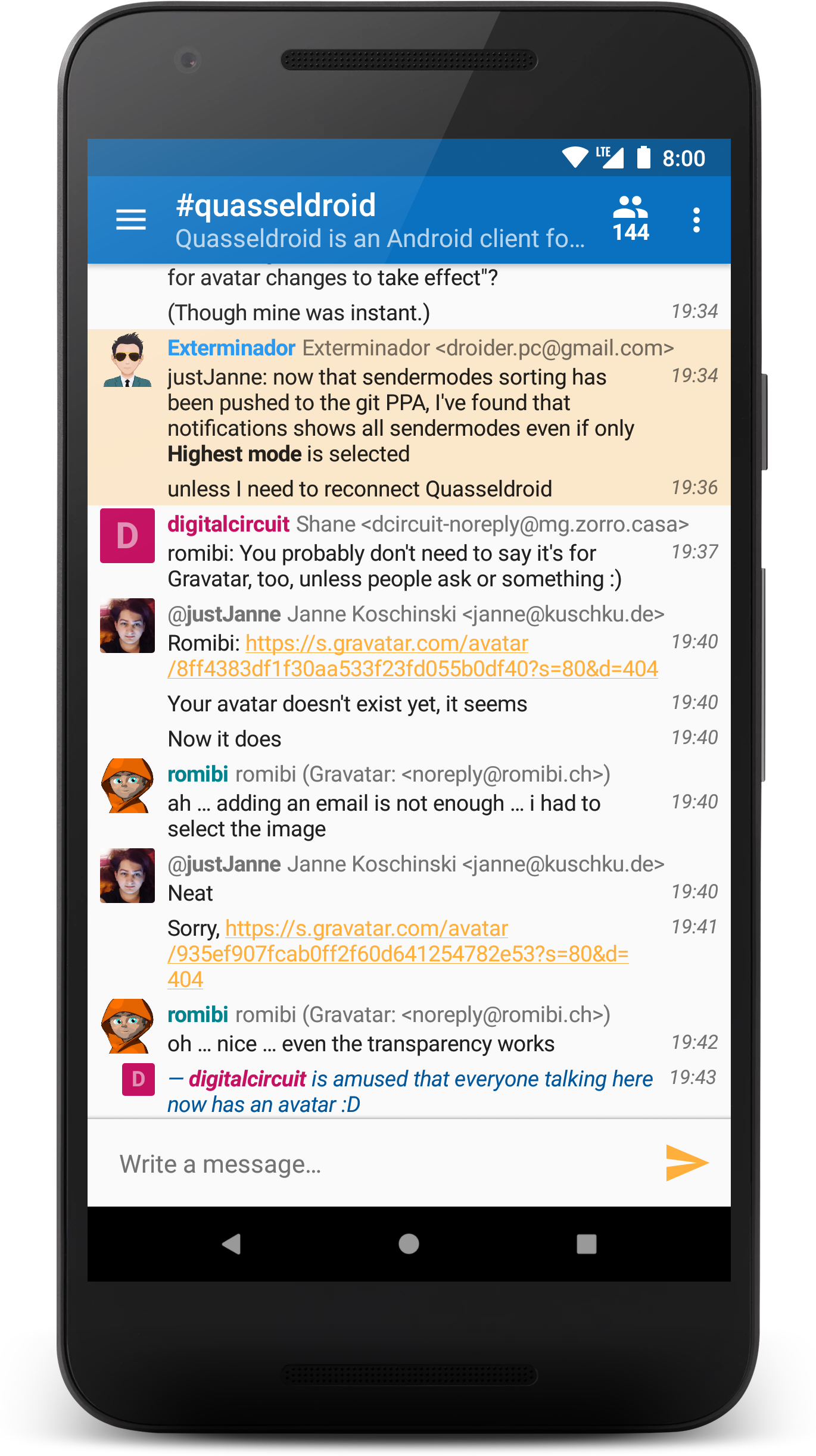
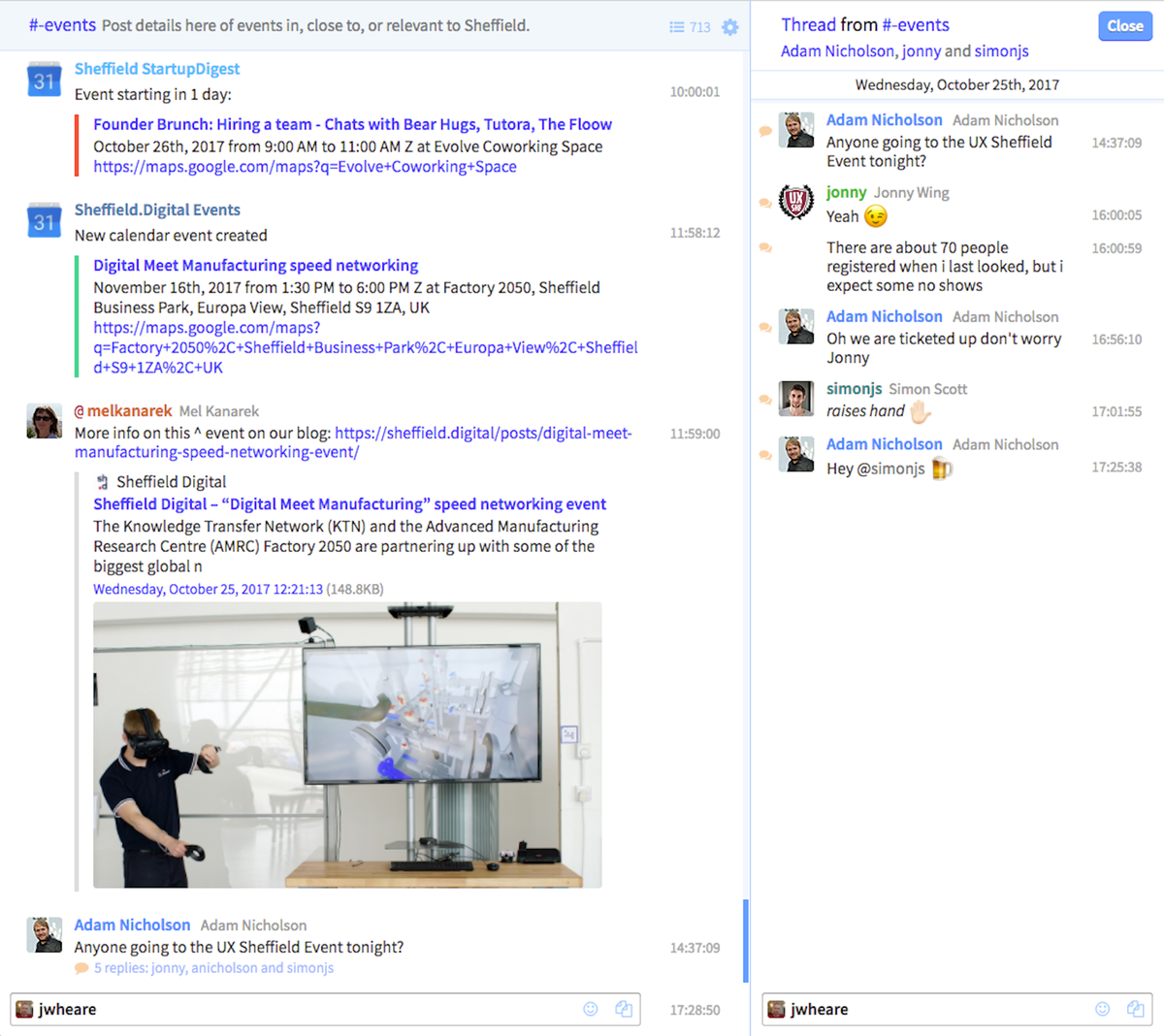
When IRC looks like this https://quasseldroid.info/assets/images/phone.png or this https://blog.irccloud.com/static/2018-05-14-slack-integratio... and people still complain about IRC’s UI or usability, then what more can we IRC devs do?

Re: We Need to Save What Made Linux and FOSS Possible

#65
post #25
post #19

Earlier quoted context omitted.

I’m probably bad but I honestly can’t get slack to work with all the different communities I’ve been invited to. Discord basically works like IRC, except almost every channel I’m in is by invitation only, making it almost impossible for new people to join. In my opinion IRC is still the best tool out there and I really, really wonder why we stopped using it.

I think by a wide margin the biggest problem is that IRC doesn't have any offline features. In a world where people swap devices all the time, it really sucks to have to drop your connection on every device change, and lose any chat that occurred while you were offline and be unreachable while you're offline.

So use IRCCloud or selfhosted Quasseldroid+Quassel? Or maybe even Matrix with Riot and the IRC bridge?

Re: We Need to Save What Made Linux and FOSS Possible

#66
post #2

Most people engage with FOSS for practical reasons, not ideological reasons. Given that developers of proprietary software have made a lot more money on the whole than developers of FOSS, I don't see that changing anytime soon.

Everyone could stand to learn the lessons of gcc.

Back in the '90s, when gcc really took off, it got a lot of attention for being faster and optimizing code better than anything else out there. It wasn't just free: it was _better_. Of course, the 'free' part helped too, but the only 'free' people cared about was as in beer, not speech. This was when Sun was charging $$$$ for C compiler licenses on top of the operating system. So you could buy Sun's cc for massive amounts of money... or get a _better_ product without having to shell out. No wonder gcc won.

And if you look down the road to the 2010s, when LLVM/clang is eating gcc's lunch, you have to wonder what went wrong. What went wrong was that gcc fell behind for ideological reasons. RMS categorically refused to allow gcc's frontends to output the AST on the grounds that proprietary tools could make use gcc's output. The developers of LLVM and clang, on the other hand, had no such qualms. Being able to get an AST out of clang meant you could have IDEs compiler-assisted syntax highlighting and real-time error checking, things that gcc will never have for ideological reasons.

gcc succeeded when it was better than the competition and faltered when it was worse, and freedom had nothing to do with it.

Re: We Need to Save What Made Linux and FOSS Possible

#68
post #64
post #45

Earlier quoted context omitted.

> Because they don't give a rat's ass about the freedom aspect of free software. It's attitudes like this that make people really not care about FOSS. Yelling at people because they're not using IRC instead of slack isn't a good way to convince anyone.

When IRC looks like this https://quasseldroid.info/assets/images/phone.png or this https://blog.irccloud.com/static/2018-05-14-slack-integratio... and people still complain about IRC’s UI or usability, then what more can we IRC devs do?

[deleted]

Re: We Need to Save What Made Linux and FOSS Possible

#69

– We collaborate inside proprietary environments Why is that? Why have users chosen those environments? Assume they are rational beings, and get at the heart of it. Ask: "How can we address the actual user needs while supporting our goals?" – Many Linux and FOSS geeks today use Linux only professionally Same answer as above. – We're not modeling our values WHY? (Hint: "the use of nonfree" is not, and has never been a…

An excellent point. FOSS has long been great at underlying tech, freedom, and openness, and terrible at UI/UX and ease-of-use. That's been true for a long time and still seems to be true today. The reasons for this are much-debated and well-known, yet the underlying challenge persists.

Rather what is considered good UI and ease of use is sub-optimal for people who understand tech, and those are the people who write free software for themselves and others like them. (Why would you spend months making some UI that in the end requires a minute of manual labor to do what some piece of syntax in a config file achieves in seconds, and which can be diffed to the previous version and so on.)

There are good examples of UI in free software. There are also terrible examples of UI in proprietary software. A lot of the peculiar user experience in GNU/Linux is that way because it was cloned quite exactly from a proprietary system called Unix. A lot of that bad user experience is standardized with an IEEE standard called POSIX, which isn't free.

Re: We Need to Save What Made Linux and FOSS Possible

#70
post #64
post #45

Earlier quoted context omitted.

> Because they don't give a rat's ass about the freedom aspect of free software. It's attitudes like this that make people really not care about FOSS. Yelling at people because they're not using IRC instead of slack isn't a good way to convince anyone.

When IRC looks like this https://quasseldroid.info/assets/images/phone.png or this https://blog.irccloud.com/static/2018-05-14-slack-integratio... and people still complain about IRC’s UI or usability, then what more can we IRC devs do?

IRCCloud is okay, but the UX/UI isn't anywhere near as nice as Slack.
Post reply on HN