Live data from Hacker News

Life in a Studio Apartment with My Wife and Two Sons

gregkroleski.com

61–70 of 187 posts

Re: Life in a Studio Apartment with My Wife and Two Sons

#61
post #51

Earlier quoted context omitted.

As someone who does not want to live there either, I can see why people move there. It's simply where the most opportunities are. The idea is to move there and live uncomfortably until you network your way to an awesome, high paying job. Alternatively, the tech companies there usually do more interesting stuff than in other area. Here in NYC most are related to advertising or media—stuff not easy to get exited about.…

Plenty of places outside of SF are doing interesting things. Boston has plenty, as does Austin.

I live in Austin and have seen many of my coworkers and friends leave for the bay area. Besides interesting work I think there are more opportunities for career growth.

I am in security (but it's similar in many specialties) and while there are very good companies in Austin if I want to to rise become a security architect or director of information security I have to go to the tech headquarters. Companies like Google and facebook may have regional offices but the core innovative security/ai/pl work and executive decision making is being done in the home campuses.

That being said, I would never leave Austin for the SF bay unless it involved a $350k+ salary.

Re: Life in a Studio Apartment with My Wife and Two Sons

#62
post #24

This isn't so bad. The Netherlands is the most dense population of any country outside Taiwan and families dwelling in small spaces continues to this day. There is a 12-member family spanning 3 generations all living in the same small house next door to me. Our tiny 60 square meter home is considered normal for our area. By American standards, SF seems like tight living, perhaps. But by world standards, space is not…

https://en.m.wikipedia.org/wiki/List_of_sovereign_states_and... Netherlands is number 30. Admittedly most of the others are a lot smaller, but Bangladesh and South Korea are a lot bigger. San Fran is also denser than the Netherlands, and AFAICS denser than any Dutch city (comparable with The Hague).

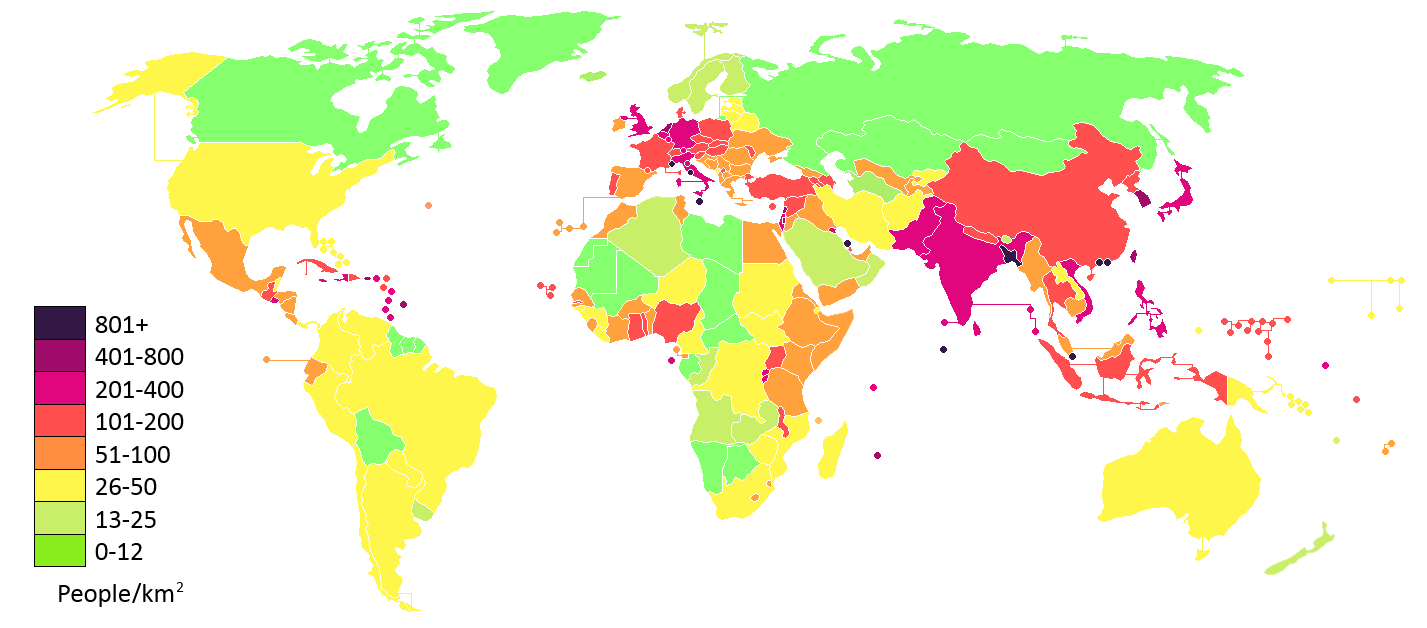
Just compare the US to other developed countries (e.g. the vast majority of Europe), high-density living (like SF) is pretty much the standard, that's really his point. [0] On population density maps the US as a whole is more akin to Australia. [1]

Beyond that, I always wonder about population density figures, afaik there is no standardised process for these calculations. You may think 'well it doesn't get much simpler than population within certain area over that total area', but when making comparisons, the statistics can be deceiving, especially as a proxy for 'living space'.

For example, I live in Amsterdam and we have quite a bit of water (from the Amstel river that divides the city east-west, the Ij river that divides the city north-south, or the Slooterpas lake that's more than a mile wide to the many different canals), as well as numerous sizeable public parks including just one of them, the Amsterdamse Bos, that's 3x (!) the size of Central Park... And if you're not familiar with Amsterdam, it's a tiny city with less than a million inhabitants. When you're outside you won't feel cramped, there's a lot of public areas, it's open, it's quite nice. But that doesn't mean that the density of actual residential space is like that. Especially when you consider that most of the Netherlands, including much of Amsterdam (a city mostly built in a swamp area!) has relatively low buildings and little vertical space as opposed to say Taipei.

Further, you may say the Netherlands is only nr 30, but there are only 4 countries with more than 10m people which are denser of which only 2 are developed countries. The US for context is number 177.

So the Netherlands is quite dense per total area for one. Secondly, vertical space is quite low, and thirdly many of its cities have large open areas (e.g. parks, bodies of waters, like Amsterdam) has ample open-areas where nobody actually lives. So while population density numbers are interesting to measure density, they can't simply be used a proxy for measuring density of housing space.

A better look would be at floor space per person. It's hard to find internationally comprehensive numbers for local areas, but take Germany and France. Germany has about twice the population density, but the floor space per person is pretty much exactly the same. Pop density would've been a terrible proxy for comparing floor area per person between these two countries.

Another example is Ireland and the Netherlands. The latter has 6x the population density. But floor space per person according to this source [2] is larger for Ireland. That's a striking difference that completely blows the popdensity statistic to irrelevance if a comparison between these countries was made for space in the home to live, even if the numbers are adjusted for errors.

I see pop density references pop up all the time in online discussions and it strikes me as a pretty bad statistic to pick for most arguments in such discussions. This particular discussion is about OP's tiny amount of floor space in his home, a popdensity stat includes much more and it may not be applicable when trying to make international comparisons.

[0] https://upload.wikimedia.org/wikipedia/commons/thumb/6/67/Wo...

[1] https://upload.wikimedia.org/wikipedia/commons/4/4d/World_po...

[2] http://www.entranze.enerdata.eu/

Re: Life in a Studio Apartment with My Wife and Two Sons

#63
post #7

The more I read such articles, the more I think you'd have to be nuts to choose to live in San Francisco. And yet, clearly, plenty of people do choose to live in San Francisco.

"And yet, clearly, plenty of people do choose to live in San Francisco."

Well, he didn't choose to live in San Francisco for long. By the end of his four years there, he decamped to Seattle, which seems to be the natural progression these days: live in SF and close a few deals in a tiny space, then move to Seattle into a slightly larger place and be amazed at all of the room you have.

Re: Life in a Studio Apartment with My Wife and Two Sons

#64
post #43
post #24

Earlier quoted context omitted.

https://en.m.wikipedia.org/wiki/List_of_sovereign_states_and... Netherlands is number 30. Admittedly most of the others are a lot smaller, but Bangladesh and South Korea are a lot bigger. San Fran is also denser than the Netherlands, and AFAICS denser than any Dutch city (comparable with The Hague).

The ultimate problem is that SF is not really all that dense. It's ~7,000/km^2. (Amsterdam is ~4,000/km^2). Seoul is 17,000/km^2. But living spaces are surprisingly reasonable, even by American standards. It always blows me away that Paris has a density of 21,000/km^2, but the living spaces I've seen are pretty bad. Like the article says, it just makes very poor use of its space.

Population density can be quite meaningless when talking about floor space to live in.

A city that has a height restriction of half of the other city can have exactly the same floor space to live in per person while ostensibly being half as population dense. And height is just one of many factors. Large bodies of water, parks, large open squares etc... they all can change density figures a lot without any change to the actual space per person in an actual house.

Paris certainly has tiny homes, I've been in more than a few, and they've felt smaller than Amsterdam (where I live) generally. But it's nowhere near the discrepancy that the density figures suggest (e.g. 21k vs 4k, but floor space per person is nowhere near 5x as big in Amsterdam, probably more like 25% or something). There are all kinds of reasons for this, one is that Amsterdam hasn't got nearly as many tall buildings as Paris does, and that Amsterdam's density is understated due to quite significant bodies of water (two rivers splitting the city vertically and horizontally), parks (Amsterdamse Bos is 3x Central Park), lakes etc etc, where nobody lives but that is part of the density calculation, making the actual places people do live denser than they appear in these numbers.

Re: Life in a Studio Apartment with My Wife and Two Sons

#65
post #49

That is stupid. If your salary won't cover decent living then why bother? It is people like yourself who drive rates low and then post how difficult is to live on them...

> That is stupid. If your salary won't cover decent living then why bother?

I think you fail to see that he'd definitely describe his living over the past few years as 'decent', and likely even much more than just decent.

Re: Life in a Studio Apartment with My Wife and Two Sons

#66
post #14

Growing up in communist Russia, 400sq. feet apartment would be the luxury option for 2 or 3 families with multiple children each. No joke, my parents lived with their siblings and parents (and sometimes grandparents) in the same apartment even after everyone had children of their own. Somehow we still managed to occasionally have 20 more people over for birthday celebrations and cook all the accompanying excessive am…

And yet we get hordes of collectivists that infest HN that say we should try it again...."but it'll be different this time"

Re: Life in a Studio Apartment with My Wife and Two Sons

#67
post #17

Earlier quoted context omitted.

> No need to turn this into another stereotyping Europe vs US issue But it is kind of true that Americans are extremely melodramatic about this stuff. 800 sqft house is often referred as a "tiny house" in American media. In the UK (for example) this is an average house size.

The US is over 10 times larger than the UK. Guess what, tons of land leads to different expectations. I don't understand why Europeans seem to like acting condescending about this stuff?

Obviously it sucks, but the Europeans have to justify it because they can't admit its much better in the US when it comes to housing.

Re: Life in a Studio Apartment with My Wife and Two Sons

#69

This isn't so bad. The Netherlands is the most dense population of any country outside Taiwan and families dwelling in small spaces continues to this day. There is a 12-member family spanning 3 generations all living in the same small house next door to me. Our tiny 60 square meter home is considered normal for our area. By American standards, SF seems like tight living, perhaps. But by world standards, space is not…

Coming from the UK it amazes me that the vast majority of family houses have a small footprint but are high. Our house has 3 stories + a small loft.

The new houses being built have 4 stories. Footprints are around 13x6.

In the UK in a similar town the footprint is easily twice that but the actual livable space is often less.

Re: Life in a Studio Apartment with My Wife and Two Sons

#70
post #53

Earlier quoted context omitted.

> The US is over 10 times larger than the UK. Guess what, tons of land leads to different expectations. I'm not sure it's just that, it's also I think, that Americans find it acceptable to live in suburbs. If everyone tried to live in the city centers (like they do in nyc or SF), small places would also be the norm.

Why would you want to live in a city center, when you could have 40 acres of good land in the country for the same money, or less? Suburbs are a compromise, where you get a little of column A (room enough for decent living) and a little column B (urban wages and access to capital), which equals a lot of column C (long, shitty commutes).

> Why would you want to live in a city center

Well, one reason would be:

> long, shitty commutes

another is that some people prefer urban life.

I bet you'd be surprised to hear that in some countries people actually prefer to live in apartments to houses.When I ask why, they often state the fact that it is much less work to upkeep an apartment, so I guess that would be another reason. I personally understand why would some kid from the midwestern suburbs want to live in nyc, even if it means a much lower standard of living.

But in reality I think it really is purely cultural, people prefer what people like them around them prefer. People in the US were living in the cities as well before the "white flight", so at some point, urban middle class families were also the norm.

Post reply on HN