Live data from Hacker News

ARMing a Breadboard – Everyone Should Program an ARM

hackaday.com

61–70 of 74 posts

Re: ARMing a Breadboard – Everyone Should Program an ARM

#61

I too am often surprised at how often people reach for an Atmel 8 bit AVR chip rather than an ARM. It is a testament to the momentum that Atmel built, the avr-freaks community and the amazing cost effectiveness of it all. But now we're seeing ARM chips with built in clocks, and fewer base components required and I think the end of that AVR dominance is on the horizon. And that is why Dialog is buying Atmel[1]. Gettin…

The documentation and ease of use of Atmel peripherals, and the electrical robustness of the chips, is something I like. Don't need an ARM to blink some LEDs when a sensor triggers. For ARM, I like both the OpenCM 9.04 ($9 board) and teensy 3 ($19 board.) Both of them can take 100 mil headers and be breadboarded if needed.
Re: ARMing a Breadboard – Everyone Should Program an ARM

#62

I too am often surprised at how often people reach for an Atmel 8 bit AVR chip rather than an ARM. It is a testament to the momentum that Atmel built, the avr-freaks community and the amazing cost effectiveness of it all. But now we're seeing ARM chips with built in clocks, and fewer base components required and I think the end of that AVR dominance is on the horizon. And that is why Dialog is buying Atmel[1]. Gettin…

I'm using a PIC12 in product that replaces an existing one. At Volume Pricing 8 Bit PICs are pretty much incomparable to ARMs. A quick check on Digikey shows that for 10000 pieces, the cheapest 8 Bit Micro is a PIC10 - 35Cents/Unit (that's for today only). ATTiny is about 2 Cents more but that can change. The cheapest 8051 from Energy micro is in the same range as well. The cheapest ARM Cortex M3/M0 or even a ARM7 is…

> At Volume Pricing 8 Bit PICs are pretty much incomparable to ARMs. A quick check on Digikey shows that for 10000 pieces, the cheapest 8 Bit Micro is a PIC10 - 35Cents/Unit (that's for today only)... The cheapest ARM Cortex M3/M0 or even a ARM7 is $1+.

I don't think that statement reflects the situation today.

Cost differences at the low end have become increasingly narrow, where they are present at all. Using just Digikey pricing at 10k, as above, it's easy to find M0/M0+ parts in the range of $0.40--$0.50/ea at 10k.

> The smallest 8 Bit micros from Atmel or Microchip or any 8051 is around 3x3mm. Most ARM micros are much larger.

These parts are obviously available in a range of package sizes, but the smallest M0+ MCUs are also 3x3mm.

Re: ARMing a Breadboard – Everyone Should Program an ARM

#64

I too am often surprised at how often people reach for an Atmel 8 bit AVR chip rather than an ARM. It is a testament to the momentum that Atmel built, the avr-freaks community and the amazing cost effectiveness of it all. But now we're seeing ARM chips with built in clocks, and fewer base components required and I think the end of that AVR dominance is on the horizon. And that is why Dialog is buying Atmel[1]. Gettin…

Most hobby electronics projects aren't really CPU limited though, so using ARM doesn't really bring relevant advantages. Having a standard platform, including the peripherals like PWM/ADC/timer etc which are going to vary wildly between ARM implementations, is far more important for people starting out and are trying to solve their problems via Google. The 5V chips are also better at taking punches from miswired proj…

[deleted]

Re: ARMing a Breadboard – Everyone Should Program an ARM

#65

I too am often surprised at how often people reach for an Atmel 8 bit AVR chip rather than an ARM. It is a testament to the momentum that Atmel built, the avr-freaks community and the amazing cost effectiveness of it all. But now we're seeing ARM chips with built in clocks, and fewer base components required and I think the end of that AVR dominance is on the horizon. And that is why Dialog is buying Atmel[1]. Gettin…

Most hobby electronics projects aren't really CPU limited though, so using ARM doesn't really bring relevant advantages. Having a standard platform, including the peripherals like PWM/ADC/timer etc which are going to vary wildly between ARM implementations, is far more important for people starting out and are trying to solve their problems via Google. The 5V chips are also better at taking punches from miswired proj…

I agree with this take on it. I either find myself using an Arduino or other cheesy AVR board, or a "serious" FPGA platform. There never seems to be much demand around here for mid-grade controllers or SoCs. If I can't get the job done with an Atmega256, I'll drag out the heavy artillery.

Re: ARMing a Breadboard – Everyone Should Program an ARM

#66
post #62

Earlier quoted context omitted.

I'm using a PIC12 in product that replaces an existing one. At Volume Pricing 8 Bit PICs are pretty much incomparable to ARMs. A quick check on Digikey shows that for 10000 pieces, the cheapest 8 Bit Micro is a PIC10 - 35Cents/Unit (that's for today only). ATTiny is about 2 Cents more but that can change. The cheapest 8051 from Energy micro is in the same range as well. The cheapest ARM Cortex M3/M0 or even a ARM7 is…

> At Volume Pricing 8 Bit PICs are pretty much incomparable to ARMs. A quick check on Digikey shows that for 10000 pieces, the cheapest 8 Bit Micro is a PIC10 - 35Cents/Unit (that's for today only)... The cheapest ARM Cortex M3/M0 or even a ARM7 is $1+. I don't think that statement reflects the situation today. Cost differences at the low end have become increasingly narrow, where they are present at all. Using just…

Could you please provide links [to DigiKey]?

Re: ARMing a Breadboard – Everyone Should Program an ARM

#67

I too am often surprised at how often people reach for an Atmel 8 bit AVR chip rather than an ARM. It is a testament to the momentum that Atmel built, the avr-freaks community and the amazing cost effectiveness of it all. But now we're seeing ARM chips with built in clocks, and fewer base components required and I think the end of that AVR dominance is on the horizon. And that is why Dialog is buying Atmel[1]. Gettin…

I'm using a PIC12 in product that replaces an existing one. At Volume Pricing 8 Bit PICs are pretty much incomparable to ARMs. A quick check on Digikey shows that for 10000 pieces, the cheapest 8 Bit Micro is a PIC10 - 35Cents/Unit (that's for today only). ATTiny is about 2 Cents more but that can change. The cheapest 8051 from Energy micro is in the same range as well. The cheapest ARM Cortex M3/M0 or even a ARM7 is…

The cheapest ARM on Mouser is the same price: 0.35/part for 5k in an SOIC-8 (6x6mm). ARM chips are available in 2x2mm chip-scale packages.

Re: ARMing a Breadboard – Everyone Should Program an ARM

#68
post #44

Earlier quoted context omitted.

My experience is that most hobby projects are RAM limited when people are using the AVR chips. Whether its trying to hold a copy of an LCD view, or any sort of moderate data structure. The ATMega328 is 8K of RAM. The M0+ chips seems to all come with 64K of RAM, and given that folks are writing in C/C++ rather than Assembler that is quite helpful. I agree with you on the general tolerances to abuse though. I've filled…

> The ATMega328 is 8K of RAM No, just 2K. [0] > The M0+ chips seems to all come with 64K of RAM That would be 8K. [1] [0] http://www.atmel.com/devices/atmega328.aspx [1] http://www.st.com/web/en/catalog/mmc/FM141/SC1169/SS1817?sc=...

Thanks, I was talking to the Atmel Tech On Tour folks today and the part I'm really interested in of late is the R21 which has both radio parts and the M0+ in a tiny package.

It has up to 32K of RAM and 256K of flash [2], the larger Cortex chips have the big RAM numbers as you note.

[1] http://design.avnet.com/axiom/atmel-sam-r21-atmel-cortex-m0-...

[2] http://www.atmel.com/Images/Atmel-42223-SAM-R21_Datasheet.pd...

Re: ARMing a Breadboard – Everyone Should Program an ARM

#69

Earlier quoted context omitted.

It needs to be regulated, because the microcontroller draws varying amounts of current. But a simple regulator is just a three-legged IC and a capacitor.

Ah okay, I didn't realize that.

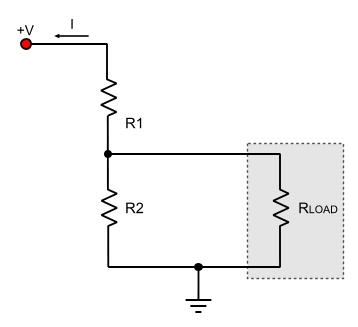
Just some technical info in this if anyone trips over this thread, consider the following diagram of a voltage divider:

http://pcbheaven.com/wikipages/images/voltagedivider_1235725...

The Rload and R2 are parallel resistors really so if Rload is really low which it is generally if it's doing anything then it will effectively shrink the R2 resistance (Rload || R2) and therefore voltage. Then whatever is connected as Rload won't get enough volts + current.

You can fix this to some degree by using very low values of R1 and R2 but then they start to sink lots of current as they are in series across the power supply and get hot so this becomes an efficiency problem. If you're really unlucky the magic smoke comes out or you touch one and burn your fingers emitting a nice bacon smell.

You can fix all of this with a single NPN transistor and a zener diode pretty easily but you might as well use a regulator IC then.

Analogue electronics is fun even if it does burn and explode in your face occasionally! My shit blows up all the time: http://i.imgur.com/GZBKblt.jpg

Re: ARMing a Breadboard – Everyone Should Program an ARM

#70
post #8

Earlier quoted context omitted.

You can also use a voltage divider if you are willing to suffer a bit of leakage current. That's just 2 resistors.

The linear regulators we are talking about are basically voltage dividers with feedback. They aren't significantly more efficient than your design, though they are ton less noisy.

While at peak current, the efficiency of a voltage divider is the same as a linear regulator, at lower currents a voltage regulator has significant benefits. This is because the quiescent current used by an unloaded voltage regulator can be very low (500nA for the TPS783!), while for a voltage divider to be sufficiently "stiff" its quiescent current should be about 10X the max load current. As a lot of microcontroller applications alternate between a low sleep current (several uA) and bursts of high run current (several mA), a voltage divider is significantly (>10000X!) more power hungry then a linear regulator in practice, even if the worst case efficiency for both is closer.
Post reply on HN