Live data from Hacker News

Replacement.ai

replacement.ai

591–600 of 725 posts

Re: Replacement.ai

#591
post #431

Earlier quoted context omitted.

It means that no one cares about the creations except in terms of money. If an Oracle building burns down and no one is hurt, I wouldn't shed a single tear. If an artistic graffiti mural adorned its wall, I would be more upset.

I get what you mean, but my point is even that Oracle building was designed, built, and maintained by the work of real people. Many of which I assume take pride in their work and may in fact care if it’s burned down.

But why should they? An Oracle data centre is built for one purpose, and one purpose only - to increase the wealth and power of Larry Ellison. Is furthering that goal really something to be proud of?

As a wiser man than me once said, do not anthropomorphise the lawnmower.
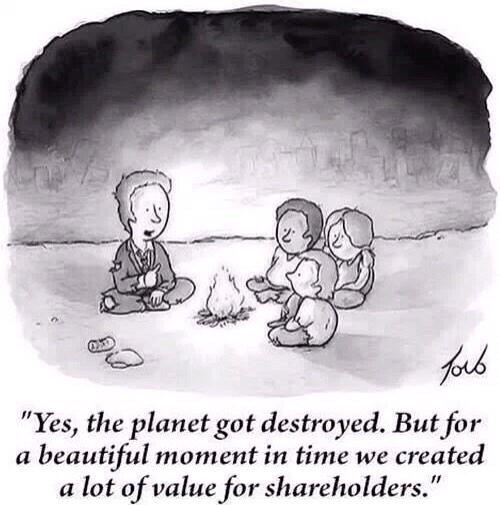
Re: Replacement.ai

#592

Let’s take this to its logical limit: imagine that AI gets so good that it can replace a lot of jobs en masse. The most popular job in about half of the US is truck drivers, and in the states where it is teachers, truck drivers are number 2. Let’s say we do get to not only self-driving trucks but self-driving trucks loaded by robotic warehouse workers. Let’s postulate that this becomes the norm and let’s say that alo…

> If robots produce so much value that it is actively not even viable for humans to work, the only real logical solution is to distribute the profits

You don't understand. Almost nobody actually thinks about this in the right way, but it's actually basic economics.

Salt.

We used to fight wars for salt, but now it's literally given away for free (in restaurants).

If "robots produce so much value" then all that value will have approximately zero marginal cost. You won't need to distribute profits, you can simply distribute food and stuff and housing because they're cheap enough to be essentially free.

But obviously, not everything will be free. Just look at the famous "cost of education vs TV chart" [1]. Things that are mostly expensive: regulated (education, medicine, law) and positional (housing / land - everyone wants to live in good places!) goods. Things that are mostly cheap: things that are mass produced in factories (economies of scale, automation). Robots might move food & clothing into the "cheap" category but otherwise won't really move the needle, unless we radically rethink regulation.

[1] https://kottke.org/19/02/cheap-tvs-and-exorbitant-education-...

Re: Replacement.ai

#593

Earlier quoted context omitted.

I love SF, but somehow I don't find it very good foundation for predicting the future. Especially when people focus of one, very narrow theme of SF and claim with certainty that's what's gonna happen.

> I love SF, but somehow I don't find it very good foundation for predicting the future. Nineteen Eighty-Four would like to have a word with you! Out of all SF, I would probably want to live in The Culture (Iain M. Banks). In these books, people basically focus on their interests as all their needs are met by The Minds. The Minds (basically AIs) find humans infinity fascinating - I assume because they were designed t…

Props on the very appropriate username, drone.

Re: Replacement.ai

#594

Earlier quoted context omitted.

> post scarcity mindset A total shift of human mentality. Humans have shown time and again there is only one way we ever get there. A long winding road paved with bodies.

That's valid, but I can still hope for better and dread that result. I genuinely believe we'll see technological world war 3 in my child's lifetime. And I'm not a super supporter of that.

[deleted]

Re: Replacement.ai

#595

Earlier quoted context omitted.

> This is what government is for, and not to stifle innovation by banning AI but by preparing society to move forward. Many will argue that the purpose of government is not to steer or prepare society, but rather to reflect the values of society. Traditionally, the body that has steered (prepared or failed to prepare) society for impending changes was religion.

Enter the Dominionists, gaining steam now. Not a regime I want to live under. Here's a forty year old article describing the inception of those religious figures close to the current USA administration ... https://banner.org.uk/res/kt1.html

Dominionists? Ready the Defiant.

Re: Replacement.ai

#596

I kind of get it, but at the same time...isn't "we made a machine to do something that people used to do" basically the entire history of of technology? It feels like somehow we should have figured out how to cope with the "but what about the old jobs" problem

that is the point of Luddism! the original Luddite movement was not ipso facto opposed to progress, but rather to the societal harm caused by society-scale economic obsolescence. the entire history of technology is also powerful business interests smearing this movement as being intrinsically anti-progress, rather than directly addressing these concerns…

Glad to see the Luddites getting a shout out here.

This is a new / recent book about the Luddite movement and it’s similarities to the direction we are headed due to LLMs:

https://www.littlebrown.com/titles/brian-merchant/blood-in-t...

Enjoyed the book and learned a lot from it!

Re: Replacement.ai

#598

Personal belief, but robots coming for your jobs is not a valid argument against robots. If robots can do a job better and/or faster, they should be the ones doing the jobs. Specialization is how we got to the future. So the problem isn't robots, it's the structure of how we humans rely on jobs for income. I don't necessarily feel like it's the AI company's problem to fix either. This is what government is for, and n…

Technology should make our lives better. Whether it's social media, AI, or nuclear power, if we introduce technology that even with its incredible benefits ends up causing harm or making life worse for many people (as all of the above have in various ways), we should reconsider. This should be self-evident. That doesn't mean we get rid of the technology, but we refine. Chernobyl didn't mean the world got rid of nuclear power. It meant we became more responsible with it.

Anyway there is a name for your kind of take. It is anti-humanist.

Re: Replacement.ai

#599

Henry Ford's philosophy was that if he paid his workers a higher wage, they would be able to afford the products they were producing, namely his Model T automobiles. This would, in turn, create a larger customer base for his company and help stimulate the economy by increasing consumer spending.

I actually think this is a pretty good argument against AI dooming that I don’t here that often. Sam Altman doesn’t own AI. His investors actually own most of the actual assets. Eventually there is going to be pressure for open ai to deliver returns to investors. Given that the majority of the US economy is consumer spending, the incentive is going to be for open ai to increase consumer spending in some way. That’s e…

I'd agree. The logical fallacy I always observe in (what I call) the marxist-nihilist AI doom scenario is that it assumes that the top N% of people perfectly cooperate in a way that the remaining 100-N% cannot. Even stratified social structure is far too muddled for a "mass-replacement" scenario to not cause the elites to factionalize across different plans that would be best for them, which in turn prevents the kind of unified coherent action that the doom scenario hinges on (ex. theyll gun down the proles with robodogs).

Re: Replacement.ai

#600
post #502

Earlier quoted context omitted.

> Now it's barely 2%. Ever wondered why? Mechanisation But did you ever wonder what happened to the displaced workers? I'm not an expert on the agricultural changes in the USA, but in the UK, huge amount of tumult can be directly attributed to agricultural changes.

The displaced workers went on to do other things. In the last 100 years for those very workers who "lost" their jobs to mechanization the overall standard of life for ALL american no matter how you measure it it better. There's fewer people living in poverty, people live longer lives, better infrastructure, and no widespread famine in the US I am aware of.

The Grapes of Wrath by Steinbeck is largely about this concept. If these social transitions were as rosy as you paint them I think the book would be called Grapes of Pleasant Improvements in Living Standards.
Post reply on HN