Live data from Hacker News

IDEs we had 30 years ago and lost (2023)

blogsystem5.substack.com

521–530 of 607 posts

Re: IDEs we had 30 years ago and lost (2023)

#521

> Visual Basic was the pinnacle of graphics programming I am still shocked how no tool since has managed to come even close to VB. You could easily develop a moderately complex GUI application that felt snappy in an afternoon. C# with WinForms is the second closest to that. All other iterations since have not been designed with individual developers in mind, sadly. A powerful developing alternative to this paradigm c…

> I am still shocked how no tool since has managed to come even close to VB

Over on OS X/macOS, Xcode's Interface Builder carried this torch a long way until Apple introduced SwiftUI. Windows developers just didn't notice because it was a different platform.

Re: IDEs we had 30 years ago and lost (2023)

#522

Earlier quoted context omitted.

All the keybindings you mentioned are commands accessible with M-x. The thing with Emacs is that a chord is always attached to a keymap. The global keymap is always accessible while all the others are accessible through a keybind in another keymap, recursively. So the only thing you need to know are those commands. And that's the main appeal of Emacs, to have commands that augment text editing. One of the most powerf…

Thank you for your helpful reply. I'm afraid I don't have enough familiarity with emacs to quite follow your explanation - I didn't actually write the bit of emacs-speak in my previous message, and I don't know what its terms mean. I just asked ChatGPT to invent something one emacs user might plausibly say to another! It has always sounded like emacs is extraordinarily powerful and configurable, and that must be grea…

I get you. Emacs is one software that you must invest some time to get the famous ROI. The promise is one unified interface for all the tools you may need (editor, tasks runner, shell, spellchecking, file manager,...). But the learning curve is there, although not as steep as some would make it appear.

One of my major motivation for putting in the time is that Emacs is very stable. You can coast for decades on a configuration. I don't mind learning new stuff, but it's grating to for it to be taken away, especially if there's no recourse (proprietary software).

Re: IDEs we had 30 years ago and lost (2023)

#523

Earlier quoted context omitted.

> Glibc is the main reason Linux software is binary non-portable between distros Linux software is binary portable between distros as long as the binary was compiled using a Glibc version that is either the same or older than the distros you are trying to target. The lack of "portability" is because of symbol versioning so that the library can expose different versions of the same symbol, exactly so that it can prese…

> Linux software is binary portable between distros as long as the binary was compiled using a Glibc version that is either the same or older than the distros you are trying to target. Well, duh? "Property A is possible if we match all requirements of property A". Yes, using older distro is the de facto method of resolving this problem. Sometimes it's easy, sometimes it's hard, especially when we want to support olde…

> Yes, using older distro is the de facto method of resolving this problem.

What i describe is different from what you wrote, which is that Linux is not binary compatible between distros. This is wrong because Linux is binary compatible with other Linux distributions just fine. What is not compatible is using a binary compiled using a newer version of some shared libraries (glibc included but not the only one) on a system that has older versions - but it is fine to use a binary compiled with an older version on a system with newer versions, at least as long as the library developers have not broken their ABI (this is a different topic altogether).

The compatibility is not between different distros but between different versions of the same library and what is imposed by the system (assuming the developers keep their ABIs compatible) is that a binary can use shared libraries of the same or older version as the one it was linked at - or more precisely, it can use shared libraries that expose the same or older versions of the symbols that the binary uses.

Framing this as software not being binary portable between different distros is wildly mischaracterizing the situation. I have compiled a binary that links against X11 and OpenGL on a Slackware VM that works on both my openSUSE Tumbleweed and my friend's Debian system without issues - that is a binary that is binary portable against different distros just fine.

Also if you want to use a compiler more recent than the one available in the distro you'll need to install it yourself, just like under Windows - it is not like Windows comes with a compiler out of the box.

Re: IDEs we had 30 years ago and lost (2023)

#524

Earlier quoted context omitted.

Completely disingenuous. Stop the snark. For UI there exists a straight up superior alternative, which keeps all of the benefits of the old solution. Neovim is just straight up better when used outside of a terminal emulator. What is true for TUI vs. GUI is not true for CLI vs. GUI (or TUI for that matter) pretending the argument I made applies to the later is just dishonest. You can not replace CLI interfaces adequa…

Maybe on paper. But the snappy low-latency feel of TUI apps in the terminal is a joy, and unequaled in GUIs.

>Maybe on paper. But the snappy low-latency feel of TUI apps in the terminal is a joy, and unequaled in GUIs.

This is not true at all. Terminal emulators are GUIs, the TUI is just another layer on top of that GUI. Using a TUI will always introduces additional latency, depending on the quality of the terminal emulator.

I do not know what GUIs or TUIs you are using, but my KDE Apps are all extremely snappy.

Re: IDEs we had 30 years ago and lost (2023)

#525
post #117

Earlier quoted context omitted.

There are no Windows UI screenshots in the article.

Fair —- but are you claiming either: 1. The DOS screenshots in the article are in any way reflective of a designer’s input 2. That Windows was a visually pleasing design?

> That Windows was a visually pleasing design?

For a while, it was.

Windows 2 was kinda ugly.

https://guidebookgallery.org/screenshots/win203

Windows 3/3.1/3.11 were fine.

https://guidebookgallery.org/screenshots/win30

Muted, boring, but you could look at it all day. And we did.

95 improved it.

https://guidebookgallery.org/screenshots/win95osr2

Tasteful greys, spot colour.

NT 4 improved that a bit more.

https://guidebookgallery.org/screenshots/winnt40

Categorised Start menu, for instance. But nearly identical.

95/NT4 were visibly inspired by NeXTstep, IMHO the most beautiful GUI ever written.

Then it all started to go a bit wrong. The first pebbles bouncing down the mountainside presaging a vast avalanche.

Windows 98.

https://guidebookgallery.org/screenshots/win98

IE4 built in so Microsoft didn't get broken up my the US DOJ. Explorer rendered local content via HTML. Ugly extra toolbars. Some floating, some embedded in the task bar. Ugly gradients and blends in window title bars.

Cheap and plastic and tacky.

But that is around the time that media and gaming PCs went mainstream, home internet use (often over dialup) went mainstream, and the alternatives died out (Amiga, ST & GEM, Arm & RISC OS) or very nearly died (classic MacOS, NeXT merger, Rhapsody).

So it's what many saw first and loved and remembered.

Result, people write entire new OSes designed in affectionate homage:

https://serenityos.org/

Look at the toolbars. Look at the textures in the title bars. This isn't Win9x, this is specifically Win98.

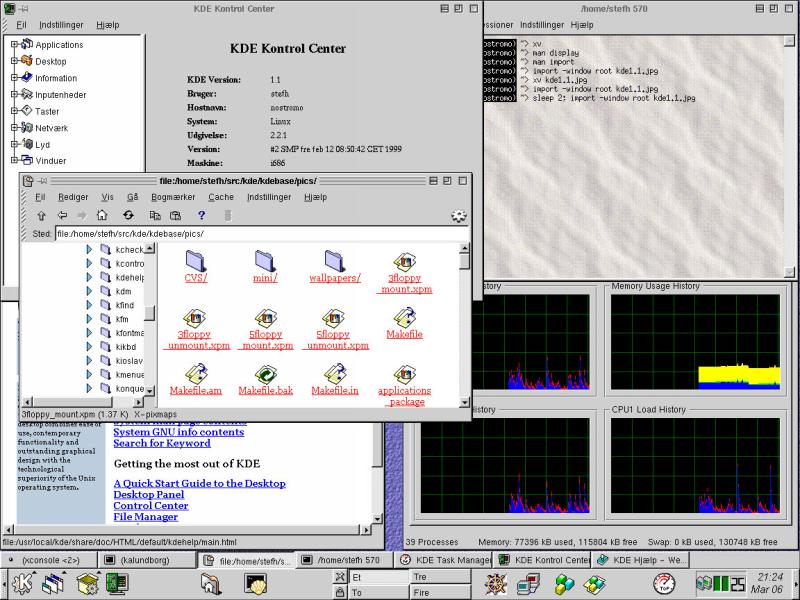
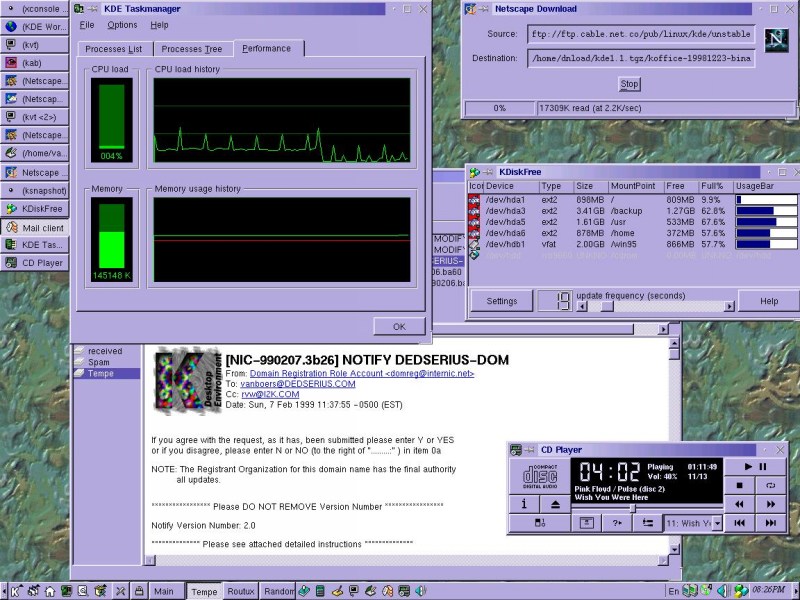
https://www.digibarn.com/collections/screenshots/KDE%201-x/i...

Specifically:

https://www.digibarn.com/collections/screenshots/KDE%201-x/h...

https://www.digibarn.com/collections/screenshots/KDE%201-x/t...

https://www.digibarn.com/collections/screenshots/KDE%201-x/m...

KDE started out as a reproduction of Windows 98/98SE by a team who didn't realise that what they were looking at was WordPerfect 5.x instead of WordPerfect 4.x -- as the late great Guy Kewney put it:

"WordPerfect 4.2 was a bicycle. A great bicycle. Everyone agreed it was a great bicycle, just about the best. So what Wordperfect did was, they put together a committee, looked at the market, and said: 'what we'll do is, we'll put 11 more wheels on it'."

Win98 is Win95 festooned with pointless needless Internet widgetry because the DOJ was about to split MS into separate apps and OS companies, because MS drove Netscape into bankruptcy by bundling IE free of charge with Windows.

Strip all that junk off and what's left underneath is a better UI. But the German kids writing their "Kool Desktop Environment" didn't realise.

After that came WinME and Windows 2000, which turned down the bling a bit as the lawsuit was over, but it was only a blip.

Then came XP with its "Fischer-Price" themes.

Then Vista with gratuitous transparency everywhere because GDI.EXE had been ripped out and replaced with a compositor and that's no fun if you don't use some 3D features like see-through stuff.

Then 7 toned that down a bit and everyone love it.

Then the universally detested Win8, and then that was toned down and the Start menu put back for Win10, which is roughly what UKUI and Deepin copied in China, or Wubuntu in the West.

Then Win11, as copied by AnduinOS and a few others, which for this long-term Windows user is the worst release ever. I can't even have a vertical taskbar any more. It's abhorrent.
Re: IDEs we had 30 years ago and lost (2023)

#526

Earlier quoted context omitted.

Yeah, basically when they said that it should’ve begged the question “why is he not used to those conventions?” And the answer would be because the conventions it uses aren’t used by anything else (which means they can barely be called conventions), and makes no effort to adopt any conventions of the platform it’s running on even just to get you started. Also, another user said it has a tutorial when opened which sho…

> I have a feeling I would need 0 minutes to learn the basics of turbo c++. Well, Turbo C++ (at least the one in the article) does use common conventions but those were conventions of 1992 :-P. So Copy is Ctrl+Ins, Paste is Shift+Ins, save is F2, open is F3, etc. Some stuff are similar to modern editing like Shift+motion to select, F1 for help, F10 to activate the menu bar, etc. And all shortcut keys are displayed on…

Yes some unfamiliar commands for sure

Re: IDEs we had 30 years ago and lost (2023)

#527
post #442
post #437

Earlier quoted context omitted.

I surely don't remember such clone. As for where Vim was born, hardly matters, it was someone with UNIX culture background, that happened to own an Amiga.

Amiga OS 3.1 has it under the Workbench floppy sets. You get it by default.

Amiga 500 was shipped with AmigaOS 1.2 in 1987, Amiga OS 3.1 was released in 1994, almost at the end of the commercial life of Amiga.

As the sibling comment points out, MicroEmacs isn't really Emacs.

Also Emacs history is older than UNIX, and overlaps with Lisp Machines.

Re: IDEs we had 30 years ago and lost (2023)

#528

Earlier quoted context omitted.

> How did the magit guy or people even come up with the data model? It's not all that different from a typical TUI interface. Magit isn't great because of the interface. It's great because the alternative (plain git) has such a crappy interface. Contrast principle and all.

Magit is pretty great because of transient, the model of showing what all the commands are. It's a very natural and easy UI affordance

> Magit is pretty great because of transient, the model of showing what all the commands are.

And that's different from many TUIs how?

Re: IDEs we had 30 years ago and lost (2023)

#529
post #303

Earlier quoted context omitted.

The DOS screenshots are reflective of the PC video hardware of the time. Text mode had a fixed 16-color palette [0] at best, the IBM font including graphics characters was preset, while the aspect ratio of the characters wasn’t fixed (the screenshots in the article are 80x25, but I used 80x40 or 80x50, with correspondingly more quadratic text cells). However, the screenshots aren’t quite representative of how things…

Thanks for the trip down memory lane! I worked with DOS in… WordPerfect? I don’t remember for sure which word processing application it was. But I honestly don’t remember ever seeing anything remotely “graphic“ in my DOS days.

Oh, there was.

WordPerfect 6 had a full GUI mode with a very vaguely Win3-like GUI implemented in DOS.

Borland Quattro Pro had one too.

Microsoft Word could be flipped in and out of it: in it, you got WYSIWYG bold, italic, underline etc, and more lines on screen, but otherwise the UI remained much the same.

PowerQuest imitated Win95 so well in PartitionMagic it was pixel-perfect.

It was entirely a thing in the late DOS era. It let DOS apps look competitive, and yet demand far lower system requirements and run on much older machines than one needed for Windows.

Post reply on HN