Live data from Hacker News

"I have come to find out what it's like to be dumb."

waldo.jaquith.org

51–60 of 123 posts

Re: "I have come to find out what it's like to be dumb."

#51
Intelligence is an immutable characteristic

I get so tired of seeing this. We can't even really define intelligence but I'm guessing this is based on a previous assumption that IQ was static, which we now know it not to be. We need to remember, also, that IQ is not a measure of intelligence.

Re: "I have come to find out what it's like to be dumb."

#52
post #44
post #31

Earlier quoted context omitted.

Thanks! I appreciate the detailed post you've written. The more I think about it, the more my case sounds like yours. I'm now thinking it's less "something happened to my brain" and more "my habits caused this problem". I'll attempt the same thing you've done to see how it goes. You just quit procrastinating cold-turkey though? How did you force yourself to read? Every time I pull out a textbook at a time that isn't…

It's the same for me that I fall asleep if I do something I'm either unmovitated to do or that is above my level. I think you have to admit first that you might be not as smart as you think you are. Highschool was easy. I don't want to sound arrogant, but the American high school is considered a joke in Europe. Not so much university. They are really good and can be equally tough. So maybe you simply experienced and…

Yup try the "tomato" it worked for me!

The method enables you to concentrate without distractions, and encourages deep thinking, which is what you need to be able to do to operate at a very high mental level.

Re: "I have come to find out what it's like to be dumb."

#53
post #21

Can someone please tell me if it's possible to get permanently sick from Lyme disease? (e.g. assume the initial systems are just a flu, get past those, and never realize you have other problems.) Because if so, I might have it. But that's impossible, right? EDIT: Yes, I should ask a doctor, but given the medical situation where I live, it is quite hard to get good advice.

http://en.wikipedia.org/wiki/Lyme_disease#Chronic_Lyme_disea... may be relevant. Good luck.

Re: "I have come to find out what it's like to be dumb."

#54
post #22

Do other people feel their cognitive abilities diminishing as they age? I've been diagnosed with major depressive disorder, generalized anxiety disorder, panic disorder, ADHD-Inattentive type, and probably other things that I can't remember right now. I think most of these diagnoses (panic disorder being the only viscerally clear one) are to explain the disparity between my IQ scores throughout the years and my lack…

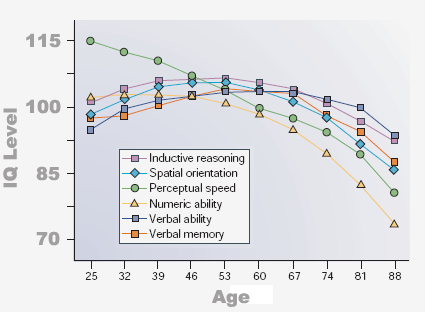
At 29 I've also become somewhat paranoid about age-related cognitive decline. From what little I've looked into it, to the extent you go by the fluid and crystallized intelligence dichotomy, fluid tends to peak at around 25 and crystallized peaks somewhere in the 35-55 range (I've heard multiple numbers from different sources), with major decline beginning around 65. Brain mass also peaks around 25 and loses around 2 grams per year thereafter. The intelligence loss seems to be exponential with age - you'll drop a lot faster between 60 and 70 than you will between 30 and 40. The different peaks for fluid versus crystallized probably affect life outcomes differently depending on lifestyle and profession, e.g. the saying I used to hear from my physics professors that "If you haven't done anything by 30, you never will," or the Primer quote, "What they do with engineers when they turn 40? They take them out back and shoot 'em." On the other hand fields requiring vast recall of domain knowledge like law or medicine probably favor the older crowd that have had decades more time to accumulate, even if they lack the high-level abstract problem solving stuff required more in e.g. physics or math.

Some relevant links on all that: http://www.highiqpro.com/wp-content/uploads/2012/03/cognitiv... http://www.brainhealthhacks.com/wp-content/uploads/2011/01/f... http://qph.is.quoracdn.net/main-qimg-fd832e64253819688a4eaaa...

There's also work on reversing cognitive decline with stem cell therapies: http://www.impactaging.com/papers/v4/n3/full/100446.html

Re: "I have come to find out what it's like to be dumb."

#55
post #43

Earlier quoted context omitted.

> it sounds kinda serious It is. > not going to make fun of it. Thank you for that. Lyme is a very easy to contract disease depending on where you live and the progressive symptoms are devastating.

Best wishes to you. At least it can be cured? I found this helpful for ignorant folks like me http://www.cdc.gov/lyme/faq/

> Best wishes to you.

Thank you, fortunately I don't have it myself but three of my family members do.

> At least it can be cured?

If you catch it early enough you can get complete recovery. If you catch it a little later you'll have symptoms lasting for months or years, if it starts to progress you might be able to arrest it at some level or slow the progression but it will always keep trying to get worse. And once you reach any of the advanced stages it can not be cured, you're stuck with it for life.

Re: "I have come to find out what it's like to be dumb."

#57
post #6

Grouping all the described symtoms under "depression" (and "stupidity") is a non-helpful way to think about Lyme disease, which messes up all sorts of neurotransmitters. You won't get very far by just comparing your experience to that of a depressed person; variously, the symptoms of Lyme disease can mimic clinical depression (serotonin/norepinephrine imbalance), or ADHD (dopamine imbalance), generalized anxiety (GAB…

Being dumb doesn't feel like having a bad memory, or thinking slower, or not being able to multitask. It feels like looking at a square peg and a grid of shape-holes, and not (quickly) realizing that "shape" is a relevant property that the holes differ by, such that you should select a hole based on the shape of the peg.

...they'd solve problems in entirely different ways, out of necessity for not recognizing patterns as easily. And then you can reflect that intuition to understand what it would be like to be more intelligent than you are: someone who would also solve problems in different ways, for seeing their structure more easily...

Let me unpack this a bit; it annoys me to end that every person depending on his/her coterie ( think technology coteries, humanities coteries, political/legal coteries etc) seems to nourish his/her own definition of what intelligence is and how - if at all - it can be measured and quantified on a nice linear scale.

Surely we all agree that such a definition and quantification is useful. I hope that is not up to debate. Only the most hyper egalitarians, insisting on the absolute equality of social statuses of all humans, would refute the utility of such quantification.

For instance, most learned, secular and urbane people do not think twice before frowning on religious zealots. Their views and outlook of the world seem like they belong in the stone-age. Whatever their scriptures say or hold, a religious devotee has to suspend the most basic premises of logic and reason to be able to subscribe utterly risible notions of how one ought to conduct his or her life based on preposterous doctrines.

In essence they almost invariably have to belong to a lower order of intelligence (if you set aside the atypical cases of candidates who are esteemed scholars, scientists and technologists, who are nevertheless fervently religious, of whom we can be sure there are more than a handful).

Surely we should be able to define - using certain parameters whatever those are - and quantify this "lower order of intelligence" in an objective manner.

After all we just cannot describe their quantum of intelligence through purely the notions - as moronic those notions might be - they subscribe to. There has to be an objective assessment.

Since such a quantification is useful - for purposes of classification or otherwise - what then is the most current (more or less universal) consensus on the measure of intelligence?

Obversely, when defining stupidity, is there no single measure that more or less captures "the congenital lack of capacity for reasoning"? [1]

[1] http://en.wikipedia.org/wiki/Stupidity#Definition
Re: "I have come to find out what it's like to be dumb."

#58
post #21

Can someone please tell me if it's possible to get permanently sick from Lyme disease? (e.g. assume the initial systems are just a flu, get past those, and never realize you have other problems.) Because if so, I might have it. But that's impossible, right? EDIT: Yes, I should ask a doctor, but given the medical situation where I live, it is quite hard to get good advice.

If you didn't treat it, then from what I understand, the spirochetes are still in your blood and brain. However, the official response of the medical community is 'no' because they don't have enough evidence to make that claim (from what I understand there is a lot of pressure from insurance companies to not make this a diagnosis that would result in them potentially having to cover years of treatment)

Re: "I have come to find out what it's like to be dumb."

#59
post #31
post #29

Earlier quoted context omitted.

I have a similar story to yours although I doubt I was as smart. In high school I could get the best grades in my class without much effort and got a near perfect score in the baccalaureate. Nothing to brag about though, since I then proceeded to drop out of law school in my second year. I completely lost the will to work and ended up with humiliatingly low grades before finally breaking down and starting afresh. Lik…

Thanks! I appreciate the detailed post you've written. The more I think about it, the more my case sounds like yours. I'm now thinking it's less "something happened to my brain" and more "my habits caused this problem". I'll attempt the same thing you've done to see how it goes. You just quit procrastinating cold-turkey though? How did you force yourself to read? Every time I pull out a textbook at a time that isn't…

Actually, I think something did indeed happen to your brain. Neuronal plasticity means that your brain prunes synapses that are left unused and strengthens those that are frequently requested. Your brain is literally being molded by what you do everyday, which is why addictive behavior is dangerous, especially at a young age.

The cold turkey was for the internet use. The method I used was to expose myself to the computer but actively resist the impulse to read bullshit no matter what. It's mentally exhausting but after the first week you get into the habit of resisting.

I still haven't completely mastered my procrastination. Like the other posters mentioned, the key is to break the task into small chunks, thereby tricking your brain into considering it to be easier.

As for meditation the simplest thing is to spend at least 15 minutes everyday doing nothing and focusing on the present moment. I suggest reading Jon Kabat-Zinn's books: they offer advice based on science and without the eastern mumbo jumbo. Good luck!

Re: "I have come to find out what it's like to be dumb."

#60
post #6

Grouping all the described symtoms under "depression" (and "stupidity") is a non-helpful way to think about Lyme disease, which messes up all sorts of neurotransmitters. You won't get very far by just comparing your experience to that of a depressed person; variously, the symptoms of Lyme disease can mimic clinical depression (serotonin/norepinephrine imbalance), or ADHD (dopamine imbalance), generalized anxiety (GAB…

Being dumb doesn't feel like having a bad memory, or thinking slower, or not being able to multitask. It feels like looking at a square peg and a grid of shape-holes, and not (quickly) realizing that "shape" is a relevant property that the holes differ by, such that you should select a hole based on the shape of the peg. ...they'd solve problems in entirely different ways, out of necessity for not recognizing pattern…

Rather than a personal definition, I really was, in my comment, defining intelligence according to the (narrow, not-all-encompassing) definition used by people who create tests of IQ or "g". IQ is tautologically defined as "the number output by IQ tests." And what an IQ test, tests, is your ability to recognize and exploit novel patterns, generalized across different domains (word problems, pictures, music), under time pressure. So as far as someone having a high IQ is correlated to the common-sense perception of them being "intelligent", and as far as a low IQ is correlated to a common-sense perception of them being "stupid", then those two properties, in their common-sense usage, have something to do with pattern-recognition.

But I think, in your comment, what you're doing is conflating intelligence with rationality. Raw intelligence doesn't help you to notice when you have an ingrained-but-senseless belief (thus predicting precisely your "candidates who are esteemed scholars, scientists and technologists, who are nevertheless fervently religious".) One of the primary properties of modern religion is its non-falsifiability -- it makes no predictions about your everyday experience you could keep track of to form a sense of "how it's doing." Because of this, a religion can sit comfortably in your mind alongside everything else you "know", and no piece of evidence you run into will ever rub up against it and wear it away.

Noticing that you have beliefs that aren't causally attached to the rest of your experience is a skill which you have to learn explicitly. This set of skills (instrumental rationality) together are a multiplier for the productive output of your intelligence, but they don't make you any more or less intelligent. Really intelligent people might come up with these skills on their own, as meta-patterns that seem to hold between pattern in different disciplines, but most anyone can learn to be more instrumentally rational by being trained in these skills by someone else. You can't learn to be more intelligent. (Though good sleep, exercise, and stimulant drugs all seem to help... at least according to IQ tests.)

Post reply on HN