Looking forward to looking more at ThoughtDAG.
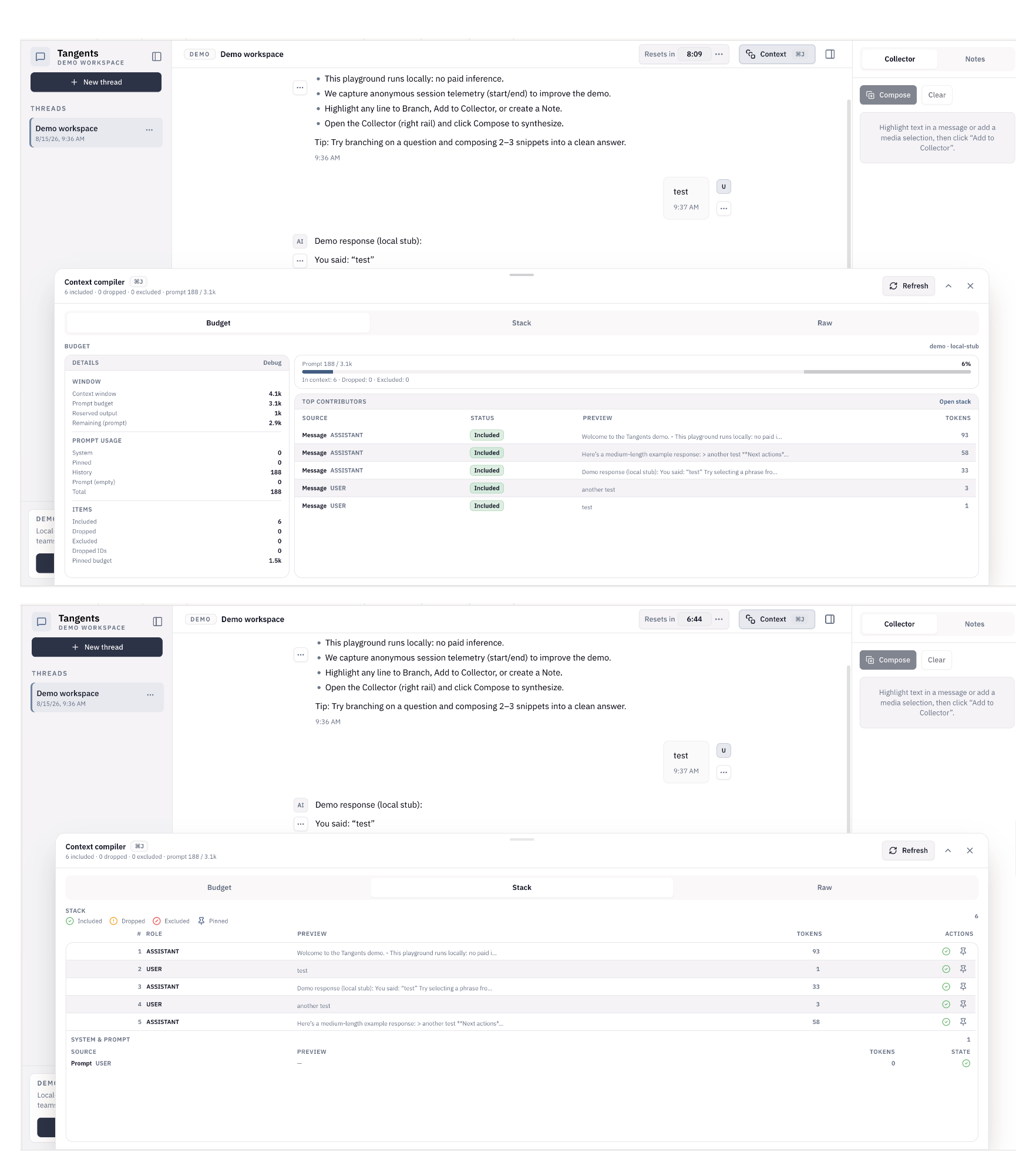
Visual: https://i.ibb.co/NRHSFrg/tangents-context-complier.png
51–60 of 82 posts
Looking forward to looking more at ThoughtDAG.
Visual: https://i.ibb.co/NRHSFrg/tangents-context-complier.png
Earlier quoted context omitted.
But agents don't _know_ why they gave an answer. They can only give "reasoning" that links to something in their context, and even then, you would have to parse out their response with some heuristics to try to match against something upstream of that turn. I could see it being done, and if you're fond of the "models all the way down" mode of thinking, you could use a smaller model to identify it, but it could just a…
I’ve struggled with this line of thought. In a strict sense, it’s true; an AI model doesn’t actually know why it fired the way it did. But I don’t know how practically useful that observation is because, using that strict definition of “know”, humans also do not know why they do what they do. If I asked you why you posted this comment, I suspect you’d be able to articulate a good reason why from your memories. But th…
There's definitely value in the "meta-cognition" that an LLM can do even if it is blind to the underlying weights and layers of the model itself.
I found it especially useful for balancing research breadth vs research width when exploring new topics. A graph structure makes it easier for me to identify potential blind spots in the research process and allows me to be more confident that no promising alternative solutions were left out while at the same time not getting too stuck in rabbit holes of subquestions.
When I built my prototype I had this image of a physarum slime mold [0] in my head that branches off into all directions first, then reinforces potential paths while starving off all other branches. In the end that path that survives is the result.
This concept is interesting, and I could see the value. But, I downloaded it to try it, and the interface is janky. The concept is interesting but the UI/UX is bad and confusing. For example, I can't pan the canvas. And the conversation on the right-hand side doesn't show all the previous messages that are getting included in the context window.
Earlier quoted context omitted.
But agents don't _know_ why they gave an answer. They can only give "reasoning" that links to something in their context, and even then, you would have to parse out their response with some heuristics to try to match against something upstream of that turn. I could see it being done, and if you're fond of the "models all the way down" mode of thinking, you could use a smaller model to identify it, but it could just a…
I think we need to distinguish between "what the model received" and "why the model generated this answer." ThoughtDAG currently focuses on the former: accurately displaying the context of the incoming request and allowing users to modify it.
Nice work! Recently I prototyped a harness for structured agentic research work and I arrived at something very similar. I found it especially useful for balancing research breadth vs research width when exploring new topics. A graph structure makes it easier for me to identify potential blind spots in the research process and allows me to be more confident that no promising alternative solutions were left out while…
ThoughtDAG currently deliberately leaves this strengthening and pruning to the user, rather than letting the model choose automatically (I think human-in-the-loop is important). I'm curious, in your prototype, is the path strengthened manually by the user, or is it done through model scoring or other signals?
Earlier quoted context omitted.
Had the exact same thought. It’s like reading a foreign language – and I’m going to be honest – not load bearing at all.
Thank you for pointing out this issue. The homepage did indeed use too many common landing page elements before actually showcasing the product. I redesigned the homepage, removing status labels, promotional slogans, and unnecessary entry points, making the interactive context graph the main focus of the page.