I had this game as a kid. Although it looked good, the gameplay left a lot to be desired.
Anyway, another great article from Fabien.
51–58 of 58 posts
Anyway, another great article from Fabien.
I think the article is sorta wrong about the sound setup, the Mega Drive I does have a sound input on the expansion port, and mixes it into its sound output. Otherwise stuff like RF cables wouldn't get Mega CD based audio (and you can do silly stuff like a Mega Drive II, which doesn't have a headphone port, with a Mega CD I). I was going to say the patch cable setup was just a passive aid to take the Mega Drive I's m…
> I think the article is sorta wrong about the sound setup, the Mega Drive I does have a sound input on the expansion port, and mixes it into its sound output. The Megadrive has a stereo sound input on the cartridge port too, for a total of 3 stereo sound sources (the YM2612, the MegaCD, the cartridge) plus one mono source (the SN76489 PSG). As far as I know no original release ever used the cartridge input, but nowa…
Earlier quoted context omitted.
> I think the article is sorta wrong about the sound setup, the Mega Drive I does have a sound input on the expansion port, and mixes it into its sound output. The Megadrive has a stereo sound input on the cartridge port too, for a total of 3 stereo sound sources (the YM2612, the MegaCD, the cartridge) plus one mono source (the SN76489 PSG). As far as I know no original release ever used the cartridge input, but nowa…
The 32X used the cartridge audio input for its PWM audio channels. For one example of how this worked, Knuckles' Chaotix used the extra channels for the percussion in its music: https://www.youtube.com/watch?v=L6BSQVK9gSc
I have a Japanese 32X and a copy of Knuckles Chaotix, but I have yet to play it so I didn't notice the sound xD
Earlier quoted context omitted.
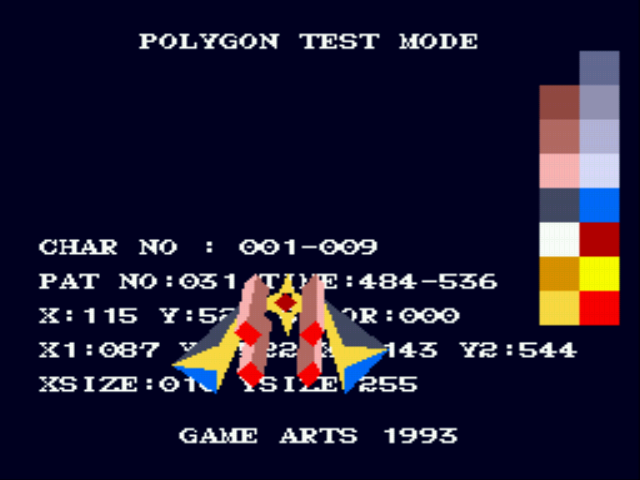
I just saw a video of it. Impressive. Were the enemy ships hand drawn 3D plastered on sprites? Or was there some actual realtime 3D rendered by the CPU? The boss ship I saw looked like realtime 3D.
There's no realtime 3D. This boss fight [1] looks super impressive, but the boss structure is FMV, your ship and bullets and stuff is all sprites overlaid on the FMV. (and the FMV is decoded to sprites too) (Stated confidently to ensure a correction if I'm wrong) [1] https://www.youtube.com/watch?v=GMO_tdlUvnc
Silpheed was amazing back in the day. It was one of the first titles that really showcased what CD drives could add to games in terms of cinematic experience. The live orchestral music gave it an epic feel and the mecha-design of the SA-77 is beautiful and modern even by today's standards.
Earlier quoted context omitted.
There's no realtime 3D. This boss fight [1] looks super impressive, but the boss structure is FMV, your ship and bullets and stuff is all sprites overlaid on the FMV. (and the FMV is decoded to sprites too) (Stated confidently to ensure a correction if I'm wrong) [1] https://www.youtube.com/watch?v=GMO_tdlUvnc
I think there is realtime 3D used for the player and enemy "sprites" (really 3D objects), including the end of stage bosses. They are small and extremely simple, as this was the maximum the Genesis/Megadrive's 68k CPU could handle. The final boss fight is the exception. Silpheed was amazing back in the day. It was one of the first titles that really showcased what CD drives could add to games in terms of cinematic ex…
The player ship rotates, but it only is 'rendered' at a handful of angles. This is a very common technique, but here they've used an art style to make it look like realtime 3d.
It's like stun runner on Lynx [1]. The Arcade stun runner was polygon based; but the Lynx doesn't have a chance, so there's just a ton of sprite options for rotation and a lot of work to make it look the part [2].
[1] https://youtu.be/4PEAzBtaStk?si=QXWf9KDUBjQRgoDh&t=204 [2] https://forums.atariage.com/topic/194231-lynx-stun-runner-3d...
Earlier quoted context omitted.
I think there is realtime 3D used for the player and enemy "sprites" (really 3D objects), including the end of stage bosses. They are small and extremely simple, as this was the maximum the Genesis/Megadrive's 68k CPU could handle. The final boss fight is the exception. Silpheed was amazing back in the day. It was one of the first titles that really showcased what CD drives could add to games in terms of cinematic ex…
I'd be very surprised if player and enemy graphics are realtime 3D. Those look very much like typical sprites where you use different sprites for different angles. The player ship rotates, but it only is 'rendered' at a handful of angles. This is a very common technique, but here they've used an art style to make it look like realtime 3d. It's like stun runner on Lynx [1]. The Arcade stun runner was polygon based; bu…
Fabien seems to be unaware of this, by the way.
This is also why the game play is so bland. The number of 3d objects and their complexity was severely constrained and did not allow for varied or more sophisticated game elements.