Live data from Hacker News

What Google Translate can tell us about vibecoding

ingrids.space

51–60 of 175 posts

Re: What Google Translate can tell us about vibecoding

#51

Earlier quoted context omitted.

Do you have a citation for that?

What a strange thing to ask for a citation on when CEO pay, stock buy backs and corporate dividends are at all time highs while worker pay and honestly just affording to live continue to crater.

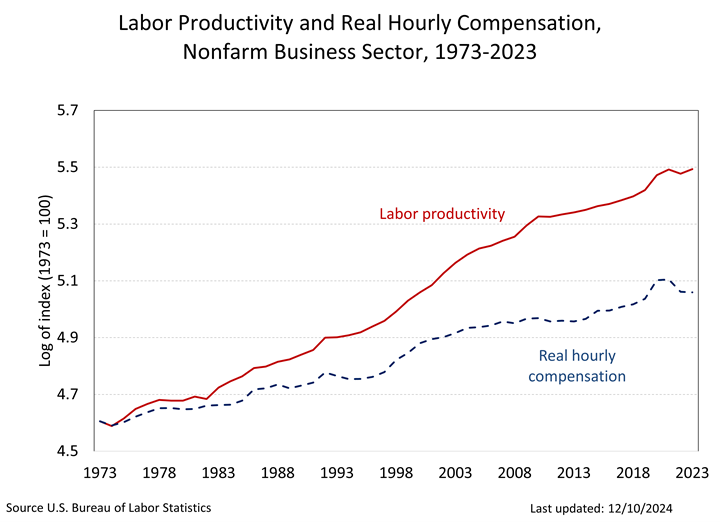
Productivity is up and labor wages are up. That’s why I asked. It wasn’t an attempt at a rebuttal it was a request for reading material as it’s a heterodox view.

The normal conversation is that productivity growth has slowed and the divide has increased, not that more productivity creates lower outcomes in real terms.

https://www.bls.gov/productivity/images/labor-compensation-l...
Re: What Google Translate can tell us about vibecoding

#52
I was thinking about this comparison recently along a slightly different axis: One challenge when working with translations (human or machine translations) as that you can't vet whether it's correct or not yourself. So you just have to either trust the translation and hope it's the best. It's a lot easier to trust a person than a machine, though I have had someone message me once to say "this translation of your article is so bad I feel like the translator did not put in a serious attempt"

It's similar to vibe coding where the user truly doesn't know how to create the same thing themselves: You end up with output that you have no way of knowing it's correct, and you just have to blindly trust it and hope for the best. And that just doesn't work for many situations. So you still need expertise anyway (either yours or someone else's)

Re: What Google Translate can tell us about vibecoding

#53
post #39

> At the dinner table a Norwegian is likely to say something like “Jeg vil ha potetene” (literally “I will have the potatoes”, which sounds presumptuous and haughty in English) where a brit might say “Could I please have some potatoes?”. I find “I will have the potatoes” to be perfectly fine English and not haughty in the slightest. Is this a difference between British English and American English?

Americans are extremely polite, and American English is replete with niceties in everyday speech. It's funny, having been a tourist abroad, it's only living in a significantly non American country for a few years that lead me to realise this. I even lived in another country albeit a former US colony for ten years and didn't even notice it there given American influence. I stopped saying, stuff "I would like a latte t…

Maybe its a NY thing I was shocked when I heard people in restaurants saying "I want...". Growing up outside the US "want" is a very impolite word. People in US are polite but direct, usually English/Irish people are much less direct.

Re: What Google Translate can tell us about vibecoding

#54

Earlier quoted context omitted.

Google translate is a good example too in terms of better-than-nothing to the completely uninitiated, helpful to someone with a little knowledge, and obviously not a replacement for a professional. That is - the more you know, the more you see its failures. I know enough Japanese to talk like a small child, make halting small talk in a taxi, and understand a dining menu / restaurant signage broadly. I also have been…

> So who knows, maybe LLM coding stays in a similar pretty-good-never-perfect state for a decade. I think this is definitely a possibility, but I think the technology is still WAY too early to know that if the "second AI winter" the author references never comes, that we still wouldn't discover tons of other use cases that would change a lot.

If there is another "AI winter" it would be at least the third one: https://en.wikipedia.org/wiki/AI_winter

Re: What Google Translate can tell us about vibecoding

#55
post #48
post #33

Earlier quoted context omitted.

The economy has taught us that when there is an excess of worker productivity, it leads to layoffs. It certainly does not lead to raises.

That sounds like the famous lump of labour fallacy. When something's cheaper people often spend more on it (Jevons paradox).

This "fallacy" is from 1891 and assumes jobs that require virtually no retraining. A farm worker could ion theory clean the factory floor or do one small step in an assembly line within a week.

Nowadays we already have bullshit jobs that keep academics employed. Retraining takes several years.

With "AI" the danger is theoretically limited because it creates more bureaucracy and reduces productivity. The problem is that it is used as an excuse for layoffs.

Re: What Google Translate can tell us about vibecoding

#56

I was thinking about this comparison recently along a slightly different axis: One challenge when working with translations (human or machine translations) as that you can't vet whether it's correct or not yourself. So you just have to either trust the translation and hope it's the best. It's a lot easier to trust a person than a machine, though I have had someone message me once to say "this translation of your arti…

Well no, you can run the output. That gives you some measure of correctness.

Re: What Google Translate can tell us about vibecoding

#57
post #53

Earlier quoted context omitted.

Americans are extremely polite, and American English is replete with niceties in everyday speech. It's funny, having been a tourist abroad, it's only living in a significantly non American country for a few years that lead me to realise this. I even lived in another country albeit a former US colony for ten years and didn't even notice it there given American influence. I stopped saying, stuff "I would like a latte t…

Maybe its a NY thing I was shocked when I heard people in restaurants saying "I want...". Growing up outside the US "want" is a very impolite word. People in US are polite but direct, usually English/Irish people are much less direct.

Coincidentally, I am in NY. That said, “I want…” when ordering seems fine to me too.

Re: What Google Translate can tell us about vibecoding

#58
post #56

I was thinking about this comparison recently along a slightly different axis: One challenge when working with translations (human or machine translations) as that you can't vet whether it's correct or not yourself. So you just have to either trust the translation and hope it's the best. It's a lot easier to trust a person than a machine, though I have had someone message me once to say "this translation of your arti…

Well no, you can run the output. That gives you some measure of correctness.

No I think the original comment is correct. You need to be able to evaluate the result.

The goal of software is not to compile and run, it's to solve a problem for the user when running. If you don't know enough about the problem to be able to assess the output of the program then you can't trust that it's actually doing the right thing.

I've seen code generated by LLMs that runs, does something, and that the something would be plausible to a layperson, but that I know from domain knowledge and knowing the gotchas involved in programming that it's not actually correct.

I think the comparison with translation is a very apt one.

Re: What Google Translate can tell us about vibecoding

#59
post #39

> At the dinner table a Norwegian is likely to say something like “Jeg vil ha potetene” (literally “I will have the potatoes”, which sounds presumptuous and haughty in English) where a brit might say “Could I please have some potatoes?”. I find “I will have the potatoes” to be perfectly fine English and not haughty in the slightest. Is this a difference between British English and American English?

Americans are extremely polite, and American English is replete with niceties in everyday speech. It's funny, having been a tourist abroad, it's only living in a significantly non American country for a few years that lead me to realise this. I even lived in another country albeit a former US colony for ten years and didn't even notice it there given American influence. I stopped saying, stuff "I would like a latte t…

> Americans are extremely polite

Having grown up in the UK and living in Australia, I do not find Americans polite. To me, politeness is "please", "thank you", "may I have", etc, whereas "I would like a latte today" reads to me as a demand. In context it's fine (it stands out a bit but not in a problematic way), it's not particularly rude, but in general just stating your desires is not considered polite in my experience in UK/AU.

There are some other parts of American English that may be considered polite, I notice a lot of US folks addressing me as "sir" for example, but this sort of thing comes off as insincere or even sarcastic/rude.

I know this is how people communicate so they don't really bother me, I'm used to them and accept that different people have different expectations. I also understand that Americans might believe they are being polite and consider me to be rude, but I think this is why blanket statements like "Americans are extremely polite" are just missing so much cultural nuance.

Re: What Google Translate can tell us about vibecoding

#60

While it's just anecdotal evidence, I have translator friends and work has indeed been drying up over the past decade, and that has only accelerated with the introduction of LLMs. Just check any forum or facebook group for translators, it's all doom and gloom about AI. See this reddit thread, for example: https://www.reddit.com/r/TranslationStudies/comments/173okwg... While professionals still produce much better qua…

I imagine even for professional teams with clients that need proper translations, LLMs have made it so one person can do the work of many. The difference between the quality of former automatic translations and LLM translations is huge; you couldn't rely on auto translation at all.

Now a professional service only needs a reviewer to edit what the LLM produces. You can even ask the LLM to translate in certain tones, dialects, etc. and they do it very well.

Post reply on HN