Is this "brain-like" in any functional way, or "brain-like" in the same way that a tall rectangle is "door-like" even if it doesn't share any functions with a door? I know quite a bit about machine learning, but very little to nothing about neuroscience and human cognition, so I am curious how an expert (that didn't work on the paper) would describe it. (Forgive me for the pre-emptive negativity but I am so utterly e…
TopoNets: High performing vision and language models with brain-like topography
51–60 of 76 posts
Re: TopoNets: High performing vision and language models with brain-like topography
#52Earlier quoted context omitted.
Indeed. What's cool is that we were able to localize literal "regions" in the GPTs which encoded toxic concepts related to racism, politics, etc. A similar video can be found here: https://toponets.github.io More work is being done on this as we speak.
My understanding coming from mechanistic interpretability is that models are typically (or always) in superposition, meaning that most or all neurons are forced to encode semantically unrelated concepts because there are more concepts than neurons in a typical LM. We train SAEs (where we apply L1 reg and a sparsity penalty to “encourage” the encoder output latents to yield sparse representations of the originating ra…
This is true. The features closer together now have much stronger semantic overlap. You can watch how the weights self-organize in a GPT here: https://toponets.github.io/webpage_assets/banner_video.mp4
We're already studying the effects of topographic structure on polysemanticity.
Re: TopoNets: High performing vision and language models with brain-like topography
#53This paper imports an arbitrarily-chosen aspect of cortical architecture — topological maps of function — and ignores every other aspect of biological neural tissue. The resulting models show lower performance for the same number of parameters — not surprising, since they are more constrained compared with baseline. They may be slightly more robust against pruning — not surprising, since they are more regularised. Th…
this paper plays into some popular fantasy about the aesthetic of ANNs. it’s not scientifically useful
> it’s not scientifically useful
Having structured weights in GPTs enables us to localize and control various concepts and study stuff like polysemanticity, superposition, etc. Other scientific directions include sparse inference (already proven to work) and better model editing. Turns out, topographic structure also helps these models better predict neural data, which is yet another direction we're exploring in computational neuroscience.
Re: TopoNets: High performing vision and language models with brain-like topography
#54I spent time working with Andrej and the rest of the FSD team back in 2020/2021, and we had plenty of conversations on how human visual processing maps onto our neural network architectures. Our approach—transformer-based attention blocks, multi-scale feature extraction, and temporal fusion—mirrors elements of the biological visual cortex (retina → LGN → V1 → V2 → V4 → IT) which break down raw inputs and integrate th…
I've found how CNN map to visual cortex to be very clear. But I've always been a bit confused about how llms map to the brain. Is that even the case?
There’s at least three fields in this:
1. Machine learning using non-neurological techniques (most stuff). These use a combination of statistical algorithms stitched together with hyperparameter tweaking. Also, usually global optimization by heavy methods like backpropagation.
2. “Brain-inspired” or “biologically accurate”algorithms that try to imitate the brain. They sometimes include evidence their behavior matches experimental observations of brain behavior. Many of these use complex neurons, spiking nets, and/or local learning (Hebbian).
(Note: There is some work on hybrids such as integrating hippocampus-like memory or doing limited backpropagation on Hebbian-like architectures.)
3. Computational neuroscience which aims to make biologically-accurate models at various levels of granularity. Their goal is to understand brain function. A common reason is diagnosing and treating neurological disorders.
Making an LLM like the brain would require use of brain-inspired components, multiple systems specialized for certain tasks, memory integrated into all of them, and a brain-like model for reinforcement. Imitating God’s complex design is simply much more difficult than combining proven algorithms that work well enough. ;)
That said, I keep collecting work on both efficient ML and brain-inspired ML. I think some combination of the techniques might have high impact later. I think the lower, training costs of some brain-inspired methods, especially Hebbian learning, justify more experimentation by small teams with small, GPU budgets. Might find something cost-effective in that research. We need more of it on common platforms, too, like HughingFace libraries and cheap VM’s.
Re: TopoNets: High performing vision and language models with brain-like topography
#55The main reason topography emerges in physical brains is because spatially distant connections are physically difficult and expensive in biological systems. Artificial neural nets have no such trade-off. So what's the motivation here? I can understand this might be a very good regularizer, so it could help with generalization error on small-data tasks. But hard to see why this should be on the critical path to AGI. A…
Locality of data and computation is very important in neural nets. It's the number one reason why training and inference are as slow as they are. It's why GPUs need super expensive HBM memory, why NVLink is a thing, why Infiniband is a thing. If the problem of training and inference on neural networks can be optimized so that a topology can be used to keep closely related data together, we will see huge advancements…
Re: TopoNets: High performing vision and language models with brain-like topography
#56The title here doesn't seem to match. The paper is called "TopoNets: High Performing Vision and Language Models with Brain-Like Topography" Even with their new method, models with topography seem to perform worse than models without.
Submitted title was "Inducing brain-like structure in GPT's weights makes them parameter efficient". We've reverted it now in keeping with the site guidelines ( https://news.ycombinator.com/newsguidelines.html ). Since the submitter appears to be one of the authors, maybe they can explain the connection between the two titles? (Or maybe they already have! I haven't read the entire thread)
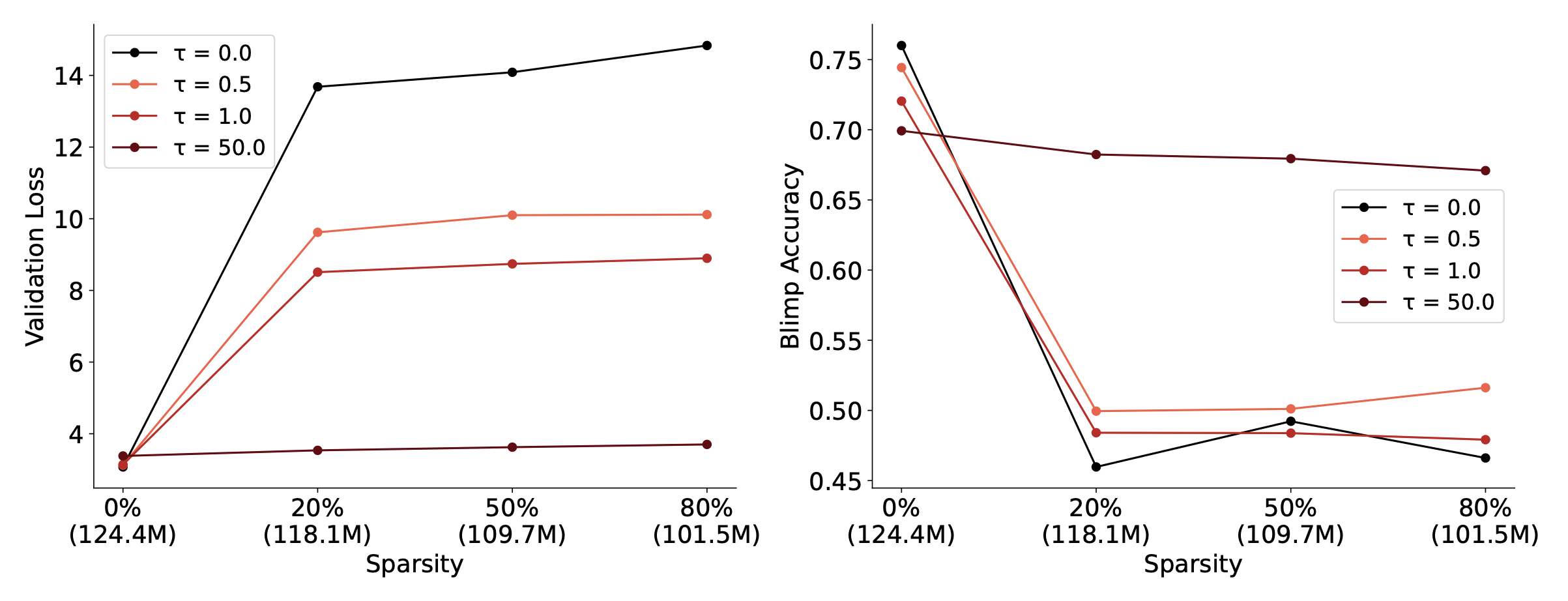
The explanation for the original title is this plot from our publication in ICLR 2025: https://toponets.github.io/webpage_assets/FigureEfficiencyNa...
You can find more details on the website: https://toponets.github.io (see section: "Toponets deliver sparse, parameter-efficient language models")
We find out that inducing topographic structure in the weights of GPTs made them compressible (during inference) without losing out on performance.
I encourage you to revert the name if you find it justified after looking into the evidence I've shown here. Thanks.
Re: TopoNets: High performing vision and language models with brain-like topography
#57This is excellent. Since reading https://books.google.de/books/about/Models_of_the_Mind.html?... I've been expecting someone to start looking back into biology to try to move forward. I guess the poster is one of the authors. Kudos!
Indeed. The problem with most AI research today is they simply do trial and error with large amounts of compute. No room for taking inspiration from nature, which is requires more thought and less FLOPS.
Re: TopoNets: High performing vision and language models with brain-like topography
#58Earlier quoted context omitted.
I've found how CNN map to visual cortex to be very clear. But I've always been a bit confused about how llms map to the brain. Is that even the case?
> how llms map to the brain For the lower level - word embedings (word2vec, "King – Man + Woman = Queen") - one can see a similarity https://www.nature.com/articles/d41586-019-00069-1 and https://gallantlab.org/viewer-huth-2016/ "The map reveals how language is spread throughout the cortex and across both hemispheres, showing groups of words clustered together by meaning."
Very different from a feed forward network with perceptrons, auttograd, etc...
Inner product spaces are fixed points, mapping between models is less surprising because the general case is a merger set IIRC.
Re: TopoNets: High performing vision and language models with brain-like topography
#59Earlier quoted context omitted.
Unless GPUs work markedly differently somehow or there’s been some fundamental shift in computer architecture I’m not aware of, spatial locality is still a factor in computers. Aside from HW acceleration today, designs like Cebras would benefit heavily by reducing the amount of random access from accessing the weights (and thus freeing up cross-chip memory bandwidth for other things).
This makes me remember game developers back when games could still be played directly from the physical disc. They would often duplicate data to different parts of the disc, knowing that certain data would often be streamed from disc together, so that seek times were minimized. But those game devs knew where everything was spatially on the disc, and how the data would generally be used during gameplay. It was consist…
Re: TopoNets: High performing vision and language models with brain-like topography
#60Earlier quoted context omitted.
Unless GPUs work markedly differently somehow or there’s been some fundamental shift in computer architecture I’m not aware of, spatial locality is still a factor in computers. Aside from HW acceleration today, designs like Cebras would benefit heavily by reducing the amount of random access from accessing the weights (and thus freeing up cross-chip memory bandwidth for other things).
That could explain compute efficiency, but has nothing to do with the parameter efficiency pointed at in the paper.