Live data from Hacker News

Socioeconomic status and the relationship between the SAT and GPA (2009) [pdf]

files.eric.ed.gov

51–60 of 76 posts

Re: Socioeconomic status and the relationship between the SAT and GPA (2009) [pdf]

#51

1.) Intelligent people befriend other intelligent people. 2.) Intelligent people get higher paying jobs. 3.) Intelligent people live in wealthier areas. 4.) Intelligent people marry other intelligent people. 5.) Intelligent people birth intelligent children. 6.) Intelligent people use their intelligence to augment their kid's intelligence. 7.) Intelligent kids go to step 1.) The emperor is walking around naked, and v…

I think the issue is that number 5 is not true, at least not in a direct way.

Look at any family of 3+ siblings. Intelligence tends to vary significantly despite having the same parents.

Re: Socioeconomic status and the relationship between the SAT and GPA (2009) [pdf]

#52

1.) Intelligent people befriend other intelligent people. 2.) Intelligent people get higher paying jobs. 3.) Intelligent people live in wealthier areas. 4.) Intelligent people marry other intelligent people. 5.) Intelligent people birth intelligent children. 6.) Intelligent people use their intelligence to augment their kid's intelligence. 7.) Intelligent kids go to step 1.) The emperor is walking around naked, and v…

The book "The Bell Curve" basically expressed the same point -- with data-- as yours here. And yeah, you are right. But then everyone is terrified by it, and hence the outcryand the name calling.

Partly right:

https://theconversation.com/are-rich-people-more-intelligent...

Re: Socioeconomic status and the relationship between the SAT and GPA (2009) [pdf]

#53

Earlier quoted context omitted.

It's worth remembering this next time you hear someone say something along the lines of, "I believe in equality of opportunity, not equality of outcome". If people are indeed born with unequal abilities, then equality of opportunity is impossible.

You seem confused. If people are unequal then equality of outcome is impossible and not worth pursuing[1]. The only possible equality is equal opportunity which as you rightly point out isn’t really equal. But it’s the only possibility. Equality of outcome denies free will. [1] edit to clarify, I mean “not worth pursuing” past the point of equilibrium. We can improve equality of outcome to a point but then will hit a…

Here's my simplified way of thinking about equality at times - let's say you've worked hard all your life and have saved $2.5 million dollars - quite a nice sum. I just looked and Bill Gates stands at $128 billion. So 51,200 times more money. Do you think Bill Gates worked 51,200 times harder? Is he 51,200 times smarter? Better? Some level of inequality just seems inherently unjustifiable. I have no specific quarrel with Gates; insert any other filthy rich person and imagine it.

Re: Socioeconomic status and the relationship between the SAT and GPA (2009) [pdf]

#54
post #51

1.) Intelligent people befriend other intelligent people. 2.) Intelligent people get higher paying jobs. 3.) Intelligent people live in wealthier areas. 4.) Intelligent people marry other intelligent people. 5.) Intelligent people birth intelligent children. 6.) Intelligent people use their intelligence to augment their kid's intelligence. 7.) Intelligent kids go to step 1.) The emperor is walking around naked, and v…

I think the issue is that number 5 is not true, at least not in a direct way. Look at any family of 3+ siblings. Intelligence tends to vary significantly despite having the same parents.

Anecdata, but yes, I am not the smartest sibling in my family, but one of the wealthier ones.

The "dumbest" one is potentially the wealthiest. The smartest one (hands down) is the least wealthy.

This is besides the point though. Anecdata doesn't get at what happens on average, and that's what his post is about.

Re: Socioeconomic status and the relationship between the SAT and GPA (2009) [pdf]

#55
So, I know the authors of this report personally. I sincerely have the highest respect for them, they do solid work; if I see something by them I take it seriously because I know I will disagree at my peril.

However, I also feel like findings like this get distorted and manipulated, and used to refute strawmen versions of arguments out there against use of standardized testing. Some of the recent arguments being used to reinstate standardized testing as required seem irresponsible to me, even though I don't necessarily see required standardized testing as undefensible per se (my own opinions about all of this are complex and don't fall neatly into either "side", so take this all as coming from someone who is frustrated with how things get oversimplified on both sides, not as advocating for a particular position).

Here's some things to keep in mind:

1. This is all about predicting freshman GPA, which itself is questionable as a criterion. If your sole question is "how will this individual do in our college their first year", it's reasonable. But if you are asking "how well would this individual master the skills necessary to succeed in X, Y, or Z role" it's entirely different. Freshman GPA predicts graduating GPA less well than you might think, and both of those are poor proxies for "real world" behavior. They're not unrelated to "real world behavior", but the relationship is low enough that this is the entire point of social justice advocates.

A lot of people would say neither SAT nor freshman GPA are relevant, that that's the point.

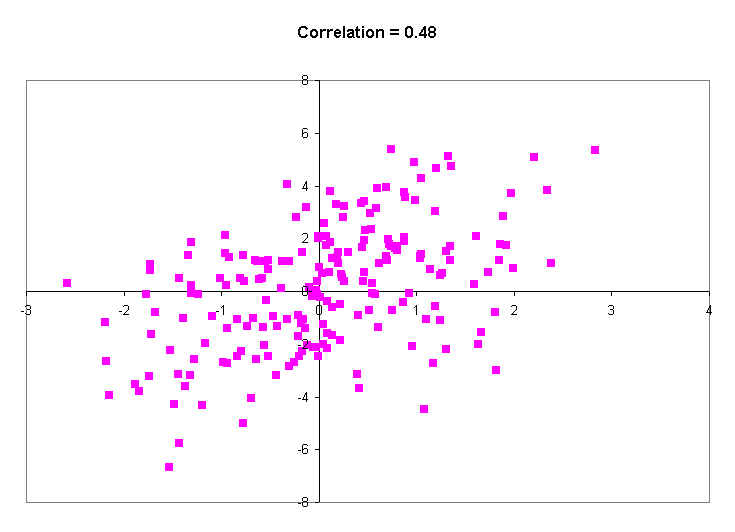
2. A correlation of 0.47 or 0.44 is something to pay attention to, but it's also far from perfect. If you want to remind yourself of how much noise is in that correlation look here:

http://www.analytictech.com/mb313/correl4.jpg

That's a ton of noise at the individual level, which is the level we care about when we're talking about admissions decisions.

The problem with a lot of this isn't with the SAT, it's that what happens is this 0.45 r inevitably gets turned into a blind metric that ignores all that real variation because it puts too much pressure on the school to take people who have all kinds of other evidence of competency, because it makes their numbers look bad.

Let me put it this way: if I was selling you a bathroom scale, and showed you that scatterplot of my scale's numbers and actual weight, would you buy it? You shouldn't, but we're making consequential life decisions based on that level of noise.

The Dartmouth report conveniently ignored that noise, when that noise is about 75% of the problem.

3. Relatedly, if you look at the individual level, things are vastly different when you start taking these kinds of population-level trends and using them to make individual decisions around a threshold. That is, it's very easy to say "0.46 correlation is pretty substantial, we should require SATs", but that 0.46 correlation is across the entire range. It includes people whose SAT scores are very very low. It's not only in the range of where decisions tend to be made, and to make use of that test as a metric for decision-making, you have to assume that what's in the college board's SES index is a perfect summary of what might be said for every applicant to your college. Maybe someone is upper class but their parents were both killed in a plane crash. Maybe they are middle class but come from an abusive family. Maybe they are applying as a much older candidate, or much younger candidate, and the meaning of the scores is really different.

In a sane world where we can have nice things, the admissions committee would look at this and make exceptions. This is the idea of having test scores optional. But when you make them required, and are required to post them, then there's pressure to take the highest scores regardless of all the other information.

4. About the other information: in Table 2, they show that HS GPA is actually less correlated with SES than SAT score. Other papers with similarly large amounts of data have shown that HS GPA is actually slightly more correlated with freshman GPA than SAT score. So is the SAT necessary? Probably not. We can argue about grade inflation etc., but the numbers are the numbers, and if it's working as an alternative that is less correlated with SES, reflects a longer sample of school behavior than just a few hours on one day, why wouldn't you prefer that?

5. Note their Figure 1b. They spend a lot of time talking about this model, and in some ways it's the focus of their paper, evaluating it against the alternative. But related to my first point, the model in Figure 1b says nothing about the extent to which a college, or anyone else for that matter, might want to select on some process represented by Figure 1b. What does it matter if test score predicts, say, some other test score composite, and both are influenced by SES?

In widely used intelligence tests, there were questions about things like 19th century European literature and classical music (I think they're still there, but I can't remember offhand; they might have been made optional now). On the one hand, yes, 19th century European literature and classical music is great, knowledge of it probably reflects some memory ability etc, but are questions about that really how you want to evaluate someone's skillset? Maybe it is, maybe it isn't, but I can tell you if you're not knowledgable about that you would not get credit on those questions.

In many ways, for many, the SAT and college freshman GPA are kind of similar. I don't feel that way, but this is the classic "book smarts" versus "real smarts" issue that always has come up since the beginning of humanity probably. Showing book smarts predicts other book smarts just isn't important in some paradigms.

Again, I'm not anti-standardized testing. I think it's useful. But I also think the way it's been used in the past, and continues to be used, is in fact broken. It's not even necessarily a problem with the tests, it's a problem with the way they get used. But to paraphrase a famous educational psychologist, if you have a thing that people tend to misuse, every single time, and there are good alternatives, maybe there is something about that thing that's a problem when you put it the hands of people, and the thing either shouldn't be used, or there should be some rules put in place with teeth to prevent it from being misused.
Re: Socioeconomic status and the relationship between the SAT and GPA (2009) [pdf]

#56

Earlier quoted context omitted.

Except the research doesn't show this at all. However, having wealth provides tutors, better schooling and teachers which lead to better outcomes from having better mentors, opportunities and education which leads to... and so on and so on.

Right, that is step 6. If you go over the research, you realize that they all assume the premise "everyone is born with an identical blank slate". Which leads to conclusions (either said outright or implied) like; "If you give enough resources to any given child, they can grow up to be anything." So we end up with schools that serve low income areas getting enormous amounts of funding to teach admin assistants and ti…

[dead]

Re: Socioeconomic status and the relationship between the SAT and GPA (2009) [pdf]

#57
post #3

Relatedly, UT Austin found the SAT highly predictive and decided to reinstate the requirement: https://news.utexas.edu/2024/03/11/ut-austin-reinstates-stan... > Those who opted in had a median SAT score of 1420, compared with a median of 1160 among those who did not. > The higher standardized scores translated on average to better collegiate academic performance. Of 9,217 first-year students enrolled in 2023, those w…

0.86 GPA points higher during their first semester. Is that really such a massive informational advantage?

Re: Socioeconomic status and the relationship between the SAT and GPA (2009) [pdf]

#58
post #51

1.) Intelligent people befriend other intelligent people. 2.) Intelligent people get higher paying jobs. 3.) Intelligent people live in wealthier areas. 4.) Intelligent people marry other intelligent people. 5.) Intelligent people birth intelligent children. 6.) Intelligent people use their intelligence to augment their kid's intelligence. 7.) Intelligent kids go to step 1.) The emperor is walking around naked, and v…

I think the issue is that number 5 is not true, at least not in a direct way. Look at any family of 3+ siblings. Intelligence tends to vary significantly despite having the same parents.

This is the Simpson paradox in action. It’s possible for smart parents to get less smart kids, or to observe a wide variation in smartness among siblings, but neither of those say anything about whether on average, smarter parents get smarter kids.

Re: Socioeconomic status and the relationship between the SAT and GPA (2009) [pdf]

#59
post #51

1.) Intelligent people befriend other intelligent people. 2.) Intelligent people get higher paying jobs. 3.) Intelligent people live in wealthier areas. 4.) Intelligent people marry other intelligent people. 5.) Intelligent people birth intelligent children. 6.) Intelligent people use their intelligence to augment their kid's intelligence. 7.) Intelligent kids go to step 1.) The emperor is walking around naked, and v…

I think the issue is that number 5 is not true, at least not in a direct way. Look at any family of 3+ siblings. Intelligence tends to vary significantly despite having the same parents.

Genetics is a grab bag of traits. A whole bunch of marbles mixed around in a bag.

What I am speaking to is the types of marbles and their prevalence in a given bag. Not what is actually chosen in any given drawing.

A better phrasing would be "Kids who draw from bags with higher than average amounts of green marbles, are more likely to end up with green marbles in their bag"

Re: Socioeconomic status and the relationship between the SAT and GPA (2009) [pdf]

#60
post #3

Relatedly, UT Austin found the SAT highly predictive and decided to reinstate the requirement: https://news.utexas.edu/2024/03/11/ut-austin-reinstates-stan... > Those who opted in had a median SAT score of 1420, compared with a median of 1160 among those who did not. > The higher standardized scores translated on average to better collegiate academic performance. Of 9,217 first-year students enrolled in 2023, those w…

These kind of things are making me conservative on knowledge. >10-15 years ago 'standardized testing doesnt matter at all' >You are an idiot if you think it matters >Oops THEY were wrong. You are still an idiot and ahole for disagreeing with me 10 years ago. Obviously there is a golden mean here, but I just remember how radical some of these teachers were.

The people who were saying tests didn't matter were the people that thought other things mattered and had other agendas to push...
Post reply on HN