Earlier quoted context omitted.
Why would Meta, Microsoft, Amazon and Google want Nvidia to remain dominant in hardware? Are you treating “big tech” like they all have one hive mind?
For MSFT, AMZN, GOOG, the competitive advantage comes from having huge datasets (that Nvidia doesn't have). It's a symbiosis that benefits the data-rich and GPU-rich players.
Mamba Explained: The State Space Model Taking On Transformers
51–60 of 101 posts
Re: Mamba Explained: The State Space Model Taking On Transformers
#52Earlier quoted context omitted.
As a member of the research community: that's nonsense. Publishing is an extremely noisy process in ML and is getting increasingly difficult for smaller non big tech collaborating labs. Reviewers' go to are: more datasets, scale, not novel. The easiest way to approach this is to work off of pretrained models. This is probably more obvious in the NLP world. I agree that Mamba doesn't solve everything and it still need…
What’s the main difference between an ape’s brain and a human brain? Scale. So that’s the train we’re riding at the moment. No roadblocks yet, aside from cost.
This is incredibly naive with absolutely no scientific basis. There is no evidence that this is in scale of data nor scale of architecture.
There are a number of animals with larger brains in terms of both mass and total number of neurons. An African Elephant has roughly 3x the number of neurons humans have. Dolphins beat humans in total surface area. Neanderthals are estimated to have had larger brains too! It isn't mass, neurons, neuron density, surface area. We aren't just scaled up chimps.
Re: Mamba Explained: The State Space Model Taking On Transformers
#53SSMs are doing exponentially weighted moving averages (EMA). That's it- to summarize the past, you take an EMA of a variable output at each time step. Mamba changes one key thing- instead of decaying the past by a fixed amount each step as in a constant-time EMA, we have another output which decides how much to forget, or equivalently, how much 'time' has passed since the last observation in our EMA.
All of the matrix equations, continuous time, discretization, etc, will end up with a dynamic-forgetting EMA as I describe above. This also makes the benefits and limitations clear- finite state size, has to decide at a given layer what to forget before it sees the past at that layer.
Re: Mamba Explained: The State Space Model Taking On Transformers
#54Earlier quoted context omitted.
No technique can get you the news other than actually searching for and then parsing the published news.
Can a control vector replace system prompts? i.e. can it do in-context learning without the context?
Re: Mamba Explained: The State Space Model Taking On Transformers
#55Earlier quoted context omitted.
What’s the main difference between an ape’s brain and a human brain? Scale. So that’s the train we’re riding at the moment. No roadblocks yet, aside from cost.
> What’s the main difference between an ape’s brain and a human brain? Scale. This is incredibly naive with absolutely no scientific basis. There is no evidence that this is in scale of data nor scale of architecture. There are a number of animals with larger brains in terms of both mass and total number of neurons. An African Elephant has roughly 3x the number of neurons humans have. Dolphins beat humans in total su…
But my point stands - our brains have evolved directly from apes brains and the main difference between them and us is brain size.
Re: Mamba Explained: The State Space Model Taking On Transformers
#56The SSMs papers and blogs always have unnecessarily complicated explanations. At this point I almost wonder if its to hide how simple the underlying algorithms are, or to make them seem fancy. SSMs are doing exponentially weighted moving averages (EMA). That's it- to summarize the past, you take an EMA of a variable output at each time step. Mamba changes one key thing- instead of decaying the past by a fixed amount…
Re: Mamba Explained: The State Space Model Taking On Transformers
#57> In other words, you can drag and drop downloaded states into your model, like literal plug-in cartridges The same could be said of "control vectors" [1]. Both ideas are still experimental, but is seems to me IINM that they could replace "system prompts" and "RAG" respectively. [1] https://news.ycombinator.com/item?id=39414532
Whoever is downvoting this post needs to stop. The concepts behind control vectors, i.e. "representation engineering" are not especially new and have been highly effective in the diffusion space. I always find it entertaining when LLM folks act like they're discovering stuff that waifu stable diffusion folks knew for 6 months + about - like "concept slider loras".
Re: Mamba Explained: The State Space Model Taking On Transformers
#58Re: Mamba Explained: The State Space Model Taking On Transformers
#59The SSMs papers and blogs always have unnecessarily complicated explanations. At this point I almost wonder if its to hide how simple the underlying algorithms are, or to make them seem fancy. SSMs are doing exponentially weighted moving averages (EMA). That's it- to summarize the past, you take an EMA of a variable output at each time step. Mamba changes one key thing- instead of decaying the past by a fixed amount…
Re: Mamba Explained: The State Space Model Taking On Transformers
#60The SSMs papers and blogs always have unnecessarily complicated explanations. At this point I almost wonder if its to hide how simple the underlying algorithms are, or to make them seem fancy. SSMs are doing exponentially weighted moving averages (EMA). That's it- to summarize the past, you take an EMA of a variable output at each time step. Mamba changes one key thing- instead of decaying the past by a fixed amount…
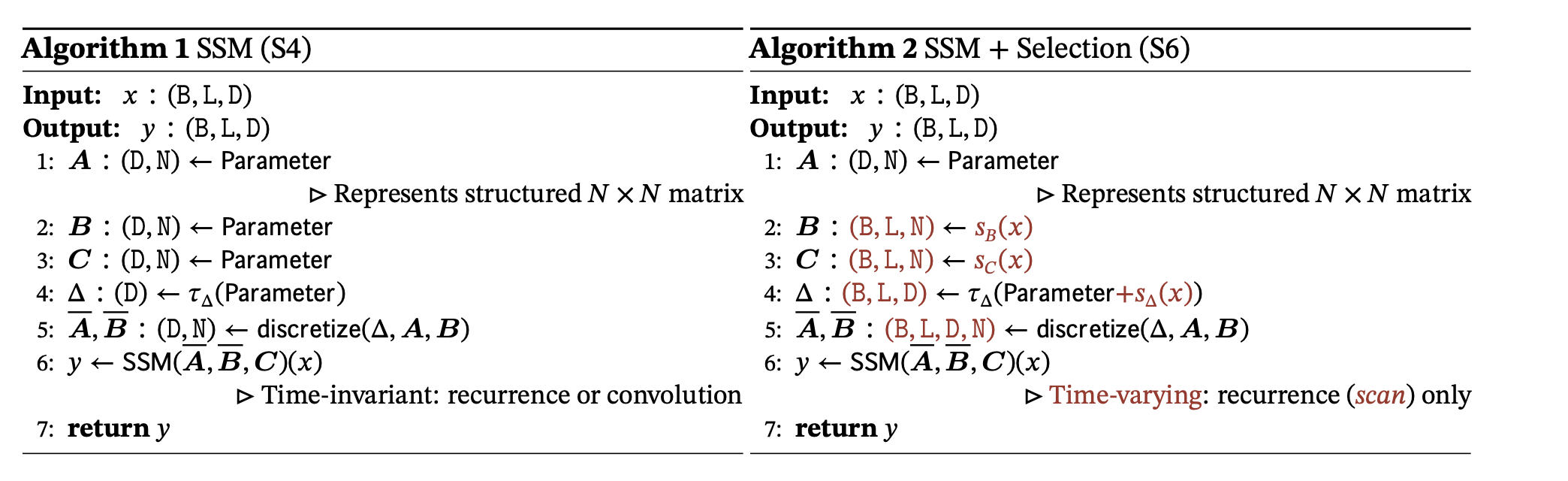
Something I've noticed is that B, C and Δ depend only on the current token. See this: https://www.kolaayonrinde.com/blog/images/mamba/ssm_algorith... -- Another thing is that I've noticed that the definition of "SSM" in the image I've linked to is apparently recursive. This is also in the Arxiv paper. Strange.
+1 though for making me go back to the article and read it more carefully! +1 also to the article.