Live data from Hacker News

TPM provides zero practical security

gist.github.com

51–60 of 111 posts

Re: TPM provides zero practical security

#51
post #36
post #3

> You can also use the TPM + PIN as a sort of Yubikey That's not zero. In my mind that's the main thing a TPM is really useful for. It's a secure enclave for a private key used for U2F/WebAuthn style attestation. I agree that the threat model not being explicitly discussed is a huge miss. But to that point, a TPM is still useful because it prevents someone who has hacked into my computer from commanding the TPM's aut…

This is not the way TPMs are used by most of the industry. For example, Microsoft and now Canonical are advertising it as a way to do FDE which Microsoft has known to be broken since 2006. They are requiring it for Windows 11 because of "security" and have provided no software feature on Windows for this kind of use case. It is only done by the OSS community. > The other useful application is to prevent block device…

> This is not the way TPMs are used by most of the industry. [...] It is only done by the OSS community.

So some industry stakeholders are doing bad things with an inherently neutral technology. Does that mean we need to get rid of the entire thing, thereby also killing the OSS use cases?

Yes, trusted computing can be used in user-hostile ways, but the solution here seems to be to not use OSes and applications using it in that way, rather than throwing out the technology as a whole.
Re: TPM provides zero practical security

#53
post #35

Unfortunately this sounds like a typical pro-Linux rant with the usual scare words such as "Microsoft", "UEFI", "secure boot", etc. To be clear, I am attacking the piece itself, not the author. The reason there is no explicit threat model defined in the TPM specs is because it defines a general-purpose hardware security module. It is up to integrator to define the threat model (TPM's security properties also depend o…

> This sounds like the rant of a typical Linux fanboy Hi, it's me the Linux fanboy whose entire personality is making Hackintosh and VM apps for iOS. Just a friendly reminder that attacks on the author's credentials have no baring on the weight of the arguments. > The reason there is no explicit threat model defined in the TPM specs is because it defines a general-purpose hardware security module It sounds like you h…

> TPMs will happily hand you the keys when you meet a certain condition. HSMs support key migration and provides a secure way to transfer keys from one HSM to another without leaving the trust boundary.

You can create non-exportable keys on TPM's, and there are mechanisms to securely transfer keys between devices.

Granted, doing so is kind of a mess, but nonetheless possible.

Re: TPM provides zero practical security

#54
post #3

> You can also use the TPM + PIN as a sort of Yubikey That's not zero. In my mind that's the main thing a TPM is really useful for. It's a secure enclave for a private key used for U2F/WebAuthn style attestation. I agree that the threat model not being explicitly discussed is a huge miss. But to that point, a TPM is still useful because it prevents someone who has hacked into my computer from commanding the TPM's aut…

> In my mind that's the main thing a TPM is really useful for.

Unfortunately, it's not much good for that either.

A yubikey has a button to confirm the user's presence - so even if a remote attacker has completely compromised the machine, because they can't press the button, they can't get anything out of the key.

The TPM has no button, so it has to rely on the OS to keep your pin safe from keyloggers. If your OS is that trustworthy, you might as well just store your secrets in the OS keyring.

The TPM is also about 50x more complicated than a yubikey, to support things like multi-user systems. This means there's a much bigger attack surface.

Re: TPM provides zero practical security

#55

Unfortunately this sounds like a typical pro-Linux rant with the usual scare words such as "Microsoft", "UEFI", "secure boot", etc. To be clear, I am attacking the piece itself, not the author. The reason there is no explicit threat model defined in the TPM specs is because it defines a general-purpose hardware security module. It is up to integrator to define the threat model (TPM's security properties also depend o…

There are two issues. One is a false sense of security. You think that you have the same level of security of a full disk encryption, but you don't. On a full disk encryption only who knows the password can access your data. On this system the disk is automatically decrypted at boot, so any flaw in Windows that permits a privilege escalation done by that PC can give access to your data. If somebody that wants your da…

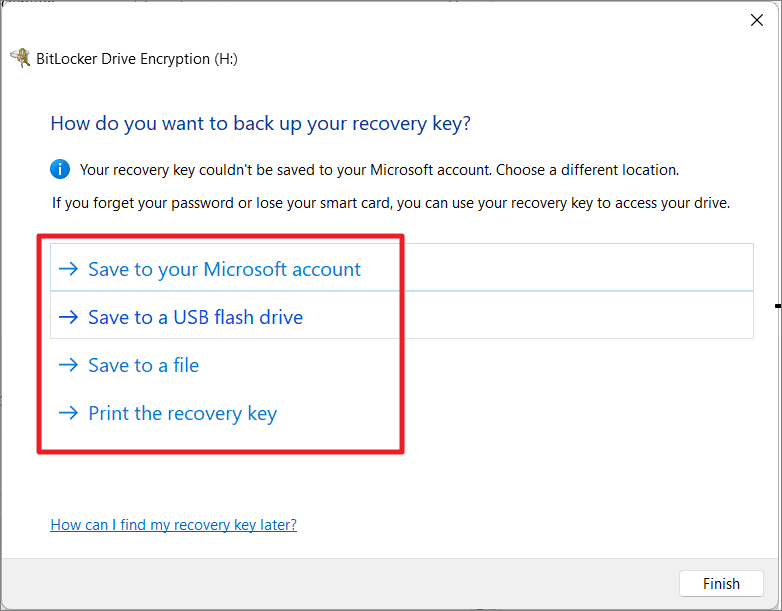
> indeed if you signed in with a Microsoft account you can recover your Bitlocker encryption key from the Microsoft portal. ... No security at all! Microsoft knows your encryption keys and it stores it on their servers.

This is complete disinformation. Microsoft gives you the OPT-IN OPTION to save your Bitlocker encryption key to your account.

It's clearly labeled and you need to click on it to activate it:

https://allthings.how/content/images/wordpress/2021/11/allth...

Re: TPM provides zero practical security

#56

Earlier quoted context omitted.

I’ve seen many widely deployed applications of TPM for security, never for DRM.

You've never used Widevine? If you ever tried to use a streaming website, you almost certainly did. EDIT: To clarify, Widevine doesn't actually use the TPM, but Widevine L2 uses a TEE for key exchange and decryption, which are all things that modern TPMs support. The use a crypto coprocessor for key exchange and decryption is widely used.

Are you sure Widevine uses the attestation functionalities of a TPM on Windows?

I thought Widevine on computers (whether Windows, macOS or Linux) is always L3, i.e. software only, and L1 needs a TEE on Android or an embedded OS such as on a set top box or streaming dongle.

Re: TPM provides zero practical security

#57
post #22

Earlier quoted context omitted.

What's the point of TPM-backed full disk encryption with no usability impact (meaning password/pin-less) for the average user who is more likely to get their device stolen vs some covert disk image shenanigan?

An attacker still needs to use some kind of semi-advanced attack in the boot chain or DMA to steal the user's data, instead of just plugging in a LiveUSB and going to town. Yes, there are a lot of vulnerabilities in the Secure Boot process on most devices, because the surface area is huge, but the attacker still needs _some sort_ of vulnerability to gain a foothold. I agree with the frustration in the gist - Secure B…

For the typical user, losing their data is a greater risk than someone with physical control over their machine being able to access it. The logic board in your computer fails or you forget your password and all your data is gone.

And the default way of mitigating it is an even worse security risk. Now all your data is on some cloud somewhere, waiting for that vendor to get breached or your account to get phished which is now possible without physical control over your device. Plus, if you couldn't get into your computer because you lost access to your account, you also lost access to the data in the cloud.

Whereas if you really do have sensitive data, you still don't need a TPM and get better security without one. You keep a Yubikey in your pocket or memorize a strong passphrase and then the key physically isn't stored on your device.

Re: TPM provides zero practical security

#58

Unfortunately this sounds like a typical pro-Linux rant with the usual scare words such as "Microsoft", "UEFI", "secure boot", etc. To be clear, I am attacking the piece itself, not the author. The reason there is no explicit threat model defined in the TPM specs is because it defines a general-purpose hardware security module. It is up to integrator to define the threat model (TPM's security properties also depend o…

There are two issues. One is a false sense of security. You think that you have the same level of security of a full disk encryption, but you don't. On a full disk encryption only who knows the password can access your data. On this system the disk is automatically decrypted at boot, so any flaw in Windows that permits a privilege escalation done by that PC can give access to your data. If somebody that wants your da…

What type of password are users going to choose if they can't use a password manager at boot time? Its no more secure to a DMA attack then a TPM protected drive. Attackers are getting the both types passwords from memory.

Re: TPM provides zero practical security

#59
post #2

I don't agree with this. Yes, any TPM is necessarily possible to bypass, but it's not easy. I know I could bypass normal password-based FDE with physical access to a machine without any special hardware or software, but not TPM-based. I assume, by the Pareto principle, that there are lots of people with my ability but exponentially fewer who could bypass a TPM. So it's definitely more secure than password-based FDE,…

>I know I could bypass normal password-based FDE with physical access to a machine without any special hardware or software

How?

Re: TPM provides zero practical security

#60
post #56

Earlier quoted context omitted.

You've never used Widevine? If you ever tried to use a streaming website, you almost certainly did. EDIT: To clarify, Widevine doesn't actually use the TPM, but Widevine L2 uses a TEE for key exchange and decryption, which are all things that modern TPMs support. The use a crypto coprocessor for key exchange and decryption is widely used.

Are you sure Widevine uses the attestation functionalities of a TPM on Windows? I thought Widevine on computers (whether Windows, macOS or Linux) is always L3, i.e. software only, and L1 needs a TEE on Android or an embedded OS such as on a set top box or streaming dongle.

Indeed, it doesn't use it on Windows. Widevine L2 however uses the TEE in exactly the same way as a TPM is used, for attestation and for cryptography (you can do AES decryption using a TPM).
Post reply on HN