Live data from Hacker News

ESA’s Juice lifts off on quest to discover secrets of Jupiter’s icy moons

esa.int

51–60 of 71 posts

Re: ESA’s Juice lifts off on quest to discover secrets of Jupiter’s icy moons

#51
post #27
post #8

Earlier quoted context omitted.

it's a shame nuclear detonations in space are banned (for obvious reasons)

What is actually the obvious reason to ban nuclear detonation in space (Not planetside) other than proliferation & security concerns?

Low altitude nuclear detonations generate EMPs on the ground; high altitude ones may generate enough of an EMP to take out higher altitude satellites. Also, radiation will be trapped by magnetic fields like the Van Allen belts, making those larger and more dangerous. There may also be fallout concerns, but I don't think those would be significant
Re: ESA’s Juice lifts off on quest to discover secrets of Jupiter’s icy moons

#52

With the likes of SpaceX being around, is it not possible to have a store of fuel in orbit, so that these missions can pick a tank or two of them, slingshot their way and use the fuel to speed up the journey? Or, is it purely economics at play?

It's been possible since the first orbital dockings in the 60s, but nobody's really found the levels of effort and costs to be practical.

Re: ESA’s Juice lifts off on quest to discover secrets of Jupiter’s icy moons

#53
post #48

Would more energy be available for capture from Jupiter's reflectance or direct from the sun? My heart wants to say yes but my head thinks even as a point source, direct solar energy is higher. If it was other RF or heat, maybe not. I wonder if a Stirling engine could work alternating shade and Jupiter's direct radiation? I also wondered if lowering a long tail could acquire electrostatic energy greater than its coef…

The problem with that is there's no atmosphere in space. A vacuum is not very good at dissipating heat.

Re: ESA’s Juice lifts off on quest to discover secrets of Jupiter’s icy moons

#54

Earlier quoted context omitted.

I stand corrected. I erroneously picked up 2034 from the timeline. But the point still stands; 8 years is a depressingly long time. If we base missions on the discoveries of previous missions, there is an 8-year minimum gap between missions. I'm just hoping we find evidence of extraterrestrial life in my lifetime, and at this rate, we'll be cutting it close..

8 years ago we were pretty much where we are now. It will come faster than you might thinkm

We could measure it by latest version of iPhones at the time: iphone 6, Release Date: September 19, 2014

Re: ESA’s Juice lifts off on quest to discover secrets of Jupiter’s icy moons

#55

With the likes of SpaceX being around, is it not possible to have a store of fuel in orbit, so that these missions can pick a tank or two of them, slingshot their way and use the fuel to speed up the journey? Or, is it purely economics at play?

Starship will be able to refuel in orbit. It’s actually a requirement for HLS to work, so I guess they’re pretty serious about that capability.

Re: ESA’s Juice lifts off on quest to discover secrets of Jupiter’s icy moons

#56
post #19

Earlier quoted context omitted.

This was an intentional choice for efficiency and to allow more science at the destination, “the final flyby.. will be 3700 km from Earth in November 2026” [1] Really disappointing that this is top comment tbh. [1] https://sci.esa.int/web/juice/-/58815-juices-journey-to-jupi...

What? How does getting there more slowly mean more science at the destination? And if so, why is Europa Clipper going to get there much faster?

Weight

Re: ESA’s Juice lifts off on quest to discover secrets of Jupiter’s icy moons

#57
post #6

Wow, 11 years to Jupiter. I wish we had better propulsion systems. EDIT: This wasn't meant to disrespect the ESA mission. I'm just sad that the outer planets are years away, rather than the hours, days, weeks or months of science fiction.

Also note that Juno is the heaviest interplanetary probe ever launched. It must carry quite a bit more fuel than most other missions to permit its eventual insertion to Ganymedes’s orbit – never before has a spacecraft orbited a moon other than ours.

Re: ESA’s Juice lifts off on quest to discover secrets of Jupiter’s icy moons

#58
post #6

Wow, 11 years to Jupiter. I wish we had better propulsion systems. EDIT: This wasn't meant to disrespect the ESA mission. I'm just sad that the outer planets are years away, rather than the hours, days, weeks or months of science fiction.

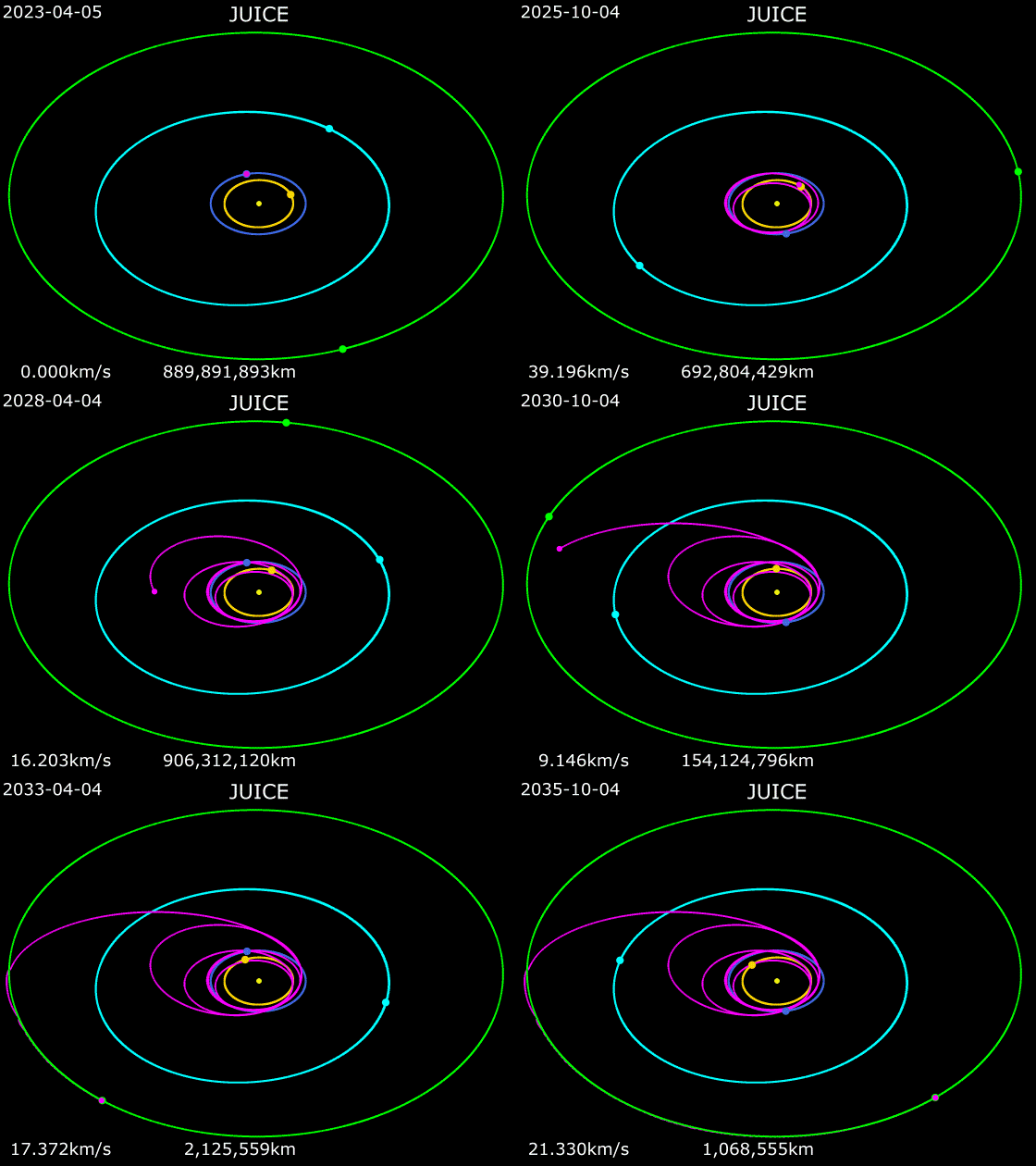
You are right that it could be a lot faster with a bigger rocket. There will be quite a few "slingshot" or gravity assist maneuvers along the way, it's not like they are blasting straight out to Jupiter orbit.

https://upload.wikimedia.org/wikipedia/commons/b/bf/Animatio...

Re: ESA’s Juice lifts off on quest to discover secrets of Jupiter’s icy moons

#59
post #6

Wow, 11 years to Jupiter. I wish we had better propulsion systems. EDIT: This wasn't meant to disrespect the ESA mission. I'm just sad that the outer planets are years away, rather than the hours, days, weeks or months of science fiction.

This was an intentional choice for efficiency and to allow more science at the destination, “the final flyby.. will be 3700 km from Earth in November 2026” [1] Really disappointing that this is top comment tbh. [1] https://sci.esa.int/web/juice/-/58815-juices-journey-to-jupi...

What is your problem? 8 years is a disappointingly long time.

Re: ESA’s Juice lifts off on quest to discover secrets of Jupiter’s icy moons

#60
post #48

Would more energy be available for capture from Jupiter's reflectance or direct from the sun? My heart wants to say yes but my head thinks even as a point source, direct solar energy is higher. If it was other RF or heat, maybe not. I wonder if a Stirling engine could work alternating shade and Jupiter's direct radiation? I also wondered if lowering a long tail could acquire electrostatic energy greater than its coef…

Probably direct from the sun. There's an what-if about using moonlight to start a fire

https://what-if.xkcd.com/145/

> First, here's a general rule of thumb: You can't use lenses and mirrors to make something hotter than the surface of the light source itself. In other words, you can't use sunlight to make something hotter than the surface of the Sun.

...

> The Sun is about 5,000°C, so our rule says you can't focus sunlight with lenses and mirrors to get something any hotter than 5,000°C. The Moon's sunlit surface is a little over 100°C, so you can't focus moonlight to make something hotter than about 100°C.

The cloud tops of Jupiter are estimated to be -280 degrees F.

Post reply on HN