isn’t dark energy just a term for something we think must be there yet we can’t find it? go too many layers deep on speculation and it starts to feel meaningless and self-referential
Black holes as the source of dark energy
51–60 of 81 posts
Re: Black holes as the source of dark energy
#52isn’t dark energy just a term for something we think must be there yet we can’t find it? go too many layers deep on speculation and it starts to feel meaningless and self-referential
I believe dark energy is the name for something that would be necessary to reconcile the model of an expanding universe with the amount of mass-energy that we can observe (even accounting for missing sources of gravitation, aka “dark matter”).
Re: Black holes as the source of dark energy
#53I don't remember this quote exactly, or whom to attribute it to but it goes something along the lines of "throwing two unsolved problems at each other doesn't create a solution".
In particular, this was a very weird sentence:
« However, this common black hole model is in tension with the overall expansion of the universe »
...why would those have anything to do with each other, a priori?
Re: Black holes as the source of dark energy
#54Re: Black holes as the source of dark energy
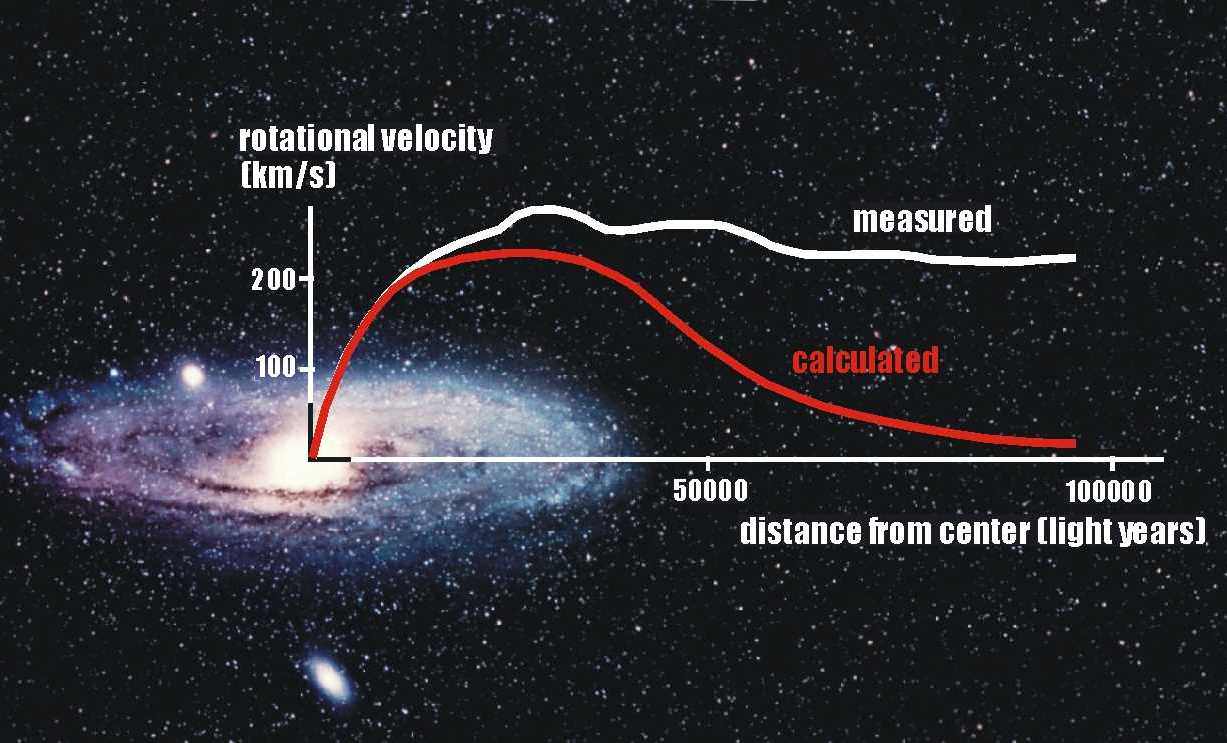
#55Couldn't the proposed variations in spacetime expansion in relative proximity to a SMBH change the curvature of galaxies and perhaps account for the discrepancy between rotational velocities [1] observed vs. expected?
I didn't get a sense of how near or far from the black hole that the expansion variations were present.
https://www.universetoday.com/wp-content/uploads/2011/12/Rot...
Re: Black holes as the source of dark energy
#56Earlier quoted context omitted.
> I actually thought that black holes slowly evaporate This is believed to be true, but the time scale is something like 60 or more orders of magnitude longer than the age of the universe, so (a) no evidence for this effect exists or is likely to be found any time soon, and (b) it's irrelevant for the dynamics of our current universe anyway.
I thought we had evidence that black holes evaporate in that Earth hasn't been swallowed up yet. A while back there were concerns (notably not from physicists) about the LHC forming black holes. I remember the response being that tiny black holes frequently form in the upper atmosphere due to high energy particle collisions, but black holes emit more radiation the smaller they are(!), so these tiny black holes evapor…
> A while back there were concerns (notably not from physicists) about the LHC forming black holes.
There were concerns, but they were not well founded in actual physics.
> I remember the response being that tiny black holes frequently form in the upper atmosphere due to high energy particle collisions
I'm not aware of any such response. The response I'm aware of was that events with higher energy than the LHC is capable of creating happen routinely in cosmic ray collisions, and no black hole formation has ever been observed in such collisions, so black hole formation is not going to happen at the LHC either. That is consistent with our best current theoretical prediction, which is that you would need an accelerator capable of reaching the Planck scale, many orders of magnitude higher energy than the LHC, for black hole production to be possible.
Re: Black holes as the source of dark energy
#57Earlier quoted context omitted.
You mention point mass. Yes, the volume also matters. If your second black box contains the same mass but over a bigger volume, then the spacetime curvature it will cause will be less extreme than the black hole in the first box. The book I most like on this topic is Kip Thorne's Black Holes and Time Warps. IMO Thorne is a better explainer than Hawking.
I'm pretty sure by the time you're outside the box, assuming it's the same size for both, you can't tell anymore. I'm quite confident this is the case for classical gravity and a spherically symmetric "box", and I don't think tides or relativistic corrections are noticeably different far away from the horizon. (Yeah, you'll feel the black hole's tides, but stars have tides too.)
I'm not a relativity expert, but couldn't you tell the difference between a point mass (or just significantly smaller volume) and a star in this black box scenario? At a great distance, they would appear the same gravitationally, but as you get closer, the star would appear less massive. Since more mass would be pulling on you at an angle, rather than directly toward the center.
Re: Black holes as the source of dark energy
#58Earlier quoted context omitted.
If I understood the paper [1] correctly, the idea is that all black holes don't contain a singularity. They have vacuum energy instead and that leads to the increase of mass and dark energy. [1] https://iopscience.iop.org/article/10.3847/2041-8213/acb704/...
> all black holes don't contain a singularity. Do you mean "not all black holes contain a singularity"?
From the article I understood it as “no black holes contain singularities”.
Re: Black holes as the source of dark energy
#59Earlier quoted context omitted.
> I always thought we could put a black box around a black hole, and it would be indistinguishable from any other mass - that is, any other mass that can be treated as a point mass. Yes, that's what the standard theory of black holes says. > this result implies that the black box with the black hole will gain mass over time, even without adding any mass into the black box? Sort of. First, it's important to note that…
The way that I understood it is that what you call an 'ordinary' black hole this paper claims is actually a 'naive' black hole, and that more nuanced solutions to general relativity allow for things that act like black holes that we know but that don't contain singularities. I only point this out because we haven't been inside a black hole, so we don't really know what an 'ordinary' one looks like.
> we haven't been inside a black hole
It’s kind of like that, starting from where we are, black holes have no “inside”, since it takes an infinite amount of time to cross the event horizon.
Re: Black holes as the source of dark energy
#60Earlier quoted context omitted.
> I actually thought that black holes slowly evaporate This is believed to be true, but the time scale is something like 60 or more orders of magnitude longer than the age of the universe, so (a) no evidence for this effect exists or is likely to be found any time soon, and (b) it's irrelevant for the dynamics of our current universe anyway.
I thought we had evidence that black holes evaporate in that Earth hasn't been swallowed up yet. A while back there were concerns (notably not from physicists) about the LHC forming black holes. I remember the response being that tiny black holes frequently form in the upper atmosphere due to high energy particle collisions, but black holes emit more radiation the smaller they are(!), so these tiny black holes evapor…
Not really, a black hole is not different orbitally than any other object with mass. You could replace all the stars in the Milky Way with a black hole of the same mass and basically nothing would change for us except not having starlight. Black holes suck everything in the same way that stars and planets do - unless you are literally heading right towards it, if the relative velocity is high, you would just move past each other.
A tiny black hole would not have enough mass to pull in a significant amount of matter and would just pass through the earth if it were coming from space. If the black hole were created on earth it would need a lot more mass than a collider could give it to do anything funky.