Live data from Hacker News

What is a molten salt reactor?

thmsr.com

51–60 of 107 posts

Re: What is a molten salt reactor?

#51
post #45

Earlier quoted context omitted.

Sequestration is an even bigger moonshot than storage. Most of the "carbon offsets" are in the form of payment in exchange for other countries to agree not to cut down forests. It isn't actually removing carbon from the atmosphere. Actually removing carbon dioxide from the atmosphere is the stuff of scientists and PR moves. Nobody has a serious plan to remove carbon dioxide from the atmosphere at relevant scales. The…

It would take until well after 2050 to build those, and they would cost many, many times as much as renewables + storage, and produce zero kWh in the meantime. Just the money spent on coal, in the meantime, not counting nuke construction, would be more than the cost of building out enough renewables. No "breakthroughs" are needed for storage. Everything works already. All that is unknown is which will end up cheapest…

> It would take until well after 2050 to build those, and they would cost many, many times as much as renewables + storage, and produce zero kWh in the meantime.

Again, no, if nuclear power plant construction was carried out at the same rate as it was in the 1960s and 70s it'd be completed on time. You might be doubtful that we'd be able to manage that pace of construction in the 21st century, but at least there's precedence for that pace of construction actually being achieved.

> Just the money spent on coal, in the meantime, not counting nuke construction, would be more than the cost of building out enough renewables.

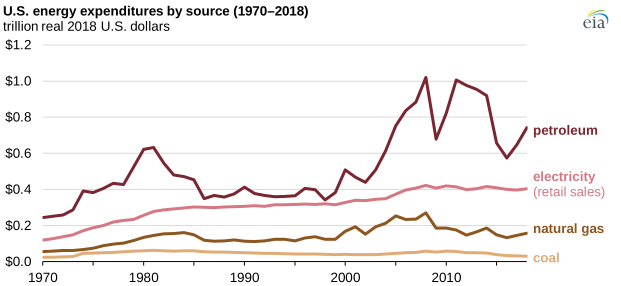
That's a very bold, source-less, claim you're making. Unfortunately the numbers don't even remotely add up. At a total of 535 million tons, and 36.14 dollars per ton for electric power consumption, we're looking at only $20 billion dollars of coal sales [1]. And that's generously assuming that all coal production went to electricity. If you're including power plant construction, that figure doesn't change much [2]. It's so small it's hard to see on the graph, but it appears to be below $25 billion dollars [3].

> No "breakthroughs" are needed for storage. Everything works already. All that is unknown is which will end up cheapest.

Right. We know something will make storage incredibly cheap. We don't know what kind of storage it will be. We don't have examples of it being delivered at that cost. But we just know it in our heart that something will save us and make intermittency a non-issue.

This is called "hope" and it's not a plan. The plan is to keep burning natural gas while wind and solar aren't producing, and keep our fingers crossed that our miraculous something will come about.

1. https://www.eia.gov/coal/annual/

2. https://www.eia.gov/todayinenergy/detail.php?id=45076

3. https://www.eia.gov/todayinenergy/images/2020.09.10/chart2.s...
Re: What is a molten salt reactor?

#52
post #37

Earlier quoted context omitted.

I'm actively trying to drive down my marginal cost of electricity explicitly so I can use more of it to make my life better. I am absolutely driving up my total energy consumption, not just switching fuels.

I’m in the process of installing solar panels and storage for exactly this reason. There are things I want to do at home, running servers, air conditioning etc. that are prohibitively expensive and unnecessarily polluting under current conditions that I’d love to be able to run without thinking about it.

Yup, exactly! I am up to a little over 6 kilowatts peak and 20 KWh installed and I haven't drawn from the grid in months.

My next stop is 14 kilowatts peak and 36 KWh. With any luck I'll be able to leave my pool warm for 6 months of the year and remain off-grid.

Re: What is a molten salt reactor?

#53
post #49
post #46

Earlier quoted context omitted.

If you find "materials the storage vessel is made of" in the salt, do you shut it down and abandon it? Alternative would be to drain it into a holding tank and, what, send somebody in to fix it? Who?

> If you find "materials the storage vessel is made of" in the salt, do you shut it down and abandon it? You identify the operational error in salt chemistry that has lead to losing some of the storage vessel material, and then you perform engineering analysis on the new resultant factor of safety. If necessary, next fueling cycle you shut down the reactor and perform remediation actions.

Assume you need "remediation actions", and that would have to mean sending somebody to climb inside and weld something. Do you shut it down and abandon it, instead? Who goes in?

Re: What is a molten salt reactor?

#54
post #45

Earlier quoted context omitted.

It would take until well after 2050 to build those, and they would cost many, many times as much as renewables + storage, and produce zero kWh in the meantime. Just the money spent on coal, in the meantime, not counting nuke construction, would be more than the cost of building out enough renewables. No "breakthroughs" are needed for storage. Everything works already. All that is unknown is which will end up cheapest…

> It would take until well after 2050 to build those, and they would cost many, many times as much as renewables + storage, and produce zero kWh in the meantime. Again, no, if nuclear power plant construction was carried out at the same rate as it was in the 1960s and 70s it'd be completed on time. You might be doubtful that we'd be able to manage that pace of construction in the 21st century, but at least there's pr…

You may continue posting falsehoods, and I will continue pointing them out.

We don't need "something" to make storage cheap. Storage is cheap, and is getting cheaper.

Again, we are not building storage out yet because we don't have enough renewables to charge it from yet. Instead, we are right now building out factories to make it. E.g., the factories to make iron-air batteries, $20/kWh, are under construction right now. Ammonia synthesis plants are under construction right now. Tankage for ammonia is dirt cheap. No breakthroughs needed, just build-out.

When we do get to building out storage itself, it will be cheaper than it already is.

Re: What is a molten salt reactor?

#55
post #19

This boldly claims that molten salt reactors are safe, but my understanding is that these systems require carefully engineered coatings to function and that in practice every such system has leaked liquid sodium. The statement may be essentially true kind of like saying elevators are safe, but there is still room for risk analysis and expectation of occasional failures.

> in practice every such system has leaked liquid sodium

Just to clarify, reactors cooled by liquid sodium are not molten salt reactors but rather belong to the class of reactors often called "metal-cooled" (sodium is a metal, not a salt, see).

Re: What is a molten salt reactor?

#56
post #48
post #38

Earlier quoted context omitted.

Existing peaker plants will burn synthetic ammonia or hydrogen, once there is enough spare renewable generating capacity to synthesize that. In the meantime, we build out the renewable generating capacity. Then we build out hydrogen and ammonia synthesis. There is no place for nukes in the inner solar system. Out Jupiter and beyond, ok.

> In the meantime, we build out the renewable generating capacity. We're already dipping into times of negative electric power cost in places with high renewable penetration... and a whole lot of the rest of the day where storage is needed, and a whole lot of usages that are not electric yet which will increase demand. Yes, more renewable build out is necessary and helpful. But it won't get us low enough in carbon in…

Diverting money from renewable build-out for contraptions that will not deliver any energy at all year after year would, then, be strictly worse.

Re: What is a molten salt reactor?

#57

Earlier quoted context omitted.

I've been working on molten salt reactor claddings for a few years now. MSRs are very safe. First, there are two main groups of molten salt systems. One group uses generic salt to transport heat. This usually provides efficiency gains over water based systems. These are the systems that might leak sodium and it's no big deal. The 2nd kind of system uses a salt with the fissile material dissolved in it. This is what t…

> These are the systems that might leak sodium and it's no big deal. Sorry can you back this statement up with more than "it's safe, trust me"? I'm not knowledgeable enough to say if this statement can be accepted at face value. History has shown that's not enough. But to me, any system that leaks by accident is a disaster waiting to happen on time scales that power plants are expected to operate on.

It's a relative statement.

In this case, leaking molten sodium merely causes a nontoxic metal fire. Definitely in the category of "not fun", but not the end of the world either. Just dump some sand on it and wait for it to cool down.

Leaks of molten salt nuclear fuels are an entirely different category of industrial disaster. A nuclear accident at best, and a large-scale disaster at worst.

It's like the difference between a water truck having an accident and spilling water on the road and a damn bursting and flooding a city.

One makes for a funny picture on Reddit, the other gets the national guard called up to deal with the emergency. Both involve spilled water.

Re: What is a molten salt reactor?

#58
post #53
post #49

Earlier quoted context omitted.

> If you find "materials the storage vessel is made of" in the salt, do you shut it down and abandon it? You identify the operational error in salt chemistry that has lead to losing some of the storage vessel material, and then you perform engineering analysis on the new resultant factor of safety. If necessary, next fueling cycle you shut down the reactor and perform remediation actions.

Assume you need "remediation actions", and that would have to mean sending somebody to climb inside and weld something. Do you shut it down and abandon it, instead? Who goes in?

You seem to be desperately angling for somebody to say that the evil reactor management orders one of the workers to be sacrificed by going into the highly radioactive reactor vessel. Why?

Re: What is a molten salt reactor?

#59
post #58
post #53

Earlier quoted context omitted.

Assume you need "remediation actions", and that would have to mean sending somebody to climb inside and weld something. Do you shut it down and abandon it, instead? Who goes in?

You seem to be desperately angling for somebody to say that the evil reactor management orders one of the workers to be sacrificed by going into the highly radioactive reactor vessel. Why?

Just trying to get answers to simple questions. If there aren't any good answers, that is an answer.

Re: What is a molten salt reactor?

#60
post #5

A molten salt reactor is, first and foremost, a distraction . By the time any production molten-salt reactor design could get proved out and the first commercial one built, renewables + storage will be providing all our power for much less money than it ever could. But we can waste a lot of $billions on it that could instead go to build out a hell of a lot of panels and wind turbines.

I came across this topic when I read about a proposed MSR powered ship. I’ve yet to see a solution for powering ships via renewables. Ships also require a relatively small reactor (since they are only powering the ship) compared to a land based reactor which will power a region. So this could be the use case needed to bring such tech to fruition.

While I'm slightly bullish on MSR's in general, I think a MSR on a ship is not a good idea. A thin-skinned reactor vessel (one of the big advantages of MSR's as they operate at atmospheric pressure) with a fuel salt that is(?) water-soluble sounds like a disaster in case of a ship sinking.

At least with a traditional water-cooled reactor there's very thick walls for the seawater to corrode through, and then the fuel itself is in a relatively inert oxide form. Similarly for a lead-cooled reactor, when the ship sinks the lead would solidify creating a big radiation protection armor around the fuel elements.

Post reply on HN