Live data from Hacker News

When Americans dreamed of kitchen computers (2021)

atlasobscura.com

51–60 of 62 posts

Re: When Americans dreamed of kitchen computers (2021)

#51

I think its interesting to see these ideas just be unable to predict the true scale of miniaturization of personal computing. They still saw the kitchen computer as some kind of appliance or something built-in to the home. Meanwhile most of us do have kitchen computers; a ton of people look to their phones or tablets for many of the tasks these early kitchen computers were planned to do. Keeping track of meals, provi…

We call them embedded systems and customers call them dishwashers or air fryers or blenders. Those are the kitchen computers, no?

Re: When Americans dreamed of kitchen computers (2021)

#52

Earlier quoted context omitted.

Exactly. I've worked in manufacturing automation long enough to know that the equipment needed to generate the huge variety of food even a mediocre cook can prepare would fill multiple kitchens. Automation equipment that's safe and reliable tends to be very big in relation to the items it operates on.

One could imagine something like an industrial robot arm that can swap implements being able to manage a relatively large variety of recipes given some staple ingredients in a limited amount of space, but it would be tremendously complex to build and cost more than an industrial robot arm. Keeping it clean and well maintained would be a nontrivial effort, even if the arm includes programming to clean up after itself.…

The robot would need to operate on ingredients that are within a narrow band of parameters. A cook will adjust the receipe if for example some vegetables or fruits are particularly ripe or tough or whatever, while the machine would have an incredibly hard time doing that. Realistically, the ingredients would need to be standardized (within a narrow band), which would increase the cost of final meal. Of course, fast food is practically doing that already, but in result they can only do simple meals with mediocre results.

Re: When Americans dreamed of kitchen computers (2021)

#53

I think its interesting to see these ideas just be unable to predict the true scale of miniaturization of personal computing. They still saw the kitchen computer as some kind of appliance or something built-in to the home. Meanwhile most of us do have kitchen computers; a ton of people look to their phones or tablets for many of the tasks these early kitchen computers were planned to do. Keeping track of meals, provi…

We call them embedded systems and customers call them dishwashers or air fryers or blenders. Those are the kitchen computers, no?

Modern appliances sometimes use computers because tiny SOCs are cheaper than electromechanical mechanisms, but the user interfaces of those appliances have scarcely changed. They haven't really caused much in the way of social change.

Re: When Americans dreamed of kitchen computers (2021)

#54
post #21

Earlier quoted context omitted.

lots of guardrails!

Slower speeds hoepfully. Imagine golf carts tottering around the city. That's the automated driving of the future. Not the current mad max roads, but with robots. Instead, some florida retiree town, but with robots.

Essentially, Johnnycab?

Re: When Americans dreamed of kitchen computers (2021)

#55
General purpose computers:

First touch screen 27" AIO for recipes, balancing the household budget, watching videos, playing games, , video conferencing with family & work

Second touch screen 27" AIO for recipes, balancing the household budget, watching videos, video conferencing with family & work

Over-powered VR computer running the other touch screen

Smart dashboard AKA iPad that shows video feeds from security cameras, google calendars, weather forecast, location of phones, wallets, cats and other household information, plus "the funnies" from various news websites

Task specific computers:

A collection of iPads for handling multiple recipes and unit conversion

Device specific computers in the kitchen/dining room area:

Coffee robot AKA Jura J9

Water filter AKA ION Smart Filter

Plant monitoring AKA Raspbery Pi with a bunch of sensors

Not computerised:

The meal plan, which is simply scribbled on to a couple of rectangular glass white boards mounted to the end of a cabinet and clearly visible

What I have found lacking in my experience is not the concept of the kitchen computer, but the software to drive it. So much proposed software is lacking in the UX & UI area that most apps border on the useless.
Re: When Americans dreamed of kitchen computers (2021)

#57

Earlier quoted context omitted.

> if the environment is adapted to prevent show-stopping accidents And what exactly would that environment look like to those outside of a car?

lots of guardrails!

“Outside of a car” includes those on a bicycle as well!

Re: When Americans dreamed of kitchen computers (2021)

#58

I think its interesting to see these ideas just be unable to predict the true scale of miniaturization of personal computing. They still saw the kitchen computer as some kind of appliance or something built-in to the home. Meanwhile most of us do have kitchen computers; a ton of people look to their phones or tablets for many of the tasks these early kitchen computers were planned to do. Keeping track of meals, provi…

We call them embedded systems and customers call them dishwashers or air fryers or blenders. Those are the kitchen computers, no?

I do agree, many of our other appliances have become more computerized. My dishwasher has several different sensors which can change how it runs its cycles and dispense an automatic amount of soap based on detected dirtiness of dishes. My clothes washer is similar, and my drier works until the clothes reach a desired level of dryness instead of just a timer. My microwave's sensor cooking modes are surprisingly good, often when all I need to do is reheat food I just toss it in the microwave and hit "Reheat" and the microwave gets it right to steaming and stops without burning. All of these are driven by computers watching multiple sensors and constantly tweaking parameters of their operation to reach the desired final state.

Its still interesting though that it seems like in the 70's they were still expecting there would be some centralized computer in charge of it all while in reality computing got so small and so cheap its found its way to each appliance on its own.

Re: When Americans dreamed of kitchen computers (2021)

#59
post #47

I lived through the era of the kitchen computers. I cannot prove it but I think this happened through a consumer focus group. In the sixties and seventies marketers loved consumer focus groups. They would always ask a couple off the wall questions. Like asking people if you had a computer in your house what would you imagine using it for and which room would it be in? As a child in the sixties the only computers we s…

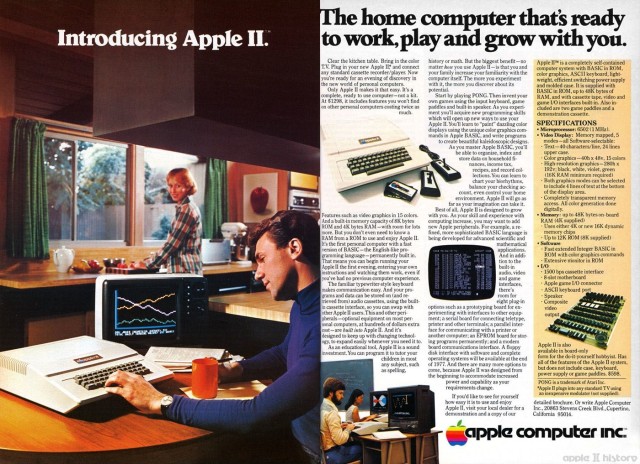
I grew up in that era too. It was interesting how narrow-minded the marketing was on these things, but we hadn't really explored ideas beyond the things you already did on paper (file recipes, balance checkbooks, track your investments).

Even Apple wasn't immune.

https://www.cultofmac.com/wp-content/uploads/2014/06/a2origi...

None of this really changed until VisiCalc came along.

Re: When Americans dreamed of kitchen computers (2021)

#60

Earlier quoted context omitted.

One could imagine something like an industrial robot arm that can swap implements being able to manage a relatively large variety of recipes given some staple ingredients in a limited amount of space, but it would be tremendously complex to build and cost more than an industrial robot arm. Keeping it clean and well maintained would be a nontrivial effort, even if the arm includes programming to clean up after itself.…

The robot would need to operate on ingredients that are within a narrow band of parameters. A cook will adjust the receipe if for example some vegetables or fruits are particularly ripe or tough or whatever, while the machine would have an incredibly hard time doing that. Realistically, the ingredients would need to be standardized (within a narrow band), which would increase the cost of final meal. Of course, fast f…

I would guess that this is why cheap packaged foods tend to be ultraprocessed. The machines need consistency to operate reliably, and the easiest way to make food consistent is to turn it into a liquid, powder, or mush.
Post reply on HN