Earlier quoted context omitted.
You and parent project this in some theoretical universe where these effects would be ignored. Why on earth do you think so? With semi-unlimited energy at our palms, we can do serious geoengineering. We can put these furnaces into high orbits, or moon and beam down just raw output energy with lasers. Or whatever, even the sky isn't a proverbial limit.
Fusion isn't magic, more energy doesn't suddenly obviate the burden of practical engineering constraints, we won't be "geoengineering" our way out of climate change for the foreseeable future.
Energy and Human Ambitions on a Finite Planet
51–60 of 62 posts
Re: Energy and Human Ambitions on a Finite Planet
#52Earlier quoted context omitted.
> Our present lifestyle does seem to require constant growth No, it doesn't. The obvious cause of the huge economic growth over the past 150 years, which is what the author focuses on, is population growth. World population is expected to level off in this century. The author also assumes, incorrectly, that GDP--money spent on goods and services--is the right measure of overall wealth. It's not. The author even discu…
> No, it doesn't. The obvious cause of the huge economic growth over the past 150 years, which is what the author focuses on, is population growth. World population is expected to level off in this century. world population is leveling off because we're approaching many of these limits to growth and that's affecting the enabling factors for continued population growth. > The author also assumes, incorrectly, that GDP…
I'm not doing that. I'm pointing out that the author of this paper is doing that. He is assuming that everything of value is captured in the GDP, i.e., in money spent. But as you acknowledge, this is false, and that invalidates his argument.
> https://en.wikipedia.org/wiki/Jevons_paradox
The Jevons paradox does not say things don't become cheaper when their cost of production is reduced. So it is not an argument against the statement of mine that you were responding to here.
Also, if we are talking about life-essential resources like food (or air), which was what I was talking about in the comment you responded to here, the Jevons paradox is of limited applicability if it applies at all, because demand for such resources is constrained. Even if food were free, people would not eat an unlimited amount of it, any more than they now breathe an unlimited amount of air because air is free. The most important factor driving an increase in total consumption of such resources is population increase, so if population levels off, the resources consumed for these life-essential things will be naturally limited no matter how cheap they become.
Re: Energy and Human Ambitions on a Finite Planet
#53Earlier quoted context omitted.
If we find a cheap new way to generate orders of magnitude more energy, we'll use orders of magnitude more energy. And you're right. We're only a bit over two hundred years away at 2.3% annualized growth in energy use from noticeably raising Earth's surface temperatures just from a thermodynamic perspective . And that's completely ignoring the effects of greenhouse gases.
You and parent project this in some theoretical universe where these effects would be ignored. Why on earth do you think so? With semi-unlimited energy at our palms, we can do serious geoengineering. We can put these furnaces into high orbits, or moon and beam down just raw output energy with lasers. Or whatever, even the sky isn't a proverbial limit.
There are literal physical limits here that can't just be handwaved away by space magic. Higher energy use in a finite spherical volume fundamentally results in increased temperatures when your only way of getting rid of that heat is radiation (and not convection or conduction). And we can't just beam that heat away with space magic either thanks to entropy.
Thermodynamics gives us no tools to deal with this problem outside of increasing the spherical volume of Earth (and therefore its surface area).
Re: Energy and Human Ambitions on a Finite Planet
#54Earlier quoted context omitted.
Fusion isn't magic, more energy doesn't suddenly obviate the burden of practical engineering constraints, we won't be "geoengineering" our way out of climate change for the foreseeable future.
A world where energy consumption increases by a factor of 10,000 is a far fetched fantasy. If we're starting with such premises, should they not be followed?
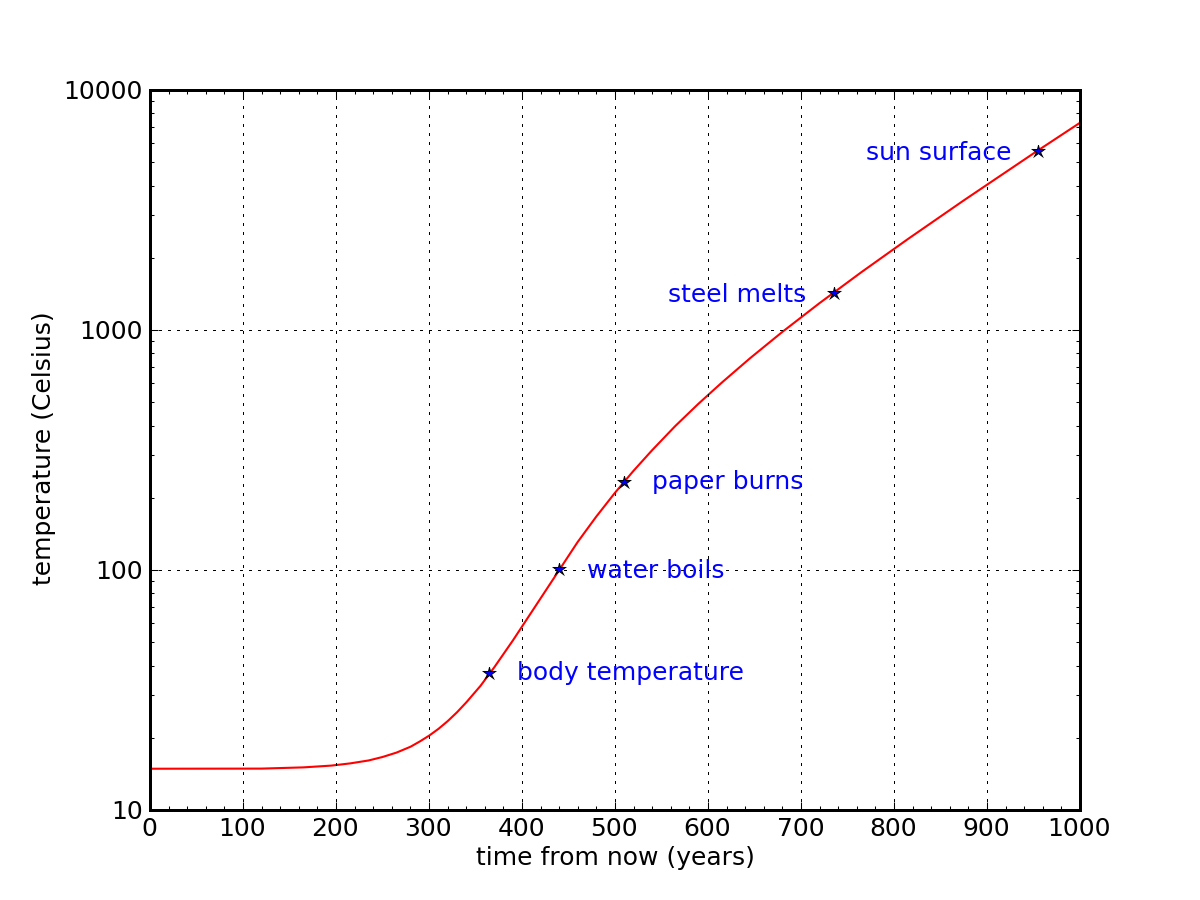
A world where energy consumption increases fiftyfold is a century and a half away and would be brushing up against the point where we are noticeably increasing the equilibrium temperature of Earth sans any greenhouse gases. Hitting the thermodynamic limits of Earth's ability to radiate heat into space isn't a far-fetched fantasy, it's terrifyingly close.
Re: Energy and Human Ambitions on a Finite Planet
#55Earlier quoted context omitted.
A world where energy consumption increases by a factor of 10,000 is a far fetched fantasy. If we're starting with such premises, should they not be followed?
A world where energy consumption increases by a factor of 10,000 would already be a world where the surface is lava thanks to basic thermodynamics. Earth can only radiate so much heat into space, and its ability to do so will not outpace energy production for much longer. A world where energy consumption increases fiftyfold is a century and a half away and would be brushing up against the point where we are noticeabl…
Re: Energy and Human Ambitions on a Finite Planet
#56Earlier quoted context omitted.
A world where energy consumption increases by a factor of 10,000 would already be a world where the surface is lava thanks to basic thermodynamics. Earth can only radiate so much heat into space, and its ability to do so will not outpace energy production for much longer. A world where energy consumption increases fiftyfold is a century and a half away and would be brushing up against the point where we are noticeabl…
This is very wrong. Humans produce about 30 TW of heat. The sun imparts 10 trillion times this amount. If we increased our production by 10,000 then we need to put a small umbrella in space to slightly dim the sun the smallest amount to maintain power balance.
Edit: Also, your numbers are quite simply incorrect. The 70% of sunlight that doesn’t bounce back into space is about 35,000TW, far from the hundreds of trillions of terawatts you claim. At 2.3% energy growth for the next 275 years, we’ll be adding 7,000TW to this number. That is easily enough to noticeably increase Earth’s equilibrium temperature, and far less than this will be necessary to do so given greenhouse gases which reduce our ability to radiate heat into space.
Re: Energy and Human Ambitions on a Finite Planet
#57Earlier quoted context omitted.
This is very wrong. Humans produce about 30 TW of heat. The sun imparts 10 trillion times this amount. If we increased our production by 10,000 then we need to put a small umbrella in space to slightly dim the sun the smallest amount to maintain power balance.
Feel free to do the math yourself. You’ll forgive me for trusting in the calculations of UCSD professor of physics Tom Murphy, who’s written about this extensively. Edit: Also, your numbers are quite simply incorrect. The 70% of sunlight that doesn’t bounce back into space is about 35,000TW, far from the hundreds of trillions of terawatts you claim. At 2.3% energy growth for the next 275 years, we’ll be adding 7,000T…
The Earth receives 340 W / m^2 on average (not accounting for albedo) [1]. The surface area of the Earth is 510 trillion m^2. Humans release 160,000 TWh / year (18.5 TW) [2]. That means the input power from the sun is 9350x what humans release into the atmosphere. If wind and solar play a larger role in the energy mix then the picture looks even better. I can't see how humans could increase power consumption by multiple orders of magnitude without solving so many other (more difficult) problems. Even if we did, playing games with albedo and/or orbital sunshades are on the table with the comparatively meager means we have today. Any future society using that much power surely could address these issues with ease.
Also, expecting constant growth for the next 275 years isn't really a good projection of current trends. We're already seeing negative 2nd derivatives in energy production and population. There is nowhere left to expand in to. The world has become very small very fast.
1. https://earthobservatory.nasa.gov/features/EnergyBalance/pag...
Re: Energy and Human Ambitions on a Finite Planet
#58Earlier quoted context omitted.
Unfair - I didn't say that all human economics are easily predicted by a spreadsheet. It's an exercise. A starting point for discussion. As in: to start with, point out the assumption that is wrong . Rather than just insult me.
> Unfair Kinda I suppose. But the whole spreadsheet 'try this' trope is already unnecessarily hostile. You could put everything that spreadsheet exercise demonstrates into words. And that's my main argument too. This equation/exercise is so simple as to be useless. Human systems are multi-variate to the degree that a simple equation -- in this case showing that reliance on extractables is bad because their availabili…
I do realize too that my model makes assumptions- which have not been demonstrated to be true. So, that’s where I would attack it. Which assumptions are false?
Re: Energy and Human Ambitions on a Finite Planet
#59Earlier quoted context omitted.
The way you’re phrasing that gives me a certain impression of your beliefs about what is and isn’t sustainable that may not be warranted, so I should ask explicitly: What do you think a sustainable way of life looks like? In terms of both global population size and typical life experiences.
To me a sustainable lifestyle would be one where if every person alive today's annual consumption was at the same level humanity’s demand for ecological resources and services could be regenerated over the course of that year- effectively balanced. I'm a fan of Earth Overshoot Day and their approach to this problem so I am using their definition: https://www.overshootday.org/about-earth-overshoot-day/ . A sustainable…
I'm not saying that this applies to your arguments, but what I notice among many people and groups claiming to be concerned with our impact on the environment is more of a fetishism towards doom and pushing forward a notion of personal sacrifice for billions of people, while actively making any excuse for decrying numerous suggestions for technologies and social advancements that could possibly let us make the world cleaner while also being able to live better on a much broader scale.
That kind of thinking teeters on the verge of pseudo-religious, ideological instead of being something reasoned and practical.
Re: Energy and Human Ambitions on a Finite Planet
#60Earlier quoted context omitted.
Feel free to do the math yourself. You’ll forgive me for trusting in the calculations of UCSD professor of physics Tom Murphy, who’s written about this extensively. Edit: Also, your numbers are quite simply incorrect. The 70% of sunlight that doesn’t bounce back into space is about 35,000TW, far from the hundreds of trillions of terawatts you claim. At 2.3% energy growth for the next 275 years, we’ll be adding 7,000T…
Sorry the 13 trillion number was from the total power output of the sun (10^26 W). The Earth receives 340 W / m^2 on average (not accounting for albedo) [1]. The surface area of the Earth is 510 trillion m^2. Humans release 160,000 TWh / year (18.5 TW) [2]. That means the input power from the sun is 9350x what humans release into the atmosphere. If wind and solar play a larger role in the energy mix then the picture…
The whole point of this debate was that fusion will not unleash a new era of unlimited cheap energy. My argument is that not only will it not, it can not. Will we have more energy available to us than before? Certainly. But all it will do is push us closer to fundamental thermodynamic limits of the Earth's ability to radiate excess heat into space.
Replacing 18.5TW of current power generation with 185TW (10x!) of fusion capacity will already start putting us frighteningly close to those limits. 10x on top of what we have today sounds like a lot, but nearly 90% of the global population today lives in poverty. Bringing them up to a developed-world standard of living will likely eat up well over 100% of that additional budget. Can we augment that with solar? Certainly! But this is hardly "unlimited" energy. A 10-fold increase in energy output will buy us maybe 150 more years of growth.
You may not be happy with it it, but this is the graph of Earth's equilibrium temperature given a consistent 2.3% annual increase in (non-solar) power generation:
https://dothemath.ucsd.edu/wp-content/uploads/2011/07/tmp.pn...
I encourage you to run the numbers yourself. They are correct. And this is treating the Earth as a perfect blackbody which it is not. These numbers are worse when you consider greenhouse gases, even if we manage to somehow go back to pre-industrial levels of carbon in our atmosphere.