Live data from Hacker News

The Gold Standard and the Great Depression (1997)

nber.org

51–60 of 149 posts

Re: The Gold Standard and the Great Depression (1997)

#51

Ben Bernanke has studied and written [0] extensively about this topic; a copy of a speech he delivered at Washington and Lee University in 2004 can be found at [1] for those interested. 0: https://www.nber.org/system/files/chapters/c11482/c11482.pdf 1: https://www.bis.org/review/r040305e.pdf

"Helicopter" Ben famously said that the Great Depression could have been averted by throwing $100 bills from helicopters to pump liquidity into the economy.

I believe the implementation of this concept via the Fed (bank of banks) is the real issue. Basically, liquidity goes to the banks. Anyone having a relationship with banks gets access to this liquidity and benefits. Of course, we plow these "gains" back into assets (hard or stock market), this drives up prices, and we get asset inflation. For the person renting an apartment, leasing a car, and with credit card debt ... well, they lose. The trickle down doesn't work. You can interpolate and extrapolate from this brief comment, and I believe that this is the fundamental source of the expanding rich/poor divide.
Re: The Gold Standard and the Great Depression (1997)

#52

Earlier quoted context omitted.

I don't understand how printing money could not cause inflation, it sounds like mental gymnastics to me. Expand the money supply without expanding the value that money represents and the money now represents less value than it did before, I don't see how that could ever not be the case.

> Expand the money supply without expanding the value that money represents and the money now represents less value than it did before Prices are a function of money supply and velocity. Inflation can rage while no money is printed because velocity surges. Just as deflation can fester while central banks print as velocity toys with absolute zero.

> Inflation can rage while no money is printed because velocity surges. Just as deflation can fester while central banks print as velocity toys with absolute zero.

What are some good examples of this? Historically it seems to me like major inflation issues usually coincide with an expanding money supply, not the other way around

Re: The Gold Standard and the Great Depression (1997)

#53
post #40

Earlier quoted context omitted.

Venezuela, once one of the richest coutries on Earth with more oil than Saudi Arabia thought this way too. Turned out great for them. By all metrics they should be Western Europe level rich and yet many young kids find it more profitable to mine coins in runescape 12 hours a day rather than actually get a job, strange how that happens hey, if only they printed more Bolivar this all could have been avoided?

There isn't 1 kind of economic crisis. Monetary expansion works well when you're dealing with a credit crunch, but it doesn't work great when your issue is lack of supply.

name a country that did monetary expansion during a credit crunch and also didn't do monetary expansion when there was a lack of supply. Note my bar is low: In "classical keynesian" theory, there should be monetary contraction during lack of supply, but I REALLY don't recall any country just "burning" reserves (deleting zeros off of ledgers at the biggest banks).

Re: The Gold Standard and the Great Depression (1997)

#54

Earlier quoted context omitted.

"printing" money does not cause inflation. Low interest rates can cause credit expansion, they don't necessarily cause inflation. Inflation rate higher than the deposit interest rate (negative real interest rate) is causes the wealth transfer. "Savers", in reality, lenders have always had a way out in this situation: investing. As in every investment boom, there are Ponzi schemes and during this one it happens to be…

I don't understand how printing money could not cause inflation, it sounds like mental gymnastics to me. Expand the money supply without expanding the value that money represents and the money now represents less value than it did before, I don't see how that could ever not be the case.

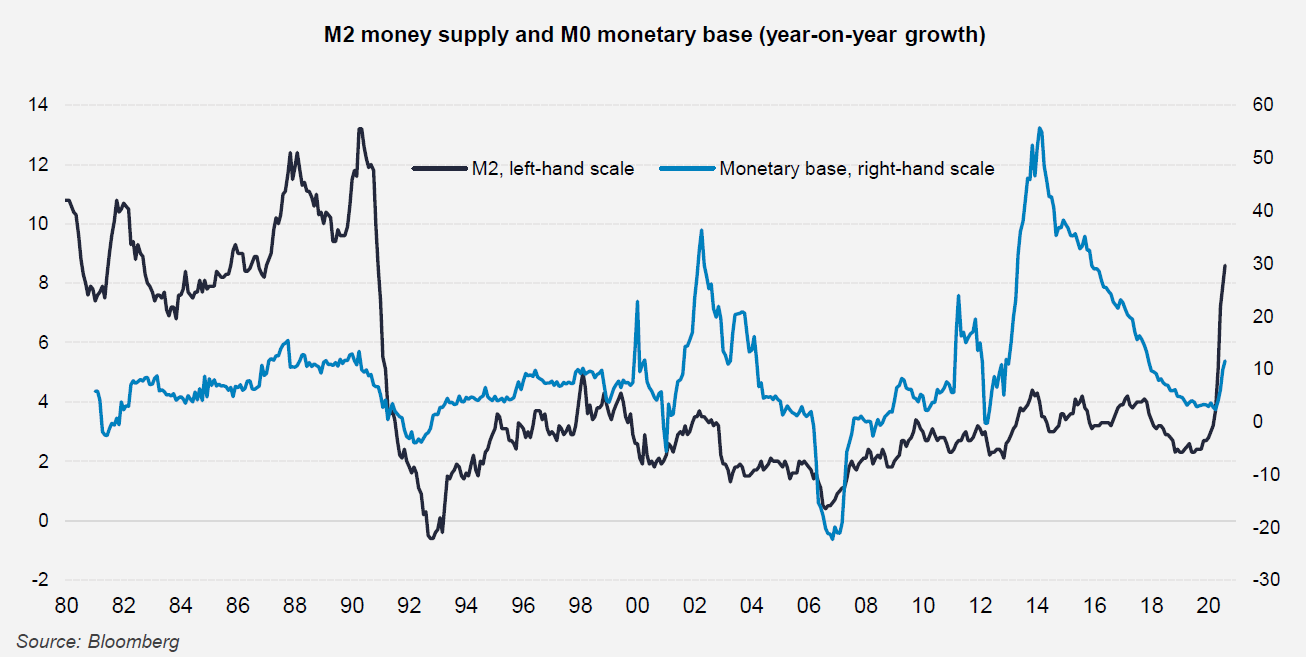
It's much more complicated than that. For example, "printing money" doesn't necessarily expand the money supply [1], since the money supply isn't composed exclusively of central bank-issued money. And then there are other variables at play.

[1] https://lazardfreresgestion-tribune.fr/wp-content/uploads/20...

Re: The Gold Standard and the Great Depression (1997)

#55

Earlier quoted context omitted.

The gold standard was abandoned because it is a terrible idea for civilizations that have technologies like accounting systems and currencies that are difficult to counterfeit. Tying economic expansion to the ability to mine and store one type of element doesn't make any sense. There are countless asteroids out there with quadrillions of dollars of precious metals. Does that mean the first private company to create a…

> Modern monetary theory is doing just fine, How's that gap between the rich and the poor going? Look, the US was on the gold standard between 1850 and early 1900s, and not only recovered from a civil war, but ALSO freed all of its slaves AND went from a backwater country to a world superpower, and reduced inequality all at the same time. https://voxeu.org/article/american-growth-and-inequality-170...

The gap is reported to be increasing, but is that actually regarded as a problem by the ruling class? They may actually prefer this, as it gives them greater chunk of power and secures their position.

In other words, the gap may be increasing and we don't like it, but this may very well be the intended "how is it going".

One case in point: in 1970's, instead of giving employees their share of profits from productivity increases, the system gave them an easy way to get into debt instead (the credit card).

Re: The Gold Standard and the Great Depression (1997)

#56

Earlier quoted context omitted.

"printing" money does not cause inflation. Low interest rates can cause credit expansion, they don't necessarily cause inflation. Inflation rate higher than the deposit interest rate (negative real interest rate) is causes the wealth transfer. "Savers", in reality, lenders have always had a way out in this situation: investing. As in every investment boom, there are Ponzi schemes and during this one it happens to be…

I don't understand how printing money could not cause inflation, it sounds like mental gymnastics to me. Expand the money supply without expanding the value that money represents and the money now represents less value than it did before, I don't see how that could ever not be the case.

> I don't understand how printing money could not cause inflation

Suppose the government prints one dollar and shortly thereafter everyone goes bankrupt and collapses the money multiplier. This will definitely result in net deflation.

OK, that's extreme, but it should prove a point in extremis. But it is possible that the government could print money and suddenly people stop... paying off their debts, or something. Maybe they start thinking that dollar-denominated-capitalism is pointless because it's all cronies that get it anyways, and just exit the economy. Or like, screwing the poor through inflation triggers some sort of revolution and all the banks selectively are levelled by anarchist activists.

So "printing money" could definitely cause deflation in some scenarios. You probably don't want to be participating in an economy that takes that turn.

Re: The Gold Standard and the Great Depression (1997)

#57

Earlier quoted context omitted.

I don't understand how printing money could not cause inflation, it sounds like mental gymnastics to me. Expand the money supply without expanding the value that money represents and the money now represents less value than it did before, I don't see how that could ever not be the case.

> Expand the money supply without expanding the value that money represents and the money now represents less value than it did before Prices are a function of money supply and velocity. Inflation can rage while no money is printed because velocity surges. Just as deflation can fester while central banks print as velocity toys with absolute zero.

Not only this, but it's also a matter of whether money supply expansion outpaces the growth of goods and services in the economy or not. As long as the growth rates roughly match, even without velocity decreasing, you wouldn't necessarily get inflation. It's way more complex than just "print money == inflation."

You want a little bit anyway. Simplistically, if all you have in your economy is 10 dollars and 10 hamburgers, then hamburgers will probably be worth something like a dollar each. If you go to 20 hamburgers but stay at 10 dollars, now hamburgers are worth $0.50, which is great for dollar holders, not so great for hamburger makers. A healthy economy, however, is not one in which actors are incentivized to hoard currency. You want economic actors to be incentivized to produce goods and services. If you grow to 20 dollars and 20 hamburgers, that is price neutral, but you don't really want price neutrality. You want it to be more lucrative to produce goods and services than to hoard currency.

There is some valid concern that this can harm retired savers, but we developed a solution to that a long time ago that doesn't require deflationary currencies. We split ownership shares of the companies that produce goods and services and trade them publicly so people can get a cut of the wealth growth without needing to become producers themselves. Retirees can own appreciating assets by buying stock in companies that make stuff, rather than holding their life savings as cash under a mattress.

Re: The Gold Standard and the Great Depression (1997)

#58

Earlier quoted context omitted.

> Modern monetary theory is doing just fine, How's that gap between the rich and the poor going? Look, the US was on the gold standard between 1850 and early 1900s, and not only recovered from a civil war, but ALSO freed all of its slaves AND went from a backwater country to a world superpower, and reduced inequality all at the same time. https://voxeu.org/article/american-growth-and-inequality-170...

The gap is reported to be increasing, but is that actually regarded as a problem by the ruling class? They may actually prefer this, as it gives them greater chunk of power and secures their position. In other words, the gap may be increasing and we don't like it, but this may very well be the intended "how is it going". One case in point: in 1970's, instead of giving employees their share of profits from productivit…

I'm not in the ruling class, so I would not say "monetary theory (modern or otherwise) is doing just fine". Perhaps nicoffeine is in the ruling class?

Re: The Gold Standard and the Great Depression (1997)

#59
post #49

Earlier quoted context omitted.

Some things are better hedges than others. Bitcoin happens to have been the best over the past decade. Edit: I'd argue this is because it has better monetary properties than the alternatives.

Do you even know what a hedge is? The perfect hedge against inflation is a large basket of consumer goods and services, because it correlates perfectly with inflation. Anything else correlates less perfectly with inflation and therefore is a worse hedge against inflation compared to a basket of goods and services.

You're talking about consumer price inflation, I'm talking about monetary supply inflation.

A basket of consumer goods and services is a nonsensical way to hedge monetary inflation under anything but the most extreme conditions, since those things should be getting cheaper as production processes/technology/understanding of the world improve.

Re: The Gold Standard and the Great Depression (1997)

#60

We are pre-great depression in many respects. Debt levels being at very high percentages. Income inequality out of control. Inflation out of control. Fundamentally as well it's the baby boomer's fault. Right before the great depression was when the boomers of the american civil war were retiring. The 1980s inflation and crashes were WW1 boomers and now is the WW2 baby boomers retiring. History repeats.

The United States at least is actively in a great depression. It's just being papered over with currency debasement so rich people don't notice. But if you actually visit parts of this country that are outside of the wealthy, coastal bubbles, you'll see first hand the real world devastation that's happening to people. It's why there's a major opioid epidemic in the Midwest. It's why homelessness is exploding. It's wh…

> It's just being papered over with currency debasement

It's also papered over by things like Norman Borlaug's agricultural revolution and supply chain innovation. Even with crappy broken supply chain, americans are not starving in the streets at depression-levels. But a whole lot of other stats support your hypothesis. Like mass exoduses from state to state.

Post reply on HN