Am I the only one twitching and reaching for Close Tab when the video labeled atmospheric air intake as "o2"?
A centrifugal spin on a 500-year-old air compressor design
51–60 of 64 posts
Re: A centrifugal spin on a 500-year-old air compressor design
#52Earlier quoted context omitted.
Fancy air compression systems (eg: not consumer) will have a drain valve that automatically opens when the pressure falls from turning system off for night/weekend/other maintenance so people don't forget to drain it. Its also not just water that is collected at the bottom of the air tank, compressor oil also collects. Oil can also be deliberately added by either as a byproduct of compressor design or from separate e…
About the only thing practical thing that valve does is perhaps lengthen the time fir the tank to rust out. Any serious industrial installation winds up with a refrigerated water removal unit.
Re: A centrifugal spin on a 500-year-old air compressor design
#53From the diagram, this seems like it wouldn't be terribly hard to DIY: you can take an off the shelf heat exchanger and a fan, then all you'd need is the centrifuge part and tubing for the pressurized gas. Would there be any special considerations in DIYing this that I'm overlooking? The only part that I can see being tricky is the centrifuge mechanism and sealing the bottom of that to a compressed air tube... not qu…
Building a DIY centrifuge is a great way to become a Darwin award candidate.
Re: A centrifugal spin on a 500-year-old air compressor design
#54Interesting. A few questions that come to mind: 1. What is the dew point of the compressed air? Many applications using compressed air require very dry air so as to avoid corrosion issues (e.g., air tools) as well as problems related to heating of water vapor (e.g., tires). For small applications, the dew point is reduced using simple traps, silica gel beads, or molecular sieves, but for even-drier air or larger appl…
300 bar air.. Are you filling scuba tanks? The wet air question is an interesting one. It seems like the compressed air would have more moisture in it than a piston-driven compressor, but at the same time having oil-contaminated air is problematic for moisture removal systems, especially dessicant-based ones. So you might need more thorough moisture removal, but with the dryer system having more life. As far as effic…
Re: A centrifugal spin on a 500-year-old air compressor design
#55Interesting. A few questions that come to mind: 1. What is the dew point of the compressed air? Many applications using compressed air require very dry air so as to avoid corrosion issues (e.g., air tools) as well as problems related to heating of water vapor (e.g., tires). For small applications, the dew point is reduced using simple traps, silica gel beads, or molecular sieves, but for even-drier air or larger appl…
Speaking as someone who uses compressors both for shops and breathing air - this is mostly non-interesting so far. For starters, 70db is actually pretty horrible. Indoor Scroll Compressors are around 47db (IE 100-1000 times quieter than the 70db mentioned here). They are completely oil-free and produce class 1/class 0 air. That is, you can use them to breathe from They are not as energy efficient as rotary screws, bu…
I am no expert here so I am making the assumption that perhaps the innovative part here has to do with using fewer moving parts than existent solutions, and potentially naturally producing cool dry compressed air without any oil mixed in. The idea of fewer parts/nothing but the air filter, belt, fan, maybe drum bearing to ever replace I’d quite appealing to someone who only has access to a pancake compressor that’s loud as all hell.
Re: A centrifugal spin on a 500-year-old air compressor design
#56Re: A centrifugal spin on a 500-year-old air compressor design
#57Re: A centrifugal spin on a 500-year-old air compressor design
#58Re: A centrifugal spin on a 500-year-old air compressor design
#59Earlier quoted context omitted.
Speaking as someone who uses compressors both for shops and breathing air - this is mostly non-interesting so far. For starters, 70db is actually pretty horrible. Indoor Scroll Compressors are around 47db (IE 100-1000 times quieter than the 70db mentioned here). They are completely oil-free and produce class 1/class 0 air. That is, you can use them to breathe from They are not as energy efficient as rotary screws, bu…
The trompe article goes into a bit more detail that might be of interest. You apparently modulate a trompe by changing the height of the intake and to some degree it’s diameter. I would assume that you modulate the Carnot device by changing the speed of the drum. I am no expert here so I am making the assumption that perhaps the innovative part here has to do with using fewer moving parts than existent solutions, and…
It's similar to some of the ways you see here: https://cascousa.com/compressed-air-101/types-of-compressors...
As for fewer moving parts and less maintenance, probably not gonna win on that. The state you want already exists. If you get a rotary screw, you are basically just going to replace oil and filters every so often until the air end dies. For a hobbyist, maybe never.
You might never run it for the 8000 hours the oil lasts or the filters last. If you ran it 3 hours a day, it would take 7 years :)
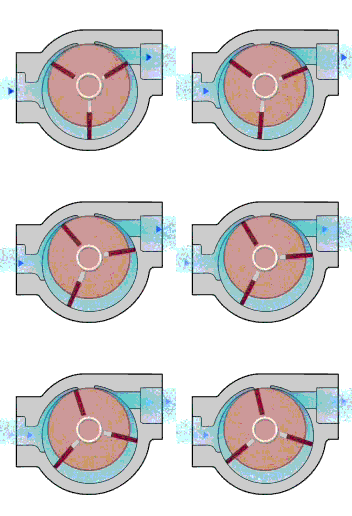
If you want simplicity and less moving parts, and the ability to fix them easily, you can get a rotary vane compressor.
They can't be modulated down as well using a VFD as you can a rotary screw (there is a minimal speed at which the vanes seal properly due to centrifugal force) , but they are ridiculously simple and have very few moving parts. They are also easily repairable.
Until it literally falls apart, you will just need to replace filters and oil every so often, and some carbon blades every so often (50k+ hours) or so of usage. The compressor itself will probably last 100k-200k hours, and so, again, for a hobbyist, may easily outlive you.
It's just a motor, connected to a slightly offset spinning circle with blades (so that as it rotates, the offset causes it to form progressively smaller chambers).
Looks like this: https://aircompressorworks.com/wp-content/uploads/2017/10/v-...
Re: A centrifugal spin on a 500-year-old air compressor design
#60Earlier quoted context omitted.
Cut a pipe on the back of a fridge and it'll run open circuit just fine. Doesn't make it appreciably louder. (beware, some fridge gasses are illegal to vent to the atmosphere, and others are pretty explosive)
> Cut a pipe on the back of a fridge and it'll run open circuit just fine Try to run a plasma cutter, or a 1" impact wrench out of a fridge compressor...
A modified fridge compressor could have 4x the capacity at 100psi and be suitable for a small workshop.