Live data from Hacker News

The computers are getting better at writing

newyorker.com

51–60 of 165 posts

Re: The computers are getting better at writing

#51

Earlier quoted context omitted.

> which is a surprisingly deep statement People used to say the same thing about Markov chains, and then the hype died down it took 20 years for another hypetrain to pull into the station. The same will happen with GPT-n. > says very uncomfortable things about the skill of humans in recognizing genuine creative significance. Indeed. People see pictures in clouds and omnipotent beings in the stars. Humans are uncomfor…

What applications are Markov chains used in now?

Kubernetes uses them to come up with random generated cluster names if you don't provide a name of your own..I bet many other applications use them in a similar manner
Re: The computers are getting better at writing

#52

Earlier quoted context omitted.

That's why no one is truly moved by a single phrase. We often quote memorable bits from larger works ("to be, or not to be"), but that quote is only memorable because the entire work makes us believe that it is not an accident.

I was by a famous 6 word poem: "For sale: Baby shoes. Never worn."

Sure, there are exceptions. And for those exceptions it may be fair to say that perhaps they were just a lucky stumble.

Even here I do wonder how well this poem would be remembered if it weren't associated with Hemingway.

Re: The computers are getting better at writing

#53
post #16

Earlier quoted context omitted.

Deep statements are deep because the communicate feeling, if the machine never felt anything but tripped over meaning like this (and it's pretty obvious it's just gluing things together) it really dulls the effect.

Who’s to say that our greatest writers didn’t “trip over meaning”? A lot of poetic processes involve finding, curating and re-contextualizing interesting phrases (see found poetry), and there’s potentially a lot of value in applying the same process to computer-generated writing.

I am wondering if we call some writers great because of what they did not, could not or cannot express (anymore). By their limited and graspable existence they serve as targets for our projections, whereas an AI is less attractive for that purpose, at least in my view.

I'd rather think about the authors of AIs, their assumptions and their worldview.

Re: The computers are getting better at writing

#54
post #48

Rewinding a bit from computers doing all the writing, are you using any tools that help you write considerably better (not just spelling/punctuation checking)? As a non-native English speaker I would like to have a tool that points out my nonstandard usages of language. I think it could be something as simple as parsing the text and searching it against a corpus, but I have no idea how many "unique structures" a text…

As a fellow non-native who accepted not to strive for full assimilation, my suggestion is to do the same. You can refine your writing by reading a lot. Books like “The elements of style” and “On writing well” can help with grasping those structural elements you might be struggling to identify. Apart from that, our brain has been shaped by our native language, and we can’t really delete that. Which is great news! It means we can express concepts in English with structures and flows that, if grammatically correct, have the advantage of sounding original, different, sometimes exotic.

One tool I use is Grammarly. I think it’s mostly crap, but if used properly it helps you identify the more blatant mistakes. Oh, and by the way, if you need a non-native speaker ego booster, try and read native speakers’ first drafts of anything.

Re: The computers are getting better at writing

#55
post #33

GPT-3 is already better than most blog comments, many bloggers, and most online text porn. Maybe most ad copy. Many pundits. Some college professors. It has no clue what it's talking about, of course. It's terrible at fact-based material, because what comes out looks plausible, but contains made-up facts. Some facts will be correct, because they were mentioned a few times in the training database. Others are just pla…

> What it really demonstrates is that much of literature has less behind it than was previously supposed.

I'm uncomfortable with this statement because GPT-3 is in a sense copying or sourcing a massive corpus of human literature to use as the paint on its brush. If it can make a sentence that sounds Shakespearean after performing a statistical analysis of all sentences ever written by Shakespeare and using fancy averages and weightings of those sentences, how does that diminish the value of Shakespeare? In a wider sense, isn't that what's happening, but instead of using every sentence written by Shakespeare the goal is to use every sentence ever written?

That said, how GPT-3 and its descendants affect the market value of "literature" is... sorry I can't resist... a story yet to be written.

Re: The computers are getting better at writing

#56
post #33

GPT-3 is already better than most blog comments, many bloggers, and most online text porn. Maybe most ad copy. Many pundits. Some college professors. It has no clue what it's talking about, of course. It's terrible at fact-based material, because what comes out looks plausible, but contains made-up facts. Some facts will be correct, because they were mentioned a few times in the training database. Others are just pla…

I expect GPT-3 to be amazing for people who want to write stories or articles but are really terrible at one specific aspect of the writing process.

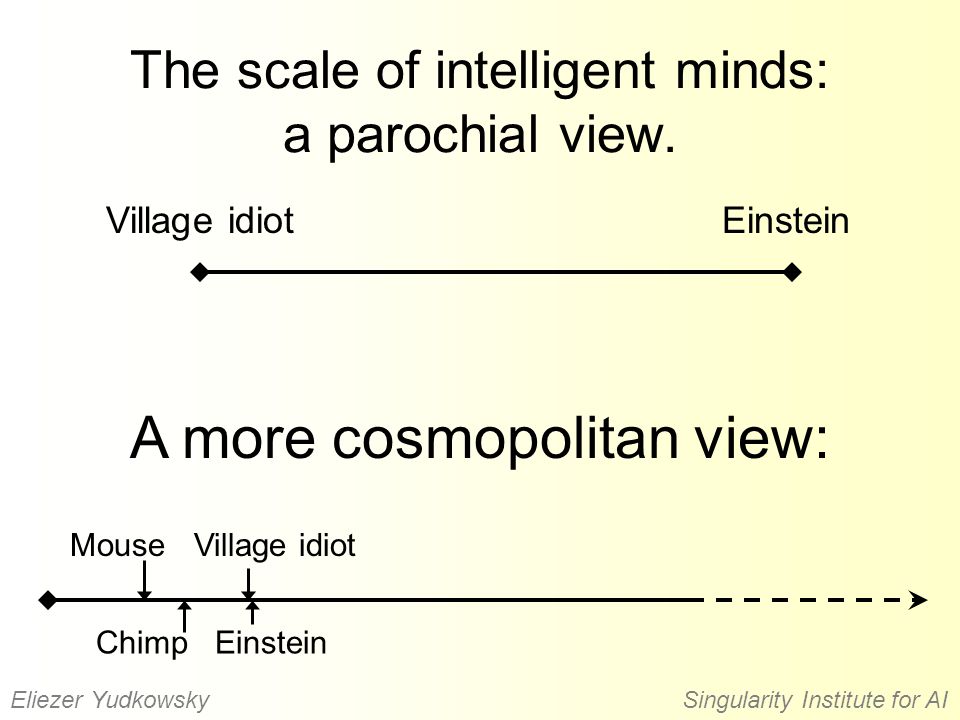
https://slideplayer.com/slide/6081467/18/images/12/The+scale...

It depends on if you think writing ability is more like the top graph, or the bottom graph. If it's like the top graph, humans have plenty of time to adopt AI tools, and incorporate them into the writing process.

If it's like the bottom graph, then GPT-4 comes out in 12 months and is human equivalent, and GPT-5 comes out a year after that and is a better writer than any human could hope to be.

Re: The computers are getting better at writing

#57
post #48

Rewinding a bit from computers doing all the writing, are you using any tools that help you write considerably better (not just spelling/punctuation checking)? As a non-native English speaker I would like to have a tool that points out my nonstandard usages of language. I think it could be something as simple as parsing the text and searching it against a corpus, but I have no idea how many "unique structures" a text…

prowritingaid has a very good, free, web-based tool that will parse out all sorts of neat things in your work. for example: i write fiction and have a real problem with “echos” — words that i repeat within a certain distance of each other — and i even miss them when proofing/editing. pwa is a godsend for this. if scrivener would add their own native version of this (hint hint incase any of you L&L people lurk here.. and it would take ten lines of java that i’d give to you for free) i would be completely covered for a word processor.

on the other side, the desktop version is expensive and needs some ui work badly. they say it’s ai-based, but it feels more like a reason to drm the product than anything. still, the free version is excellent for my limited use scope, so i hope you’d have some luck with it too

the other thing to try and do is find someone that you would use as a language buddy. there’s a subreddit (i forgot the name) where people look to pair with others who are looking for/offering certain language combos, then you get on imessage/whatsapp/whatever and use each other as a language bot. right now i’m looking for someone who speaks mandarin or cantonese and needs someone who speaks english, so if that’s you op, hit me up

Re: The computers are getting better at writing

#58
post #48

Rewinding a bit from computers doing all the writing, are you using any tools that help you write considerably better (not just spelling/punctuation checking)? As a non-native English speaker I would like to have a tool that points out my nonstandard usages of language. I think it could be something as simple as parsing the text and searching it against a corpus, but I have no idea how many "unique structures" a text…

As a fellow non-native who accepted not to strive for full assimilation, my suggestion is to do the same. You can refine your writing by reading a lot. Books like “The elements of style” and “On writing well” can help with grasping those structural elements you might be struggling to identify. Apart from that, our brain has been shaped by our native language, and we can’t really delete that. Which is great news! It m…

That's a good point of turning your native language into an asset. The goal of communication is to be well-understood. That's so easy to forget that and strive for something more. Good writing also keeps the readers engaged, maybe entertained, but is there much more to that?

Re: The computers are getting better at writing

#59
post #35
post #3

I have been doing a lot of writing lately, short and longer essays. I have also written on-and-off for the last ten years. Writing well is not easy. I used to think I wrote well until I started reading better writers. The whole idea that we will just slap together a bunch of text using some “AI” and it will resonate with people is crazy to me. As an engineer whose dabbled with some AI and ML, and has even seen what G…

we are as far away from being able to use AI to write a best seller as we are from landing on the Sun. Harlequin Romances, though, those little soft-core porn pamphlets for women found at supermarket checkouts, could probably be generated. There are about 4,000 of them, and they're written to a set formula - “Boy meets girl, boy loses girl on page 56, and, by page 180, the book would end with a marriage proposal.” Lo…

AI is pretty far away from those, too. The "window" mechanism that GPT-3 and similar methods use basically prevents it from staying on-topic over the course of a few paragraphs.

Re: The computers are getting better at writing

#60

Earlier quoted context omitted.

> which is a surprisingly deep statement People used to say the same thing about Markov chains, and then the hype died down it took 20 years for another hypetrain to pull into the station. The same will happen with GPT-n. > says very uncomfortable things about the skill of humans in recognizing genuine creative significance. Indeed. People see pictures in clouds and omnipotent beings in the stars. Humans are uncomfor…

And other people reward those findings with money. Good writing is hard. Writing that evokes emotions in others is even harder.

It is extraordinary rare to ear money by writing. It may be hard, but people dont reward it with cash.
Post reply on HN