Live data from Hacker News

Neuroscientists discover molecular mechanism that allows memories to form (2020)

news.mit.edu

51–60 of 88 posts

Re: Neuroscientists discover molecular mechanism that allows memories to form (2020)

#51
Article does a pretty terrible job at explaining how memory's are formed, some bits even misleading.

If you're interested in the biological basis of memory, I suggest reading 'In search of memory' by Eric Kandel. It's a biographic tale of Eric Kandel winning his nobel and along the way you learn a ton about how the brain works.

Re: Neuroscientists discover molecular mechanism that allows memories to form (2020)

#52
post #50

Earlier quoted context omitted.

So, isn’t the nature of memory in the brain still understood pretty vaguely? The “memory is connections and involves the whole brain” is still kind of a hypothesis and less of a hard, empirically-validated theory, no? May still be the best idea we have, but from what I understand (which isn’t much), it’s not nearly that cut and dry and we don’t really know enough to exclude a lot of the other models of memory formati…

There's no single concept of nature that's understood completely. For example, there are a lot of things still understood pretty vaguely about milk. Or apples. So you can say that about pretty much anything.

>There's no single concept of nature that's understood completely. For example, there are a lot of things still understood pretty vaguely about milk. Or apples. So you can say that about pretty much anything.

But that is practically untrue (I'm not just saying there are corner cases, but that the main topic is still very poorly understood) and a cop-out.

And yet I can speak concretely about a hydrogen atom. Or even photosynthesis. Or DNA.

In DNA, there are 4 base pairs. We can see how that maps to RNA and how that in turn codes to amino acids. (and exceptions exist to these things, but we have a pretty strong grasp on it.) We can even try to fold the resulting Amino Acids into shapes, although it's computationally very difficult to do so. So data storage within a cell has some concrete understanding. Empirically validated and useful (this is how we were able to engineer the mRNA vaccines).

Our knowledge of memory, our knowledge of data storage in the brain is far less concrete. And not just because it's not thought to be precisely molecular like DNA or RNA (although perhaps it could be!) but we have a poor grasp of even where, precisely, information is stored in the connections. Like, sure, you can say it's not stored in a particular location in 3D space, but there must be some transformation, some (non-euclidian) representation of the connections where memories CAN be located. Because our brains are capable of recalling memories on demand. But we have only a vague understanding of how that all occurs. It's very unlike DNA or RNA or whathaveyou in that our understanding is still primitive and vague.
Re: Neuroscientists discover molecular mechanism that allows memories to form (2020)

#53

I often wonder why universities post these press releases for the general public. Epigenetic modifications and memory is still basic research in early investigation, known to play a role in memory extinction and reconsolidation for example, but this is still too early research to make any concrete announcements that would have actionable information, esp. for the general public.

To let the public known they are making progress and get/keep them excited so that they can keep getting funding. Also to attract the students and staff they want.

Re: Neuroscientists discover molecular mechanism that allows memories to form (2020)

#54
post #50

Earlier quoted context omitted.

There's no single concept of nature that's understood completely. For example, there are a lot of things still understood pretty vaguely about milk. Or apples. So you can say that about pretty much anything.

>There's no single concept of nature that's understood completely. For example, there are a lot of things still understood pretty vaguely about milk. Or apples. So you can say that about pretty much anything. But that is practically untrue (I'm not just saying there are corner cases, but that the main topic is still very poorly understood) and a cop-out. And yet I can speak concretely about a hydrogen atom. Or even p…

> And yet I can speak concretely about a hydrogen atom

You can talk about some abstractions about how a hydrogen atom works, but we don't fully understand everything about atomic structure. We don't know if there is something that makes up the structures of subatomic particles becuase we don't have particle accelerators that have enough energy for us to peer deeper into what quarks are made up of. We don't even know if we've found all the types of particles.

Re: Neuroscientists discover molecular mechanism that allows memories to form (2020)

#55
post #19

Maybe one day we'll have pills to have total recall for a few hours, wouldn't that be cool for exams and learning languages ? I much prefer that than a chip in my head which the silicon valley seems super keen on selling me.

My memory is generally terrible. One discovery that was alarming, encouraging and disturbing at the same time is that I do appear to have some form of nearly total recall buried in there somewhere. Unfortunately it only surfaces in one way. If I listen to a podcast while I’m doing something, then listen to that same podcast again within a week or so, I will have regular, intrusive visual recall of exactly what I was…

That's sort of fascinating- it reminds me of how the ancient romans used to memorize long epic poems etc (walking around and making visual/spatial associations, then recalling their travel to recite it later. I might be butchering that a bit but that's how I understood the method)

Re: Neuroscientists discover molecular mechanism that allows memories to form (2020)

#56
post #32

It is really cool we're getting (slightly) closer to the understanding how memories work. It is still basic research, but if I understand the significance of this correctly having a confirmation there are specific physical changes neurons undergo when forming some kinds of memories allows at least theoretically extraction of those memories from pieces of inactive tissue. As a layman in the subject I've been always ve…

I'd argue that the line between software and hardware isn't as clear in neuro as someone with an IT background would like to think, specifically because the electro-chemical activities going on are both, hard and soft, at the same time. This isn't some abstract process running on a biological computer, the biological computer is the sum of the processes that constitute itself. (That's the fascinating thing about bio)…

I have a background in both. Both are implemented in physical mediums. The gating and current flow are similarly physical as are magnetic field changes on disk mediums. There is a greater diversity in the brain which uses field effects ala hormones, ion movement, transmitter diffusion, and direct electrical connection. The physical/informational duality is present in both so I would suggest that the building out of the hardware using the ambient materials (i.e. trophic factor) is the more specific difference you're looking for rather than the duality.

You transition to a difference in encoding which is a significant but separate consideration. I think the thrust of your statement agrees with the science but quickly nice into speculation and undue specificity that to me reads as though you are declaring fact. Language and good communication are hard.

Re: Neuroscientists discover molecular mechanism that allows memories to form (2020)

#57

Earlier quoted context omitted.

>There's no single concept of nature that's understood completely. For example, there are a lot of things still understood pretty vaguely about milk. Or apples. So you can say that about pretty much anything. But that is practically untrue (I'm not just saying there are corner cases, but that the main topic is still very poorly understood) and a cop-out. And yet I can speak concretely about a hydrogen atom. Or even p…

> And yet I can speak concretely about a hydrogen atom You can talk about some abstractions about how a hydrogen atom works, but we don't fully understand everything about atomic structure. We don't know if there is something that makes up the structures of subatomic particles becuase we don't have particle accelerators that have enough energy for us to peer deeper into what quarks are made up of. We don't even know…

Actually, we do fully understand everything about the atomic structure of the hydrogen atom, everything relevant to chemistry and how life (for instance) works. If we have not yet unified the fundamental forces, that doesn't mean we don't have an INCREDIBLY detailed and complete understanding of the hydrogen atom.

Corner cases in several layers lower than chemistry vs not even really knowing where a memory is stored!

Re: Neuroscientists discover molecular mechanism that allows memories to form (2020)

#58

Earlier quoted context omitted.

> And yet I can speak concretely about a hydrogen atom You can talk about some abstractions about how a hydrogen atom works, but we don't fully understand everything about atomic structure. We don't know if there is something that makes up the structures of subatomic particles becuase we don't have particle accelerators that have enough energy for us to peer deeper into what quarks are made up of. We don't even know…

Actually, we do fully understand everything about the atomic structure of the hydrogen atom, everything relevant to chemistry and how life (for instance) works. If we have not yet unified the fundamental forces, that doesn't mean we don't have an INCREDIBLY detailed and complete understanding of the hydrogen atom. Corner cases in several layers lower than chemistry vs not even really knowing where a memory is stored!

> Actually, we do fully understand everything about the atomic structure of the hydrogen atom,

Not sure where that hubris comes from. There are physical phenomena we have not been able to test, so there will always be unknowns and assumptions based on (abstract) modeling. eg the metallic liquid hydrogen described here https://edu.rsc.org/soundbite/hydrogen-falls-apart-under-pre...

Re: Neuroscientists discover molecular mechanism that allows memories to form (2020)

#59

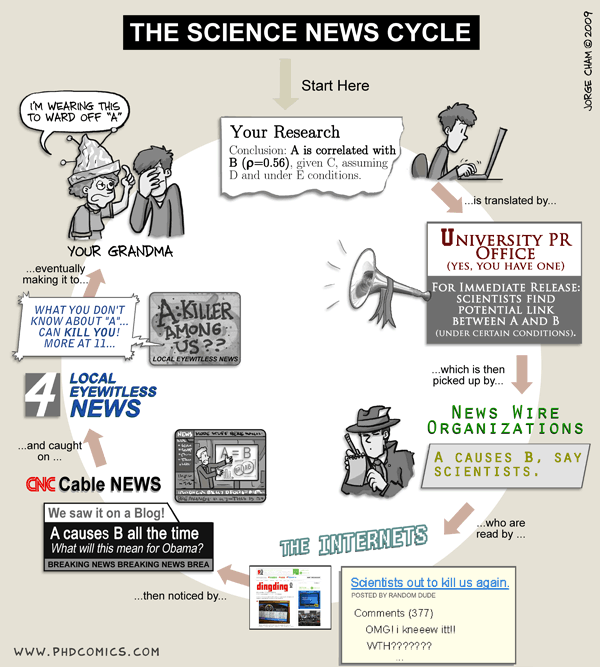
I often wonder why universities post these press releases for the general public. Epigenetic modifications and memory is still basic research in early investigation, known to play a role in memory extinction and reconsolidation for example, but this is still too early research to make any concrete announcements that would have actionable information, esp. for the general public.

A classic illustration of the science news cycle:

http://phdcomics.com/comics/archive/phd051809s.gif

(sorry for plaintext URl, poating from phone and can't recall what the HN markup is for a link.)

Re: Neuroscientists discover molecular mechanism that allows memories to form (2020)

#60

Earlier quoted context omitted.

Actually, we do fully understand everything about the atomic structure of the hydrogen atom, everything relevant to chemistry and how life (for instance) works. If we have not yet unified the fundamental forces, that doesn't mean we don't have an INCREDIBLY detailed and complete understanding of the hydrogen atom. Corner cases in several layers lower than chemistry vs not even really knowing where a memory is stored!

> Actually, we do fully understand everything about the atomic structure of the hydrogen atom, Not sure where that hubris comes from. There are physical phenomena we have not been able to test, so there will always be unknowns and assumptions based on (abstract) modeling. eg the metallic liquid hydrogen described here https://edu.rsc.org/soundbite/hydrogen-falls-apart-under-pre...

It comes from the unreasonable effectiveness of quantum electrodynamics. That we predicted a metallic state of hydrogen (a sort of molecular, not atomic, structure) under an extreme corner case (extreme pressure) over 80 years ago (well before it could be experimentally verified) just highlights what I mean.

And I don’t mean to say that neuroscientists are doing shoddy work. Far from it! The brain is a far more complex entity than RNA or a hydrogen atom. The task is MUCH harder! But I am showing that high level of specific, concrete knowledge IS possible in the physical sciences. Memory in the Brain is a physical process as well, but we have only a relatively vague understanding of the specifics of it. We can sequence DNA or RNA accurately with relative ease. We cannot do the same with memories in the brain.

Post reply on HN