There are many problems with mainstream ideas about inflation, but one key problem is that it does not take into account the disastrous decline in the quality of public services that Americans have experienced over the last couple of decades. How do you measure the inflationary impact of the fact that in many cities, the public schools have declined in quality so much that people are faced with the choice of either moving to the suburbs, or paying for private school? What about the impact of the transformation of the built landscape from nice walkable towns to disgusting exurban sprawl?
Inflation Truthers
51–60 of 99 posts
Re: Inflation Truthers
#52There are many problems with mainstream ideas about inflation, but one key problem is that it does not take into account the disastrous decline in the quality of public services that Americans have experienced over the last couple of decades. How do you measure the inflationary impact of the fact that in many cities, the public schools have declined in quality so much that people are faced with the choice of either m…
Yet, We are spending more on public schools than virtually any time in American history.
Re: Inflation Truthers
#53One gotcha about how inflation is calculated (at least in Germany, I assume it to be the same in the US), is that they try to compare identical products. So if this years cars do not have air conditioning, but next years cars do, the prices can increase accordingly without showing up as inflation, because you are getting "more car for more money". The problem appears at the point, when there are no cars without air c…
I once read an article that claimed official statistics radically over-estimated how healthy US manufacturing was - because the official statistics considered a factory making CPUs with 16MB cache to have 1000x the output of a factory making CPUs with 16kB cache.
Re: Inflation Truthers
#54I found the “Price Changes” graph about 2/3 down the page really alarming. Virtually all of the gains in the form of lowered prices are purely in discretionary consumption and subsistence goods. Cheap entertainment, toys, staple foods. Meanwhile the insane price increases are in critical needs, medical care, housing, college education. In my mind that graph is pretty strong evidence that there really is massive infla…
The price elasticity of higher education is 0, and healthcare is also very low. We see my more inflation in things that we're not willing to go without.
Re: Inflation Truthers
#55Based on recent sales, our house has been appraised in the low $700,000 range for the last few years. We just put it up for sale and received three offers. $1,025,000, $1,030,000, and $1,050,000.
I’d say something is going on with home prices.
Re: Inflation Truthers
#56I think the author is confused about what inflation is, vs the benefits reaped from the advancement of technology. The author also seems to have a bias against the people screaming "inflation". That is pretty obvious from the title. To show real inflation, I like using the Burger King whopper as an example. In the early 90's I remember being able to buy 4 whoppers for $1. With the advancement of farming technology, transportation technology, preservation technology, etc.... Why do we see the whopper cost over $7 now?
Re: Inflation Truthers
#57“Cars last longer, require less fuel to operate and are better for the environment.” That emissions chart looked good. Half as much as 1970. Too bad we have 5 times as many vehicles There were 250 million vehicles in the world in 1970. 1.3 billion today and we’re projected to go to 2 billion by 2035. https://en.m.wikipedia.org/wiki/Motor_vehicle#Ownership_tren...
Also, all those changes were wrought by government fiat, and have been accomplished almost completely by reducing the weight of the cars, not by quality improvements as the article implies.
>have been accomplished almost completely by reducing the weight of the cars
This is entirely false. All the work in materials to make cars lighter has been countered by added amenities (from power seats all the way to chilled cupholders), additional safety measures (extra airbags), and (in the U.S. at least) shifting preferences toward trucks and SUVs.
From the first google result on the subject, slate: "The average new car weighed 3,221 pounds in 1987 but 4,009 pounds in 2010."
Much of efficiency gains are coming from improved engines which have better control of the combustion process to make sure fuel burns more completely and less energy is wasted, or in other words, engines are better quality.
Re: Inflation Truthers
#58On one hand, he's not wrong, overall inflation for 2020 was on par for a normal year, we're not headed into hyperinflation territory just yet. But you also have to realize that some people are affected quite a bit harder by the crazy shifts in deflated and inflated costs this year.
https://inflationdata.com/articles/wp-content/uploads/2020/1...
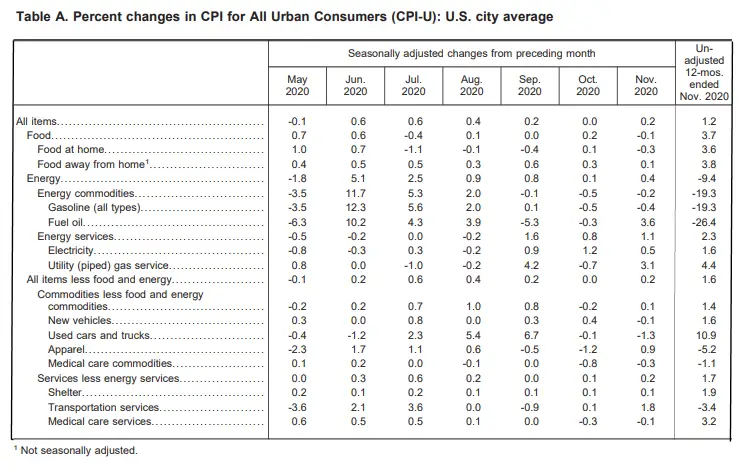
Look at the breakdown of the line items that make up the US inflation rate for 2020 and you see that the massive drop in fuel cost (-19%) caused a massive offset to the overall number. Meanwhile food cost has gone up over 3%, medical expenses also went up over 3%. As we head out of this hell hole it will be interesting to see if inflated sectors return to more normal levels again.
Re: Inflation Truthers
#59It's a bit confusing what he's arguing against. But his 2nd-last graph is the good one, [1]. That's only 20 years but [2] is the same thing since 1950. Some things have become much cheaper, other things have become more expensive. Attempting to summarize that in one number seems like it hides more than it exposes, no matter what number you pick. [1] https://awealthofcommonsense.com/wp-content/uploads/2021/01/... [2]…
The thing he's arguing against is the Chicago/Austrian school of economics, whose response to just about every monetary policy measure is "But inflation!" UBI would cause inflation; raising the minimum wage would cause inflation; worker protections would cause inflation; government borrowing causes inflation. That kind of economics gained popularity in the 1970s, when inflation caused genuine hardship. It left a kind…
> especially among people who have money, because inflation erodes the value of savings.
What? Wealthy people don't buy CDs. They tend to invest heavily in assets. Often, these are leveraged assets like real estate or equities in a margin account.
NOTHING makes the rich richer like inflation. Reducing the burden of low-interest mortgage or margin debt whilst boosting earnings in equities.
Meanwhile, the poor still pay 20%+ on credit cards used to buy food that gets more expensive every year, and see annual rent increases from their landlord.
There's a reason that CNBC cheerleaders absolutely love ZIRP, and it's not because it helps the downtrodden poor.
Re: Inflation Truthers
#60I think the author is confused about what inflation is, vs the benefits reaped from the advancement of technology. The author also seems to have a bias against the people screaming "inflation". That is pretty obvious from the title. To show real inflation, I like using the Burger King whopper as an example. In the early 90's I remember being able to buy 4 whoppers for $1. With the advancement of farming technology, t…
> In the early 90's I remember being able to buy 4 whoppers for $1.
The simple answer is that your memory is wrong, and that at no point in the 1990's were you able to buy 4 Burger King Whoppers for $1. Other than your recollection, do you have any evidence that this price is correct? Or have I missed a layer of hyperbole in your argument?