This track by BT was written entirely in Csound and is one of my favourite pieces of electronic music: https://www.youtube.com/watch?v=ve8WaGmyhfI
Csound: A sound and music computing system
51–60 of 94 posts
Re: Csound: A sound and music computing system
#52There's also ChucK from Princeton which I find more intuitive than Csound or alternatives such as Supercollider. Much smaller community that Supercollider, though, I guess. https://chuck.cs.princeton.edu/
Re: Csound: A sound and music computing system
#53How does something like sonic-pi or tidal cycles compare with this? I wanted to try those out since they look fun and accessible. http://sonic-pi.net/ https://tidalcycles.org/
I remember trying to install Tidal Cycles a few years back and having some difficulty - IIRC it's a library that requires other components/config. Same for Overtone [1] (Clojure frontend to SuperCollider), it took a bit of time to configure Leinengen at first.
Cabbage [2] interface to CSound would probably be closest to Sonic Pi, rather than straight CSound iteself.
Also worth investigating is Pyo [3] - a Python interface to DSP code written in C.
So many interesting (and free) choices - it really just comes down to your language preference. I make a lot of music in DAWs like Ableton Live & Apple Logic, but I have some fairly original, very specific ideas around exploring pitch, rhythm & harmony that a text-based language is better suited for.
Re: Csound: A sound and music computing system
#54I appreciate that the title of this post calls it a "sound and music computing system" rather than a "musical programming language". In truth, Csound is more of a text-based modular synthesis environment than a programming language.
As others have said, the orchestra syntax is a bit strange at first, but you do get used to it. Writing Csound code feels more like patching a modular synthesizer rather than writing a computer program. It's basically a DSL for connecting small sound/signal modules (called opcodes) together. Most of the time one thinks about things in terms of signal flow and not computer logic. A common mistake I see new Csounders make is to immediately reach for the conditional statements and loops. They often don't behave the way you expect, so people get frustrated.
The Csound dev team has a very strong emphasis on backwards compatibility, to the point where the older opcodes do not get bugfixes in case someone is exploiting the bug in the compositions. The programmer in me groans a little bit, but the composer takes great comfort in the fact that pieces I write now will be playable for many years or even decades (some of the Csound test pieces, like Trapped In Convert by Richard Boulanger or Xanadu by Joeseph Kung, are over 30 years old and still run).
I've been told that many works written in MusicN languages (a precursor to Csound) have been ported to run in Csound, which means that the legacy of Csound includes computer music written in the 60s! I wish I knew where to find those, as I quite enjoy computer music history.
Re: Csound: A sound and music computing system
#55Earlier quoted context omitted.
This has got to be one of the sickest burns I've ever seen.
I'm not trying to burn anyone. The people who make the project really care about it and have put a lot of effort in it. I personally am just too stupid to figure it out. I think like Haskell and R it's designed for a different profession so to people like me who are programmers first I am scratching my head the whole time. I can do some thing in it, yeah eventually, usually... The documentation appears complete and I…
Re: Csound: A sound and music computing system
#56Earlier quoted context omitted.
I honestly find it way way easier to do FFTW manually in C and then convert the output with ffmpeg then use supercollider, like by a significant number of orders of magnitude. I've given sc 5 years, usually I'll try to use it, give it a few days of effort to do what I want, then give up, rewrite what I want in C, and be done with it in an hour Some people love it. More power to them. I wish I was one of them
This is exactly my experience with both sc and Csound. (And Max too, for different reasons.) Csound is based on a synthesis paradigm that dates back to the very first computer music experiments. It started life as a microcomputer implementation of Music 11, which was based on Music IV, which dates back to the 60s - and it hasn't moved on from there. Meanwhile sc is a masterpiece of software development - a smooth and…
As a resident of both Davis and Berkeley, CA I've heard a lot of stiff academic music made in Max/MSP on UC campuses, though I'd say UC Davis' Bob Ostertag is the notable exception - really compelling stuff - but that's because he's using at as an expressive musical instrument.
But still, these environments hopefully provide a DSL/interace that abstracts away some of the complexity of bare-metal C or C++ code; and non-PhDs like Autechre, Squarepusher, Aphex Twin, BT, Leafcutter John and Christopher Willits have made great-sounding things with them. And these tools are often used by professional audio developers to quickly prototype DSP algorithms.
Re: Csound: A sound and music computing system
#57I think most have moved on to supercollider or puredata. A proprietary but much more approachable and functional offshoot is Max/MSP.
Have you used it? I usually don't use proprietary software but I've been thinking of giving it a go. Supposedly bitwig has a language as well but I haven't used it either
REAPER is probably the most-scriptable DAW of all, with an API using EEL, Lua, and/or Python. [4]
[1] https://www.kvraudio.com/forum/viewforum.php?f=268
[2] https://www.bitwig.com/en/community/learning/grid-lets-build
[3] https://julienbayle.studio/PythonLiveAPI_documentation/Live1...
Re: Csound: A sound and music computing system
#58Earlier quoted context omitted.
I'm not trying to burn anyone. The people who make the project really care about it and have put a lot of effort in it. I personally am just too stupid to figure it out. I think like Haskell and R it's designed for a different profession so to people like me who are programmers first I am scratching my head the whole time. I can do some thing in it, yeah eventually, usually... The documentation appears complete and I…
Do you have any recommendations for learning sound synthesis and such (for the purpose of music production) for those who are, as you say, programmers first? Most the materials I’ve found teach using Csound, PD, SC etc (understandably), and that’s always a bit off-putting to me and appears as another obstacle / headache, so the projects get shelfed more quickly. I’ve begun reading Miller Puckett’s book Theory and Tec…
You can make midi interfaces in Python and plugins in LADSPA and other things with Jack ... lots of programs are fairly extensible these days.
so for instance, instead of a physical instrument connected to a usb port, your software is feeding the midi input into some other software, say something simple like seq42 (https://github.com/Stazed/seq42)
Synthesizers have some interesting things too. https://zynaddsubfx.sourceforge.io/ uses an XML format for its synthesis definition. It also has "learnable midi" as in parts of the interface can be instrumented from a midi controller - so you turn a knob in physical space and it turns in the software accordingly.
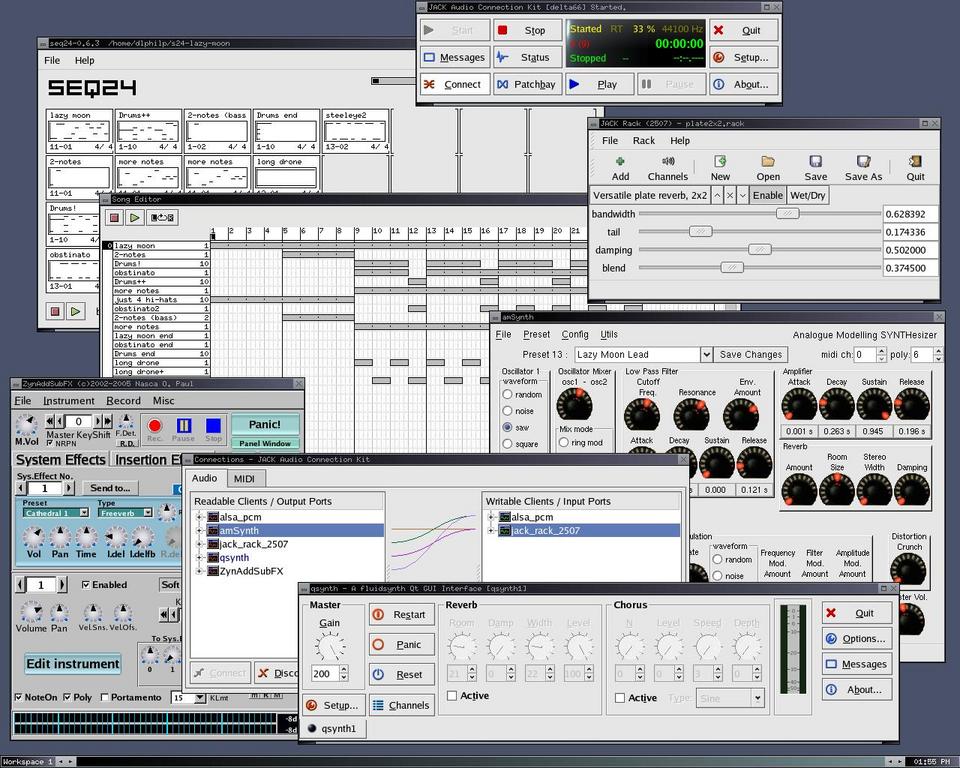
So let's go back to the previous part, the part about software defined midi. You can now emit the mutation of the sound and the sound itself into software like that. Here's a 2005 linux journal article with a screen shot (https://www.linuxjournal.com/files/linuxjournal.com/linuxjou...) essentially the stack I just said. https://www.linuxjournal.com/article/8304 ... "2005" you say? yeah, old pianos also still work.
The linux space is littered with generic audio tools that don't really work on their own and must be pasted together with other tools in order to get anywhere, much like in the shell. I did a bit of editing on the linux audio wiki about 3 years ago, it's probably the best place to look: https://wiki.linuxaudio.org/wiki/introduction
It's still just a bunch of hacks on top of hacks. Things break all over the place and latency is a bitch ... I dunno, there's a lot out there.
Re: Csound: A sound and music computing system
#59I think most have moved on to supercollider or puredata. A proprietary but much more approachable and functional offshoot is Max/MSP.
Puredata and Max/MSP are great, but programmed in a visual dataflow style rather than a source-code style. Imo that makes some things much more intuitive and other things really complex. The visual dataflow style is especially good for interactive stuff, where you're taking inputs and running them through chains of synths and filters, but it gets really hairy if you want to do non-interactive composition. People use…
I'm not sure what you're referring to. Pd has a whole category of control objects for routing arbitrary message data. This includes branching and looping in zero logical time.
Re: Csound: A sound and music computing system
#60Long-time user of Csound, Max, and Pd (& have spent a little time with ChucK & Supercollider). Max & Pd are fantastic for incorporating sensors & other physical interfaces, real-time interactivity, routing signals, creating visualizations, & all that. Supercollider is fantastic for generative music & using control flow compositionally. Csound, on the other hand, is really, really great for creating beautiful & nuance…
wondering if you have any favorites that you can recommend.