Live data from Hacker News

Anatomy of a Mechanical Keyboard (2018)

drop.com

51–60 of 108 posts

Re: Anatomy of a Mechanical Keyboard (2018)

#51
I wonder if this is the audiophile equivalent of computer enthusiasm.

I mean, like audiophiles buying gold cables for 10x the price and no reason, and using 20's tech (vacuum tubes) in their amps, selecting individual tubes and all that...

So here the keyboard enthusiasts select their switches, key curvatures, materials, etc. and the result might just be some placebo feel good improvement and more noise for everyone else.

Re: Anatomy of a Mechanical Keyboard (2018)

#52
post #8
post #2

You'd think that with the DIY freedom people would be making Kinesis Advantages and slapping touchpads in the middle. But no, somehow it's the same old flat boards for arms that grow out of the chest and fingers that extend out of the hand instead of rotating on joints; with the typewriters' staggered layout that makes no sense on electronic keyboards. Only now they're a couple centimeters higher so the wrists are ev…

https://ultimatehackingkeyboard.com/ As soon as the trackpoint modules are complete this will be the dream for me.

I have one. It’s sweet even without the modules, can always order them later. I consider it one of those few perfect purchases. Only issue in 1/2 year: I thought the cool coiled cable was too short so i bought a straight replacement cable for 5€.

Re: Anatomy of a Mechanical Keyboard (2018)

#53
post #39

Earlier quoted context omitted.

If you compare a piano with a standard keyboard, there are a lot of differences. The problem with the standard keyboard is, that for touch-typing, the hands need to be angled very unnaturally, as they have to be close together, yet lined up in an almost parallel position. The only way to achive that is to flex your wrists, and that is where a lot of stress originates from. A piano is very wide, and you often have you…

The piano keyboard is pretty poorly designed from a pure user interface standpoint; its design is mostly dictated by the direct mechanical connection to a big bunch of parallel strings. Tons of pianists get RSI, which can seriously impact their careers. It is important for serious musicians to figure out a piano technique which does not require putting too much static load on any of the joints. An improved piano keyb…

I would also imagine manufacturing a piano keyboard is much harder, since it's not a simple on/off switch like computer keyboards. They need to have very precise tactile feel, and support multiple steps of pressure and speed when pressing the keys.

It's also an un-chorded interface (pun intended) for traditional pianos. So I'm not really sure how much better it could be made.

Re: Anatomy of a Mechanical Keyboard (2018)

#54
post #2

You'd think that with the DIY freedom people would be making Kinesis Advantages and slapping touchpads in the middle. But no, somehow it's the same old flat boards for arms that grow out of the chest and fingers that extend out of the hand instead of rotating on joints; with the typewriters' staggered layout that makes no sense on electronic keyboards. Only now they're a couple centimeters higher so the wrists are ev…

Because not a lot of people prefer touchpads over mice. I'd very much prefer a compact keyboard + comfortable mouse to that setup (and given the keyboards a lot of people are building, I'm not alone)

Re: Anatomy of a Mechanical Keyboard (2018)

#55
post #20
post #10

Earlier quoted context omitted.

There are tons and tons of ortholinear diy-boards floating around. The problem with curved boards is manufacturing (for diy) and the pcb. But 3D printing solved the first problem and they are mostly soldered with wires rather than experimenting with pcbs. So there are a few curved boards out there as well. Such as https://github.com/abstracthat/dactyl-manuform/blob/master/R... As for touchpads they kind of suck as an…

> But 3D printing solved the first problem and they are mostly soldered with wires rather than experimenting with pcbs. It doesn't really. Modern diy culture is ultimately about publishing. That is what puts you on somewhat equal footing with a large entity. What we mostly have with 3d printing is a do-it-for-yourself culture. That is why every institution will have an exclusive maker space, where you will get reprim…

Modern diy culture is ultimately about publishing.

That's amusing. But not wrong.

Re: Anatomy of a Mechanical Keyboard (2018)

#56
As someone who restores old Teletype machines, I don't consider little key units with clickers in them to be a "mechanical keyboard". On a real mechanical keyboard, like a Teletype or an IBM Selectric, you cannot push two keys at once. The mechanism resists that.

Re: Anatomy of a Mechanical Keyboard (2018)

#58
post #2

You'd think that with the DIY freedom people would be making Kinesis Advantages and slapping touchpads in the middle. But no, somehow it's the same old flat boards for arms that grow out of the chest and fingers that extend out of the hand instead of rotating on joints; with the typewriters' staggered layout that makes no sense on electronic keyboards. Only now they're a couple centimeters higher so the wrists are ev…

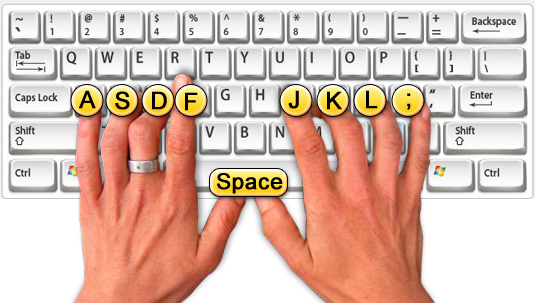
Why do you think that the keyboard is the problem, and not the indoctrination of "this is the right way to type and posture" leading to further stress?

In fact, in my admittedly small sample of others I know who do have problems with their wrists, they were all ones who tried very hard to rigidly conform to the "standard" posture and move only the fingers of the hands instead of the whole arm. They were also people who hit the keys much harder than necessary.

I use a standard flat QWERTY keyboard and I can type for hours at 150+ WPM with no problem, but I've had comments from some of those people above that I'm not doing it right... when they're the ones who are getting pains in their wrists, not me...

If you try to keep your hands parallel to the keyboard no matter what, you are going to stress your wrists. Let them approach at whatever angle feels comfortable, and relax. That also happens to be the "trick" to typing faster too --- if you expend effort on trying to be "strict" about posture rather than just hitting the keys in whatever you feel to be the most comfortable way, you'll tire quickly, type slower, and stress your joints more.

This is good:

https://us.123rf.com/450wm/pxhidalgo/pxhidalgo1604/pxhidalgo...

This is not:

http://help.nchsoftware.com/help/en/keyblaze/win/keybd_hand_...

(My resting position is more like awef and jio;)

Re: Anatomy of a Mechanical Keyboard (2018)

#59
post #49

I’ve wanted to make a keyboard, but I’m not sure it’s possible to make something materially better than the kinesis advantage. I switched to it 10 years after my hands would feel numb after typing. I think I might have some problem other people don’t, but even for normal people, I find it hard to believe that a kinesis wouldn’t be better for them as well. I’ve seen some split diy keyboards, but none of them have the…

> Being able to type your password with one button is super cool!

Do you really have a button on your keyboard mapped to type your password? If that's the case, I'm horrified.

But I secretely wish I had a button like that too...

Re: Anatomy of a Mechanical Keyboard (2018)

#60

Now seems like a good time to ask: does the loud, audible click of a mechanical keyboards increase the user's accuracy? Are our ears in the loop, consciously or not? A family member had a mechanical keyboard with a cherry mx switch and I tried it out with an online typing test I'd tried before. I could type about 20% faster than usual, which is already way up there. I easily hit 135+ in several segments[1], which is…

I don't get the clicky keys for the sound, personally. For me, it means that I don't have to bottom out the key to know that a key press has happened and I like having the sharp click. This is very nice for me, as I have reoccurring tendonitis in my wrist and the tendons that connect my fingers. That and the fact that I play organ, where you're supposed to press the key the absolute minimum to get the sound out.

Also it just feels nicer to me.

Then again, I haven't spent an insane amount of money on a keyboard. My work keyboard is a Red Dragon 10 keyless with Cherry MX blues (what you think of with clicky keyboards), one of the cheapest you can get on Amazon at around $25. Definitely worth the money, and in all honesty not a whole lot louder than the OEM keyboards some of my co-workers use (probably because I don't bottom out the keys).

Post reply on HN