Live data from Hacker News

Abe explains choice of Reiwa for next era name

japantoday.com

51–60 of 87 posts

Re: Abe explains choice of Reiwa for next era name

#51
post #48

Earlier quoted context omitted.

In this particular case, '令月' means[1], a good month. https://kotobank.jp/word/%E4%BB%A4%E6%9C%88-660939 If we have to trace back even further, it can date back to the ancient Chinese classic, the Classic of Poetry, where it is being used as good/respectful: https://baike.baidu.com/item/%E4%BB%A4%E9%97%BB%E4%BB%A4%E6%...

The namers can publicly claim it to mean one thing while privately intending to be another, of course.

In case of Chinese characters, they can be interpreted under different context, I agree.
Re: Abe explains choice of Reiwa for next era name

#52
post #50

Earlier quoted context omitted.

it is a self-imposed complexity that we could opt out if we were smart You could say that about a lot of things in a lot of countries. You have to think twice before you throw away such an old tradition that connects people to the past and the history of their culture. Most Japanese people I know are either ambivalent or happy about it. No one is suggesting doing away with it. You do know that plenty of other culture…

I'm Japanese, and while I don't exactly suggest doing away with it completely, I don't think it has a place in the vast majority of information processing going on in society today. These Gengō updates force a massive, MASSIVE number of date entry forms (both paper and digital) -- from banks to government offices to driver's licenses to middle school soccer club application forms to just literally ANYTHING else imagi…

Don't feel bad. Japan at least was smart enough to choose the metric system.

Re: Abe explains choice of Reiwa for next era name

#53
post #4

Earlier quoted context omitted.

It's a combination of two existing characters, the rei as in meirei/命令 (order, command) and wa as in heiwa/平和 (peace, harmony). No new characters need to be reserved.

Rei, 令, in this case means 'good, fortunate', not command.

Unless you do mind reading this is all a matter of interpretation. There is no single meaning.

Re: Abe explains choice of Reiwa for next era name

#54
post #16

Amusingly there's a pun here on "Zero-sum Era". This because "rei" is a common way to read the numeral zero, and "zero-wa" (using the same "wa" from the new era name) is the Japanese term for "zero-sum".

No, because nobody cares about the sound. The kanji matters. Soundwise there are tons of kanji with the exact same pronounciation so there is no pun to be found.

Re: Abe explains choice of Reiwa for next era name

#55
post #54
post #16

Amusingly there's a pun here on "Zero-sum Era". This because "rei" is a common way to read the numeral zero, and "zero-wa" (using the same "wa" from the new era name) is the Japanese term for "zero-sum".

No, because nobody cares about the sound. The kanji matters. Soundwise there are tons of kanji with the exact same pronounciation so there is no pun to be found.

The joke is blowing up on Japanese Twitter, so yes, people do get the joke:

https://twitter.com/groebner_basis/status/111254775708283289...

Re: Abe explains choice of Reiwa for next era name

#56

Earlier quoted context omitted.

Rei, 令, in this case means 'good, fortunate', not command.

Huh, according to Jim Breen's dictionary ( http://nihongo.monash.edu/cgi-bin/wwwjdic ) 'good, fortunate' is '礼' (rei). '令' (rei) is listed as 'command, decree'. The official character that is being used is '令'. Is there some rule or convention that explains why 令 means 'good, fortunate' here? Is it due to the usage in the 7th century poetry that is referenced in the article?

Even though there's an explanation, I've seen a bunch of negative reaction to the name from Japanese people online because of the association with "command", also linking it to the current prime minister and his relatively militaristic politics.

Re: Abe explains choice of Reiwa for next era name

#57
I think the biggest problem is that if you type "reiwa" in an IME, 令和 wouldn't be shown as a suggestion because it wasn't a real word before. You'd have to write each character separately.

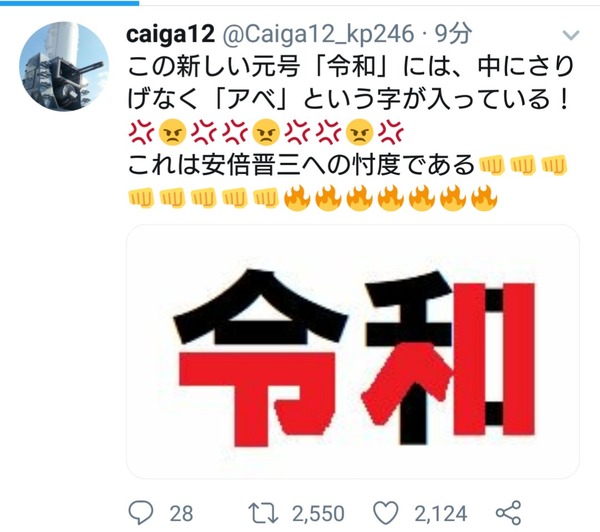
Also speaking of Abe I saw a joke that you could see アベ in the era name if you look closely. http://livedoor.blogimg.jp/animanmatome/imgs/5/f/5fa3bffe-s....

Re: Abe explains choice of Reiwa for next era name

#58
post #45
post #14

This is stupid. Make no mistake: this is not the Japanese "culture". Most private organizations in Japan have already switched to the Western calendar, and its only user is the Japanese government (although it's one of the biggest ones, sadly). They should stop wasting their time and energy for this farce. And yes, one could argue that this will create extra IT jobs that would be unnecessary if they abandoned the sys…

For what it’s worth, Japan is not unique in using different calendars in different contexts. There are several calendars in India, all based on the moon. In my state within India everyone uses the Gregorian calendar for most things except in certain cases. For example, no marriages happen during the month of Margazhi (December 15th - January 15th). There’s no conspiracy in using a different calendar. It’s just a cont…

The difference is that in India nobody uses the traditional calendars outside religious contexts, while in Japan the nengo dates are used for everything from yogurt expiry dates to government forms.

Re: Abe explains choice of Reiwa for next era name

#59

Earlier quoted context omitted.

Those two homonym “Rei” characters do not mean the same thing. Reiwa is a newly conjured “word” that means roughly “declaration/ordinance of peace” https://dictionary.goo.ne.jp/jn/233980/meaning/m0u/

Yeah, I'm stupid.

If it makes you feel better, here's a (presumably) Japanese person making the same association:

https://www.reddit.com/r/newsokur/comments/b7wf5k/令という漢字/eju...

Rough translation: "Somehow this kanji feels winter-like. I guess because of a strong sense of '冷'."

Re: Abe explains choice of Reiwa for next era name

#60

Earlier quoted context omitted.

Heisei 31 is this year. Heisei 32 and above are the ones that don't exist.

Thankfully I don't live in Japan and have to deal with that system on a daily basis.

It's been thirty years since anyone has to touch that code.
Post reply on HN