Live data from Hacker News

First contact made with melted nuclear fuel at Fukushima plant

asahi.com

51–60 of 222 posts

Re: First contact made with melted nuclear fuel at Fukushima plant

#51

Earlier quoted context omitted.

If you look objectively at the numbers, you'll see that nuclear is one of the safest forms of energy production we know. Even considering conservative estimates from Fukushima and Chernobyl, nuclear power has net saved over 2 million lives simply by displacing air-pollution related deaths that would have occurred had the nukes not been built. Coal kills on the order of hundreds of thousands of people per year. Fukush…

We shouldn’t be burning coal either.

Of course we shouldn't be burning coal, but we are. In 2017, 17.8% of US energy production was from coal. 28.0% from petroleum, and 31.8% from gas.

Until these three numbers become 0.0, 0.0, and 0.0, building more nuclear plants to displace them is an immense progress.
Re: First contact made with melted nuclear fuel at Fukushima plant

#53

Forgive the macabre question, but if a human (or other living creatue) were to venture in to the plant and collect this fuel by hand, how long would they survive? I'm in no way suggesting that this is an option, of course -- just curious.

This might interest you and give you a benchmark for the lethality of approaching it: https://rarehistoricalphotos.com/the-elephant-foot-of-the-ch... > After just 30 seconds of exposure, dizziness and fatigue will find you a week later. Two minutes of exposure and the body cells will soon begin to hemorrhage; four minutes: vomiting, diarrhea, and fever. At 300 seconds you have two days to live. > All of the fire figh…

I've read (long time ago) the US did tests on monkeys, exposing them to large neutron doses. There is also a number of human cases of exposure to large neutron doses, starting with Louis Slotin

https://en.wikipedia.org/wiki/Louis_Slotin

Re: First contact made with melted nuclear fuel at Fukushima plant

#54

Earlier quoted context omitted.

If you look objectively at the numbers, you'll see that nuclear is one of the safest forms of energy production we know. Even considering conservative estimates from Fukushima and Chernobyl, nuclear power has net saved over 2 million lives simply by displacing air-pollution related deaths that would have occurred had the nukes not been built. Coal kills on the order of hundreds of thousands of people per year. Fukush…

I don't know how nuclear can be considered remotely "carbon free" if you take into account the usually-externalised emissions incurred in mining, refining and processing the uranium ores into fuels. Then, too, I've seen no figures on the carbon costs of nuclear waste-management.

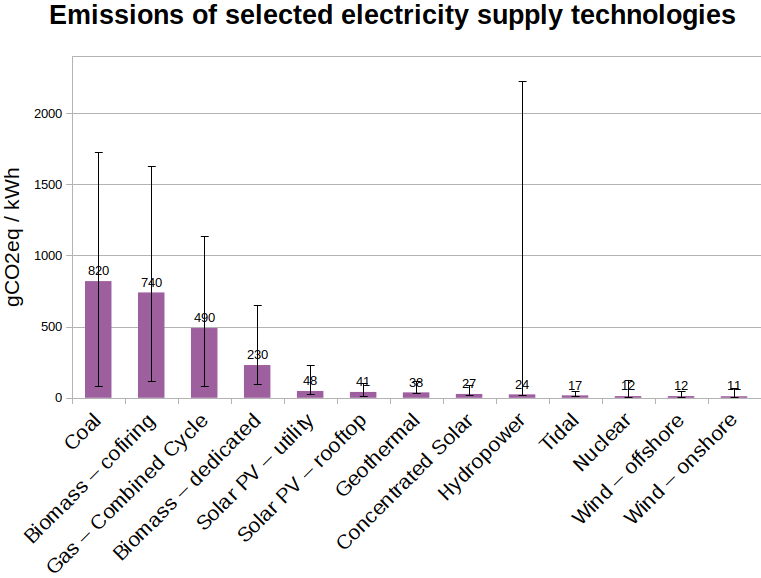
Those are all considered in the lifecycle emissions calculations done by folks like the IPCC, who released these data [1]. It considers mining, construction, transportation, waste, etc. of all energy sources so they can be compared for energy policy purposes.

E=MC2 is an amazing thing.

[1] https://partofthething.com/thoughts/wp-content/uploads/ipcc-...

Source: Schlomer S., et.al., 2014: Annex III: Technology-specific cost and performance parameters. In: Climate Change 2014: Mitigation of Climate Change. Contribution of Working Group III to the 5th Assessment Report of the IPCC

Re: First contact made with melted nuclear fuel at Fukushima plant

#56

Earlier quoted context omitted.

If you look objectively at the numbers, you'll see that nuclear is one of the safest forms of energy production we know. Even considering conservative estimates from Fukushima and Chernobyl, nuclear power has net saved over 2 million lives simply by displacing air-pollution related deaths that would have occurred had the nukes not been built. Coal kills on the order of hundreds of thousands of people per year. Fukush…

I don't know how nuclear can be considered remotely "carbon free" if you take into account the usually-externalised emissions incurred in mining, refining and processing the uranium ores into fuels. Then, too, I've seen no figures on the carbon costs of nuclear waste-management.

Uranium mining is a tiny operation due to it's absurd energy density. I wouldn't be surprised if the mining cost of rare Earth's used to maintain broken solar units surpasses it it's so insignificant.

Besides most countries with a nuclear weapons program end up with a lot of reactor-grade uranium lying about anyway, and those countries also happen to be the biggest polluters in energy

Re: First contact made with melted nuclear fuel at Fukushima plant

#57

Are there not any suits that protect against the radiation to let them go in and do some things by hand? If there are but it's still not a good idea -- why?

Gamma radiation goes through everything. The only thing that stops it is mass and distance. You can only wear a certain amount of lead before you collapse.

The amount of radiation is just too high.

Re: First contact made with melted nuclear fuel at Fukushima plant

#58
post #48
post #15

It took 10 years to even get a robot that could get close to the fuel... and people still ask if nuclear might not be as bad as coal! The truth is that accidents like this can never be cleaned up or salvaged. It's time to move away from nuclear, as other countries have already figured out. Fortunately for us in the US, the last nuclear plant under construction today will likely be cancelled, as the last two were. The…

Nuclear kills less people than Coal mostly from asthma, but coal even causes more cancer because on a normal day it emits far more radiation in the form of small particles of radioactive dust present in coal. The real danger of Nuclear is it can make land unusable by people for centuries (this actually appears to be good from a biodiversity and ecological heath stand point because people do more damage to that than s…

Centuries? Have you been to the Chernobyl exclusion zone recently? [1] That was the worst accident imaginable. Fukushima is much less bad. Natural background radiation in places like Ramsar, Iran are way higher than what you'd experience at Fukushima even right after it happened. And people have been living healthily there for hundreds of years. Low-dose effects of radiation seem to not be all that bad.

[1] https://news.nationalgeographic.com/2016/04/060418-chernobyl...

Re: First contact made with melted nuclear fuel at Fukushima plant

#59

Forgive the macabre question, but if a human (or other living creatue) were to venture in to the plant and collect this fuel by hand, how long would they survive? I'm in no way suggesting that this is an option, of course -- just curious.

You should watch this documentary on Chernobyl:

>According to Vyacheslav Grishin of the Chernobyl Union, the main organization of liquidators, "25,000 of the Russian liquidators are dead and 70,000 disabled, about the same in Ukraine, and 10,000 dead in Belarus and 25,000 disabled", which makes a total of 60,000 dead (10% of the 600,000 liquidators)

https://en.m.wikipedia.org/wiki/Chernobyl_liquidators

They had guys running in and throwing lead bricks - and some of the scientists died by giving their life to get in and take video of the meltdown.

https://www.youtube.com/watch?v=ti-WdTF2Qr8

These guys knew they were doomed.

But they had freaking reportedly 700,000 men attack that problem.

Re: First contact made with melted nuclear fuel at Fukushima plant

#60
post #55

I suspect I am not the only person who saw "First contact made" at the top of HN and for one brief, shining moment lived in a far more interesting Universe.

This has happened to me here and there on various aggregators over the years, and every time I get the goosebumps, and ride it out without fully reading the headline all the way, letting myself imagine, think "yeah, this is probably how I'd find out about it!"

To me it would feel like discovering magic, or the existence of latent psychic abilities in humans. A reality shattering event.

Post reply on HN