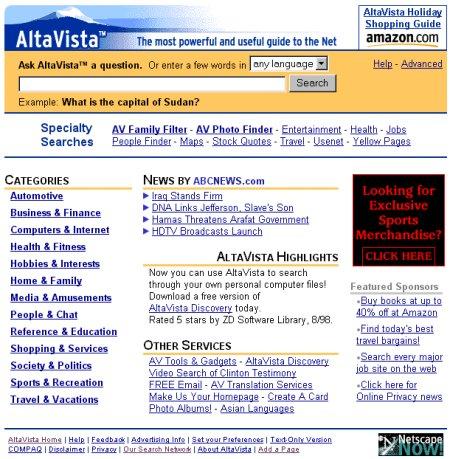
What I miss most about Altavista was the boolean search operators, and being able to reliably insist that words either must or must not appear in the results with the + and - characters. With Google these operators are seemingly just hints that it feels free to ignore. +noir +film -"pinot noir"
And the ability to do case-sensitive search. "DoS" != "DOS"
Altavista: The rise and fall of the biggest pre-Google search engine
51–60 of 323 posts
Re: Altavista: The rise and fall of the biggest pre-Google search engine
#52If I remember correctly, Altavista produced better results than Google back then, for me at least. However, Altavista took seconds to load the first page (on 56k) whereas Google's first page loaded almost immediately. I honestly didn't expect Google to have survived the dot-com bust back then. This was before they figured out online adword auctions.
That's why I moved from Altavista to Google. Google had a minimalist homepage and results page which were focussed and loaded very quickly compared to the bloated pages (for the time) of Altavista and Yahoo.
Re: Altavista: The rise and fall of the biggest pre-Google search engine
#53I loved the seeming technical excesses of Digital so much. Nothing they did seemed as calm and staid as Cray, Sun or even SGI.
Think about that name - Alpha Server 8400 Turbo Laser
Re: Altavista: The rise and fall of the biggest pre-Google search engine
#54What I miss most about Altavista was the boolean search operators, and being able to reliably insist that words either must or must not appear in the results with the + and - characters. With Google these operators are seemingly just hints that it feels free to ignore. +noir +film -"pinot noir"
Re: Altavista: The rise and fall of the biggest pre-Google search engine
#55Re: Altavista: The rise and fall of the biggest pre-Google search engine
#56... and in 2019 the "digital.com" domain is apparently hosted by a site that can't handle the traffic of this article. SPECIAL BONUS: Their current robots.txt appears to be blocking the old Digital.com pages from the WayBack machine. Argh.
Not sure without a bit more digging whether they honor explicit rules for their crawler.
Edit: (but a little looking at comments indicates that they don't, and notes that ia_archiver is Alexa, not the Internet Archive)
Re: Altavista: The rise and fall of the biggest pre-Google search engine
#57What I miss most about Altavista was the boolean search operators, and being able to reliably insist that words either must or must not appear in the results with the + and - characters. With Google these operators are seemingly just hints that it feels free to ignore. +noir +film -"pinot noir"
Re: Altavista: The rise and fall of the biggest pre-Google search engine
#58If I remember correctly, Altavista produced better results than Google back then, for me at least. However, Altavista took seconds to load the first page (on 56k) whereas Google's first page loaded almost immediately. I honestly didn't expect Google to have survived the dot-com bust back then. This was before they figured out online adword auctions.
Google was immediately better then anything else from day one. Google was launched in Fall of 1997. In January 98 is when I started using it and it was hands down better then crawlers or any other search engine.
It was probably subjective but IMO google wasn't better initially, but it did end up being the best. Even tho I use bing or ddg, Google still has the best search engine.
Re: Altavista: The rise and fall of the biggest pre-Google search engine
#59Earlier quoted context omitted.
I'm nostagic for precise search, but I wonder how it would have fared with the scale we have now. (Edit: scale and diversity of input data but also audiences) Google regularly fails to include all words I searched (even if it's only three or four), often retrieving completely useless results. I doubt it's due to incompetence; I take it as a signal that they're now struggling to match the volume and characteristics of…
I suspect it's a reflection of the way the majority of their audience interacts with search. For a large number of people, Google's ability to answer the underlying question, rather than explicitly identify pages where all search terms appear, means it works better. If you think of Google as a way to get answers, this is good. If you think of Google as a search engine, and particularly if you have historical experien…