cuz they're in the Southern Hemisphere get at me NEXT QUESTION
What a remarkably concise demonstration of Dunning-Kruger effect.
Someone should make a screenshot of this and use it in their next talk.
51–60 of 64 posts
cuz they're in the Southern Hemisphere get at me NEXT QUESTION
Someone should make a screenshot of this and use it in their next talk.
Earlier quoted context omitted.
Note that is for the cherry blossoms of Kyoto. So I'd say that the graph means next to nothing in terms of global or even national climate trends. This is about a very small city-dominated local climate. Any variation from a norm could have more to do with the heating/cooling of buildings and local traffic rather than global warming. The trend towards the use of glass in new buildings could have as much an impact as…
Despite the down votes this is a perfectly valid point. In the last 100 years Kyoto has turned from a quiet backwater into a city of over 1 million, liberally slathered in concrete like every other Japanese city. This will have an impact on the local climate, above and beyond global warming as a whole.
Earlier quoted context omitted.
And this is 100% correct. And, it has happened before. The world has had warming and cooling cycles for as long as there has been earth. The idea that all of this is a “new” thing isn’t supported by evidence.
While there are people putting out papers that suggest that what we are seeing is the result solar cycles, and perhaps the overlaying of multiple solar maxiuma, eg: https://www.sciencedirect.com/science/article/pii/S001282521... * There are many more that refute this however: - https://www.nature.com/articles/ncomms14845 - https://agupubs.onlinelibrary.wiley.com/doi/abs/10.1029/2018... and it seems to me that current…
There are major examples in both directions here. In the overstating direction, between 2001 and 2010 the warming slowed to 0.11C per decade. [1] For the 17 years before then was 0.17C. Because the models just map past data to future, nobody predicted this. There is of course a matter of long term vs short term. But at the same time, I think it's important to ensure we don't use this as never-fail defensive tool. Everybody missing a decadal long period of dramatic change is something that should not be ignored and I think we've been disconcertingly quick to marginalize.
In the other direction many climate models underestimated the rate of antarctic sea ice melting. This is, paradoxically, then used as a defense of the models. 'See? We were just being conservative. The sea levels are rising even faster than we said!' But this is again a very disconcerting form of handwaving, that also seems to indicate severe bias. Something happening faster than a model predicts is no better than it happening slower than the model predicts. What it means is the same in both cases - the model is broken.
[1] - https://www.scientificamerican.com/article/did-global-warmin...
Earlier quoted context omitted.
I’m assuming you’re trying to claim this is not related to global warming (“ it has happened before”). Global warming is a large scale and long term problem, and the first thing you would expect is an increase in frequency of previously uncommon events - take warm weather: historically there may have been a few year where the temp got to X degrees, from an average of Y degrees. But now the average Temperature has inc…
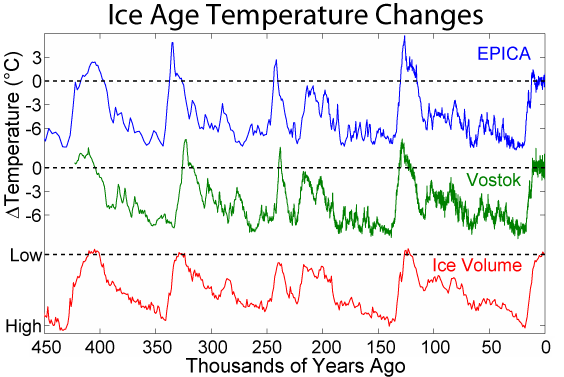
These [1] are the ice core data from the past ~400k years. Not only has the temperature gotten substantially hotter before, but this cycle of rising and lowering global temperatures has been happening before humans even existed. And these are not small temperature deviations. The range between the lows and the highs is around 9 degrees celsius. I don't entirely understand why people are so averse to these data. Do pe…
The importance of timescales is very simple: evolution requires many generations to adapt, and the larger the change the more generations are needed.
Literally no one argues that there have been no changes in global temperature. That is a straw man.
The problem with human created global warming is that it is much much faster than any prior cycle, and that the mechanisms that are causing it (increased CO and CO2) have compounding ramifications - like ocean acidification - that are causing direct damage to major ecosystems, including the organisms that do absorb CO2. I don’t recall any studies of prior occurrences of this - I would expect that the impact would be gaps in things like the cliffs of Devon, etc where you’d see large scale (global) die offs of more or less all mollusks.
Earlier quoted context omitted.
Despite the down votes this is a perfectly valid point. In the last 100 years Kyoto has turned from a quiet backwater into a city of over 1 million, liberally slathered in concrete like every other Japanese city. This will have an impact on the local climate, above and beyond global warming as a whole.
The population of Kyoto has been over 1 million since 1932.
Earlier quoted context omitted.
Note that is for the cherry blossoms of Kyoto. So I'd say that the graph means next to nothing in terms of global or even national climate trends. This is about a very small city-dominated local climate. Any variation from a norm could have more to do with the heating/cooling of buildings and local traffic rather than global warming. The trend towards the use of glass in new buildings could have as much an impact as…
Despite the down votes this is a perfectly valid point. In the last 100 years Kyoto has turned from a quiet backwater into a city of over 1 million, liberally slathered in concrete like every other Japanese city. This will have an impact on the local climate, above and beyond global warming as a whole.
Wow.
Kyoto was the capital of Japan for close to a millennium.
Unrelated to that, the regular cherry blossom event has been happening progressively earlier due to climate change. The typhoons and heatwave that caused the irregular bloom were likely influenced by it as well.
TL;DR: The unusual bloom seems to be a direct consequence of the natural disasters hitting Japan over the course of this year. "Direct" as in "typhoons ripped off a lot of the cherry trees' leaves, but missing leaves are also a biological signal that start the blooming process". Unrelated to that, the regular cherry blossom event has been happening progressively earlier due to climate change. The typhoons and heatwav…
Earlier quoted context omitted.
These [1] are the ice core data from the past ~400k years. Not only has the temperature gotten substantially hotter before, but this cycle of rising and lowering global temperatures has been happening before humans even existed. And these are not small temperature deviations. The range between the lows and the highs is around 9 degrees celsius. I don't entirely understand why people are so averse to these data. Do pe…
All of those changes took place over extended periods of time, as opposed to the human generated climate change that is labeled “global warming”. The importance of timescales is very simple: evolution requires many generations to adapt, and the larger the change the more generations are needed. Literally no one argues that there have been no changes in global temperature. That is a straw man. The problem with human c…
How long of a time do you think would be the minimum to allow for the presumably substantial evolutionary changes that would be required for adaptation? How does this contrast against the warming, potentially upwards of 10 degrees celsius, that occurred some 330k years ago - to say nothing of the sharp increases in CO2 that also followed? In particular, how rapidly do you suppose that warming occurred?
[1] - https://upload.wikimedia.org/wikipedia/commons/f/f8/Ice_Age_...
Earlier quoted context omitted.
Despite the down votes this is a perfectly valid point. In the last 100 years Kyoto has turned from a quiet backwater into a city of over 1 million, liberally slathered in concrete like every other Japanese city. This will have an impact on the local climate, above and beyond global warming as a whole.
>quiet backwater Wow. Kyoto was the capital of Japan for close to a millennium.
The point, though, is not the politics, but that modern Kyoto bears very little resemblance to pre-1900 Kyoto.