Live data from Hacker News

Numworks: open-source, Python-compatible handheld graphing calculator

numworks.com

51–60 of 71 posts

Re: Numworks: open-source, Python-compatible handheld graphing calculator

#51
post #17

Earlier quoted context omitted.

Instead of asserting the title is wrong, it would make sense to recognize that the title is correct, and that the discrepancy with your beliefs is simply a result of the fact that plenty of other people do not, in fact, take OSI's opinions as facts like you do.

The title is indeed wrong. There is no definition or usage of the word "open source" that is compatible with restriction of commercial usage. Never in the history of free software or open source software from the release of Donald Knuth's TeX in 1979, to the birth of FSF in 1985, or the formalization of OSD in 1998 was it ever acceptable to forbid commercial usage in something that is known as open source. The corrup…

This sounds a bit like the No True Scotsman fallacy. There is no official definition of "open source", so taking what the words literally mean, "open" and "source", ie the source code is open to view, is an acceptable definition.

Re: Numworks: open-source, Python-compatible handheld graphing calculator

#52

It's always amazed me how, in 2018, TI calculators with software and hardware from 10 years ago still cost $100+ dollars [0] and command a near monopoly in US secondary schools (which, I suppose, is why they still cost that much). For that price you can get a significantly more powerful and functional mobile phone [1] (see 24K of ram vs. 2GB, 96x64 screen vs. 720 x 1280)! The space needs competition, and I hope Numwo…

This isn't a technology issue. TI has a monopoly because they spent a lot of money going after the teachers. Teachers just want something that they know. They already don't get paid well and have a struggle just to get kids to learn the basic stuff. They just just want something that works and is well supported.

Here is a good article about the how TI goes after the teachers: https://mashable.com/2014/06/03/ti-calculator-evolution/

Re: Numworks: open-source, Python-compatible handheld graphing calculator

#53

Earlier quoted context omitted.

I think this tradeoff was to keep it compatible with Collegeboard's (archaic) calculator policies, which forbid keyboards. [1] Being able to market the calculator as SAT-approved is probably super valuable since most students won't buy multiple calculators. [1]: https://apstudent.collegeboard.org/takingtheexam/exam-polici...

It'd be pretty tough to use it on the SAT if you take most of the allotted time trying to type out a function.

You can use it just like a TI-84, its just that it uses Python (which programming curriculums in k-12 are increasingly using) instead of TI-Basic.

Re: Numworks: open-source, Python-compatible handheld graphing calculator

#54
post #25

It's always amazed me how, in 2018, TI calculators with software and hardware from 10 years ago still cost $100+ dollars [0] and command a near monopoly in US secondary schools (which, I suppose, is why they still cost that much). For that price you can get a significantly more powerful and functional mobile phone [1] (see 24K of ram vs. 2GB, 96x64 screen vs. 720 x 1280)! The space needs competition, and I hope Numwo…

More like hardware from 20 years. Yeah I hope the TI monopoly gets broken. Numworks looks exactly like the calculator I was dreaming about when I was in uni.

Actually, more like hardware from 40 years ago. The Z80 processor was released in like the mid 70s.

Re: Numworks: open-source, Python-compatible handheld graphing calculator

#55
post #12

Earlier quoted context omitted.

Source being on GitHub does not equal "is open source". Restrictions on commercial use are incompatible with open source. The Open Source Initiative, which coined the term and evaluates licenses for compatibility with the Open Source Definition (see https://opensource.org/definition ), is crystal clear on this point: if your license has a field-of-use restriction -- such as a restriction on commercial use -- then it'…

It may not be "Free Source", but if the source is open in the sense if being accessable, then for normal people it is open source. One organization using words in a specific way, doesn't negate all other legit interpretations of those words. It's an unsolvable problem they created there.

Well, sure, language is ultimately defined by usage, so if enough of us agree that the word "broccoli" refers to source code being available, then it's legitimate to go around saying "broccoli" means "visible source", etc.

But the important question is, who is using "open source" to mean the definition I gave earlier? The answer is: pretty much everyone. Not just the Open Source Initiative (opensource.org) and the Free Software Foundation, but also: the Wikimedia Foundation, Creative Commons, the Electronic Frontier Foundation, all government agencies who have formally defined the term (at least as far as I've seen), also every major tech firm as far as I can tell, including Google, Microsoft, Amazon, Apple, IBM, Hewlett-Packard, Yahoo, Samsung, Huawei, ... this list could go on for a very, very long time :-). Basically, it's everyone.

Notice that that list includes Creative Commons -- that is, the organization that wrote the particular license that Numworks is using agrees that that license is not open source. That's a pretty clear sign, I think :-).

And, of course, Numworks themselves are careful not to call their stuff "open source" anywhere. You can bet that they would use that term if they felt they could. It has great marketing karma; everyone loves to advertise their stuff as "open source". And yet Numworks doesn't -- because they know a lot of hackers would come down on them like a ton of bricks if they tried to make that claim.

To a first approximation, pretty much every organization that produces or procures software use the term "open source" to mean the definition that the Open Source Initiative originally established.

You can claim that "open source" means something else, if you want, in the same way that you can claim that the word "broccoli" or "red" means something different from what most other people mean by those words. For you, your meaning will be correct, in your own private language.

But what I'm saying is, when the phrase "open source" appears in a Hacker News headline, most people will interpret it in the way I described. When the vast majority of people intepreret a word or phrase as having a certain meaning -- and especially when it's a term of art in a profession and all the specialists, lawyers, policy makers, etc in that profession agree on the meaning of the term -- then it's fair to say that that is what the term "means".
Re: Numworks: open-source, Python-compatible handheld graphing calculator

#56
post #37

Earlier quoted context omitted.

Nope. Open Source is a trademark precisely to avoid this sort of misuse. It's not a "what it means to whomever" sort of deal. That was done in part due to intentional (and damaging, if ultimately unsuccessful) efforts to undermine the meaning of terms like 'Free Software' by Microsoft back when the FSF was a fledgling movement and Microsoft was an evil empire. I don't mean to imply negative things about the company.…

I'm talking about casual language-usage, like this headline, not commercial usage. Open and source are regular words, and they still are regular words when used together. Trademarks can't force people to talk as they want, it can only force company to not sell everything as they wish.

Yes, the term can't be trademarked, because they're both common English words used in combination (and that combination has a somewhat older, unrelated meaning, which further contributes to making the term untrademarkable).

But this isn't a trademark issue. No one has trademarked the word "carrots" either, but if someone were to sell pencils under the label "carrots", people would be understandably confused and annoyed.

It's the same thing here: don't call it open source if it's not. The software industry relies on that term having a specific, well-defined meaning. That meaning is widely agreed on, which, again, is why Numworks themselves is not claiming their stuff is open source.

Re: Numworks: open-source, Python-compatible handheld graphing calculator

#57

Earlier quoted context omitted.

Source appear to be on GitHub. Non commercial is not incompatible with open source. It makes sense to me that to get the investment required to fund this, you’d want sole rights to commercialize. Nothing prevents someone else from building a cheaper DIY version as long as they don’t sell it. For example it could be a local college class exercise to build these from scratch for local high school. That’s not imaginable…

Whether it's still open source is a bit of a semantic quibble. Fact is that a restriction to non-commercial usage is incompatible with all the major open-source licences like GPL, LGPL, Appache, BSD, MIT, etc. In a sense it's still open source, but the restriction is very unusual.

It's no more a "semantic quibble" than any other inaccurate use of a term is a semantic quibble. People are counting on headlines meaning what they say they mean, and this one doesn't.

If the headline mistakenly said "Lisp-compatible" instead of "Python-compatible", you wouldn't say "Oh, that's just a semantic quibble", right? You'd say it's wrong, flat out. The programming language it's compatible with is Python, not Lisp, so saying Lisp would just be inaccurate. (And they're both English words -- neither term is trademarked, obviously, and they both have meanings unrelated to their meanings in the realm of programming languages.)

Saying this is "open source" is wrong in exactly the same sense. The term has a settled meaning in the software world. The reason "non-commercial usage is incompatible with all the major open-source licenses", as you say, is that it is by definition incompatible with all open source licenses. Because "open source" means freedom for use for any purpose, including commercial purposes.

This is not merely a semantic quibble any more than any other wrong use of a word is a semantic quibble. It's wrong in the normal way that language usage can be wrong.

Re: Numworks: open-source, Python-compatible handheld graphing calculator

#58
post #4

It's not open source; the Hacker News headline is wrong. The Numworks web site does not claim it's open source, by the way -- the problem is only in the headline here. The license is Creative Commons Attribution-NonCommercial ShareAlike (CC-BY-NC-SA), and the presence of the "NonCommercial" clause makes it unambiguously non-open-source. If that clause were not present, CC-BY-SA would still be an odd license to use fo…

Instead of asserting the title is wrong, it would make sense to recognize that the title is correct, and that the discrepancy with your beliefs is simply a result of the fact that plenty of other people do not, in fact, take OSI's opinions as facts like you do.

dataflow, I've made a few replies elsewhere in this thread that address what you said. I don't want to make noise by repeating them here, but wanted to point them out, in case you'd like to see the counterargument.

Re: Numworks: open-source, Python-compatible handheld graphing calculator

#59
post #22

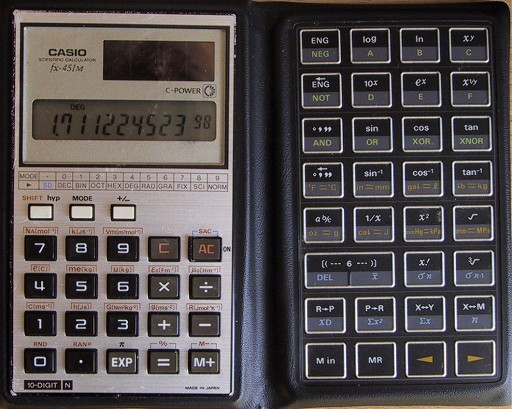
Personally I feel like clamshell design would make lots of sense for these more advanced calculators. At the same footprint you could have lot bigger screen, and more/bigger buttons. As an added bonus the screen would be more readable when sitting on a desk. I wouldn't think the marginally added thikness would impact much something thats being carried around in backbacks most of time anyways. For some reason practica…

Casio have produced some. This old one: http://www.voidware.com/calcs/images/fx451m-1.jpg There's been others since with the same basic design. They all seem to fail at the fold because there is no hinge or much protection at the fold.

There was a pocket computer from a slightly earlier era http://pocket.free.fr/html/casio/fx-5200p_e.html

Trying to find an image of those I stumbled across the fx-9860G Slim that seems to be current: https://www.casio.com/resource/images/press/fx-9860gslim_pre...

Re: Numworks: open-source, Python-compatible handheld graphing calculator

#60
post #12

Earlier quoted context omitted.

Source appear to be on GitHub. Non commercial is not incompatible with open source. It makes sense to me that to get the investment required to fund this, you’d want sole rights to commercialize. Nothing prevents someone else from building a cheaper DIY version as long as they don’t sell it. For example it could be a local college class exercise to build these from scratch for local high school. That’s not imaginable…

Source being on GitHub does not equal "is open source". Restrictions on commercial use are incompatible with open source. The Open Source Initiative, which coined the term and evaluates licenses for compatibility with the Open Source Definition (see https://opensource.org/definition ), is crystal clear on this point: if your license has a field-of-use restriction -- such as a restriction on commercial use -- then it'…

I didn’t say it’s open source, and I don’t agree that the NC clause is incompatible with the notion of open source. I don’t recognize the OSI as the sole authority on the subject but a useful legal framework, so all your argumentation about definitions is moot for me.
Post reply on HN