Live data from Hacker News

The Real Adam Smith

aeon.co

51–60 of 125 posts

Re: The Real Adam Smith

#51
post #26

The writer tries to pretend that there is something drastically opposite from knowing that the state captured by business is different from the danger of mere statism. Well, the answer that preserves liberty is to reduce the chances of the state being captured. This begins by having a limited govt. If the madam of the bordello is out of business, there is no need for customers to line up

If no one governs your rights/freedoms, you don't have any. There is no difference between an unchecked corporation and a corrupt state. The answer doesn't lie at either end, but in a balance.

The opposite actually. Start with John Locke and work your way up to Nozick.

Individual have rights and:

"So strong and far-reaching are these rights that they raise the question of what, if anything, the state and its officials may do."

Re: The Real Adam Smith

#52
post #51
post #26

Earlier quoted context omitted.

If no one governs your rights/freedoms, you don't have any. There is no difference between an unchecked corporation and a corrupt state. The answer doesn't lie at either end, but in a balance.

The opposite actually. Start with John Locke and work your way up to Nozick. Individual have rights and: "So strong and far-reaching are these rights that they raise the question of what, if anything, the state and its officials may do."

How's that work in practice?

"Am I being detained?!"

"You can't mug me, I have a right not to be mugged!"

It's not a law of nature. The laws of nature are things like "the strongest take what they want" and "cannibalism not only feeds you, it removes competitors from the food chain!". Inalienable rights must be enforced in order to exist.

Re: The Real Adam Smith

#53
post #35

Earlier quoted context omitted.

>"I have never met a Neoliberal" That's because neoliberalism is not an ideology, but a label used to try to understand a historic period. Neoliberalism would be the bastard child of neoclassic economics and liberal ideology and it can be defined by events and people that definitely exist. The intellectual parents would be the economist in the orbit of Milton Friedman and the 'Chicago school' and the political parent…

> That's because neoliberalism is not an ideology, but a label used to try to understand a historic period. No its not. Its a term that is used by pretty much anybody for whatever they felt like. > The intellectual parents would be the economist in the orbit of Milton Friedman and the 'Chicago school' and the political parents would be Reagan and Thatcher. That is just false. Friedman never called himself a neolibera…

Well, of course, now that the label it's fashionable, it's going to be used by everybody for everything. A little like using "nano" a few years ago, or "AI" nowadays. That doesn't mean that the term was originally void of meaning as you claim.

>"This is not all part of some grand 'neoliberal' conspiracy."

I beg to differ. Perhaps, conspiracy it's not the word, but very concrete policies have been imposed all around the world by very powerful actors. Those actors are clearly defined, and the times when this happened are also clear. So we can talk of a "neo-liberal" period. After all, we have to call it something.

>"The idea that the 'Washington Consensus' derive from the same basic ideas as the classical liberal ideas (such as Friedman) are also wrong"

Maybe they don't derive from the same basic ideas, but, for sure those ideas have been used to justify it.

Re: The Real Adam Smith

#54
post #49
post #27

Ah, we have the Adam Smith article again. As somebody interested in these for many years, there is a periodic rewriting of this article. The beats are always the same, Smith not actually like evil neoliberals (whoever that is) think. He also wrote 'The Theory of Moral Sentiments' and so on. Admittedly this is by far the best one I have seen in many years. Nothing in the article is really wrong, and it is completely c…

From Paul Sagar's bio (the author of this article): "i am lecturer in political theory in the department of political economy, king’s college london i completed my doctorate at the university of cambridge (2014), after receiving an ma in intellectual history and the history of political thought from the university of london (2010), and a ba in politics, philosophy, and economics from the university of oxford (2008).…

Hey, this is a discussion forum, so can we please not appeal to authority here just to say (in so many words) "I don't care what your opinion on this linked article is because he's an expert and you're not."

What's the point of discussion if you simply say "Oh, but they know more so just shut up"?

Re: The Real Adam Smith

#55
post #7

Earlier quoted context omitted.

> never met a neoliberal "Neoliberal" is typically a term of abuse, but I've seen a movement (from econ professors to /r/neoliberal) to appropriate as a term for centrist radical pragmatism. These self-proclaimed neoliberals are very progressive socially and (claim to, at least) support any policies that have actual firm evidence for it. Of course, this makes them pro-trade and pro-"globalism".

there's plenty of evidence that globalism has not worked out for substantial parts of the population in most developed countries.

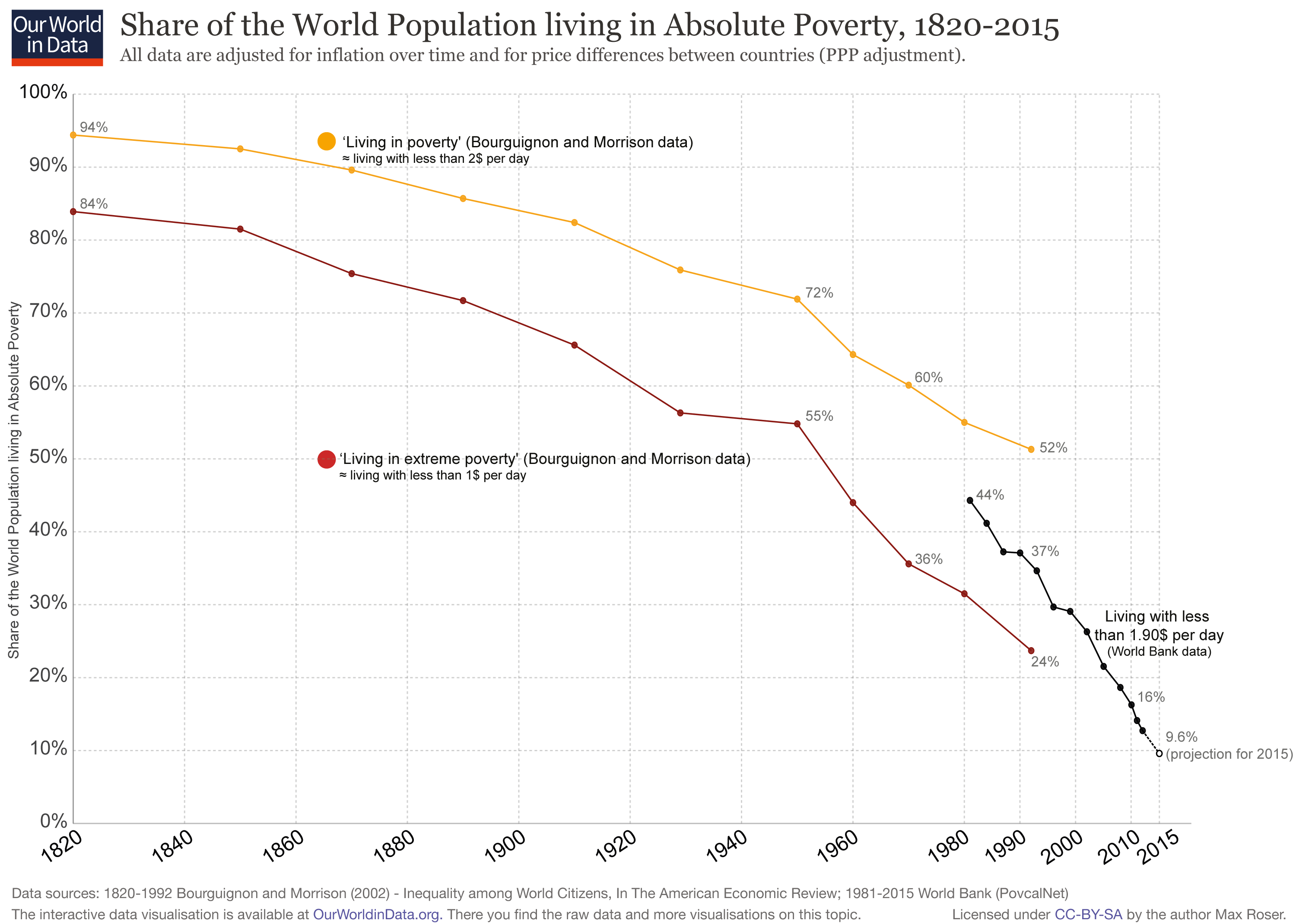
There is overwhelming evidence that Globalisation has turned many undeveloped countries into developed ones. Do people in newly developed countries somehow not count as people in developed countries? Just look at China. That's over a billion people in a country transformed from a hopeless basket case in the 70s into a global superpower and economic powerhouse.

https://www.theguardian.com/society/2013/mar/17/aid-trade-re...

https://ourworldindata.org/wp-content/uploads/2013/05/World-...

Re: The Real Adam Smith

#56
post #40

Earlier quoted context omitted.

All that is very nice in theory, but who is doing the "cut down"? By definition it has to be some entity more powerful that the entity that is cut down. And who should control that entity but the majority of the society? So, we finish with the (very imperfect) solution of a democratic government. We should recognize that it's going to be a lot of interest trying to corrupt it and we (the people) have to keep watching…

I agree it has to be a democracy. The right points to harms of government overreach to argue for less government. The left points to exploding inequality and argues for more government in order to tackle it. A good faith assumption could be that both are trying to decentralize power and maybe putting it that way will make it easier to reach across the ideological divide.

I think there's an increasingly compelling argument to be made at this moment in history, with the rise of powerful increasingly intelligent software that can 1) rigorously shape policy to ensure that ends are met and that 2) the means to those ends employ minimal bias, and 3) do so adaptively, shifting policy dynamically as circumstances evolve. I believe it's time to start planning for the day when we shutter the voting booths and find a better way to govern using networked sensors and dispassionate computers.

Democracy is dying. Long live automatic government for the people.

Is this really necessary? IMHO, yes. It's become clear that the easy manipulation of a gullible, clueless, and intellectually lazy electorate has broken all three branches of US government:

1) we have an imbecile President and a cabinet of grotesques who border on insanity

2) we have a congress that for over 30 years has done almost nothing constructive, that campaigns on one set of principles then serves others, the primary two being: the financial interests of Those With Money, and paying lip service to the fantasy-laden desiderata of Those Without.

3) a legal system that imprisons over 90% of those charged without a trial.

What brought America to such a dysfunctional State? The democratic popular vote, of course. Nothing else could.

Thus I believe it's time there was a serious discussion (outside of Washington, of course) about alternative ways to shrink and de-bias all three branches of government, at all levels.

I'm convinced that software soon will be powerful enough to fairly, effectively, and adaptively guide the players (both citizens and businesses) in questions of policy to reliably and precisely achieve desired ends, rather than relying on the venerably bent tools of power -- a gigantic incoherent mass of self-serving, ends-oblivious, and inconsistent principles chisled into marble long ago by power brokers to preserve eon-old biases that reliably serves only vested interests.

If we want AI to reach its true potential, I propose better government be its ultimate objective. Start from the bottom up -- local government -- and introduce ends-driven smart services to serve civic and main street business needs at that level -- where feedback is clearest, most immediate, and most accountable. This way we might just put government right, from the bottom up, cutting away Caesar as we go.
Re: The Real Adam Smith

#57
post #43

I'm surprised it didn't mention an obvious difference from modern conceptions of the free market: he thought landownership was a monopoly privilege that could be taxed without harm, so long as you are taxing only the land rent itself, not the improvements. "Ground-rents are a still more proper subject of taxation than the rent of houses. A tax upon ground-rents would not raise the rents of houses. It would fall altog…

Smith does not seem to be a private-propery-idealist as almost anyone in the mainstream today. Take this passage for example, also from book V.

"Wherever there is great property there is great inequality. For one very rich man there must be at least five hundred poor, and the affluence of the few supposes the indigence of the many. The affluence of the rich excites the indignation of the poor, who are often both driven by want, and prompted by envy, to invade his possessions. It is only under the shelter of the civil magistrate that the owner of that valuable property, which is acquired by the labour of many years, or perhaps of many successive generations, can sleep a single night in security. He is at all times surrounded by unknown enemies, whom, though he never provoked, he can never appease, and from whose injustice he can be protected only by the powerful arm of the civil magistrate continually held up to chastise it. The acquisition of valuable and*23 extensive property, therefore, necessarily requires the establishment of civil government. Where there is no property, or at least none that exceeds the value of two or three days labour, civil government is not so necessary.

Civil government supposes a certain subordination. But as the necessity of civil government gradually grows up with the acquisition of valuable property, so the principal causes which naturally introduce subordination gradually grow up with the growth of that valuable property. "

http://www.econlib.org/library/Smith/smWN20.html

Re: The Real Adam Smith

#58
post #54
post #49

Earlier quoted context omitted.

From Paul Sagar's bio (the author of this article): "i am lecturer in political theory in the department of political economy, king’s college london i completed my doctorate at the university of cambridge (2014), after receiving an ma in intellectual history and the history of political thought from the university of london (2010), and a ba in politics, philosophy, and economics from the university of oxford (2008).…

Hey, this is a discussion forum, so can we please not appeal to authority here just to say (in so many words) "I don't care what your opinion on this linked article is because he's an expert and you're not." What's the point of discussion if you simply say "Oh, but they know more so just shut up"?

There's nothing wrong with an appeal to authority in response to an appeal to authority.

Re: The Real Adam Smith

#59
this describes the current "capitalist" system we have today, where powerful individuals can lobby the state to create laws favouring them directly. the problem is, of course, the existence of the state.

Re: The Real Adam Smith

#60

this describes the current "capitalist" system we have today, where powerful individuals can lobby the state to create laws favouring them directly. the problem is, of course, the existence of the state.

Of course.

Maybe you can point us to some examples, current or historical, where human societies thrived without the existence of the state.

Post reply on HN