Earlier quoted context omitted.
It's not differentiating by content, you're paying for a different service tier. It's like saying getting faster internet by paying for Comcast Business violates net neutrality.
One of the primary consumer arguments in favor of net neutrality was that ISPs advertised bandwidth at certain speeds, and therefore were obligated to provide that speed to any point on the Internet. Using that same argument, Google should be obligated to provide maximum interface speed from any of their compute instances to any point on the internet, and should not be allowed to sell a tier that gets closer to that…
Introducing Network Service Tiers
51–60 of 215 posts
Re: Introducing Network Service Tiers
#52- An unmentioned alternative to this pricing is that GCP has a deal with Cloudflare that gives you a 50% discount to what is now called Premium pricing for traffic that egresses GCP through Cloudflare. This is cheaper for Google because GCP and Cloudflare have a peering arrangement. Of course, you also have to pay Cloudflare for bandwidth.
- This announcement is actually a small price cut compared to existing network egress prices for the 1-10 TiB/month and 150+ TiB/month buckets.
- The biggest advantage of using private networks is often client latency, since packets avoid points of congestion on the open internet. They don't really highlight this, instead showing a chart of throughput to a single client, which only matters for a subset of GCP customers. The throughput chart is also a little bit deceptive because of the y-axis they've chosen.
- Other important things to consider if you're optimizing a website for latency are CDN and where SSL negotiation takes place. For a single small HTTPS request doing SSL negotiation on the network edge can make a pretty big latency difference.
- Interesting number: Google capex (excluding other Alphabet capex) in both 2015 and 2016 was around $10B, at least part of that going to the networking tech discussed in the post. I expect they're continuing to invest in this space.
- A common trend with GCP products is moving away from flat-rate pricing models to models which incentivize users in ways that reflect underlying costs. For example, BigQuery users are priced per-query, which is uncommon for analytical databases. It's possible that network pricing could reflect that in the future. For example, there is probably more slack network capacity at 3am than 8am.
Re: Introducing Network Service Tiers
#53Egress pricing for Google and AWS (sans Lightsail) continues to be one of the biggest price differences between them and smaller hosts such as Linode and DigitalOcean. I think Google missed an opportunity here. They should have cut the prices more significantly for standard tier (sacrificing performance) to make this more competitive. Right now Linode's and DO's smallest $5 plan offers 1TB of transfer, which would co…
I suspect that the smaller hosts' plans traffic quota is sold below their own cost - assuming (correctly) that the vast majority of customers would not use anywhere close to the limit.
The traffic quota also scales much slower than the price as you move to bigger, more expensive plans.
I guess that it's fine if you reach the limit on a few servers, but if you rented 1000 x $5 droplets from Linode/DigitalOcean, and maxed out all of their traffic quota, you would get kicked out. Has someone tried to use these hosts just for cheap file servers?
Re: Introducing Network Service Tiers
#54Compare with the difficulties of https://cloud.google.com/images/locations/edgepoint.png
Elegant and subtle work. Just like the networking.
Re: Introducing Network Service Tiers
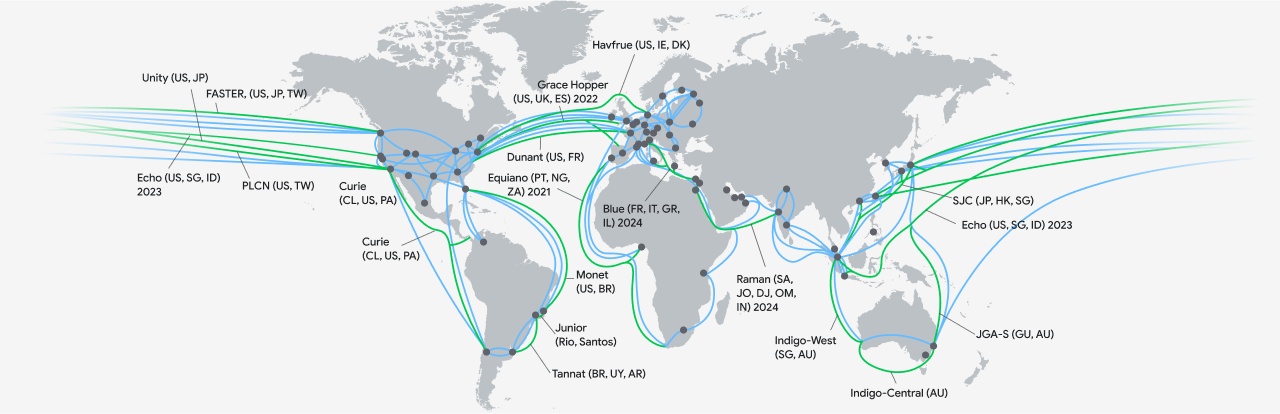
#55Not that I'm really surprised, but does that map imply that Google has its own trans-atlantic undersea cables? Is there some more info about that?
"The new cable will become the sixth submarine cable that Google has a stake in (the others are Unity, SJC, FASTER, MONET and Tannat)."
So it looks like Google isn't the sole owner, but they do partner with others to do these.
[0] https://techcrunch.com/2016/10/12/google-and-facebook-are-bu...
Re: Introducing Network Service Tiers
#56This precedent (including CloudFlare's new private routing) doesn't bode well for the public internet. Imagine the day when everyone has to use private routing and the public internet barely even gets maintained anymore. Of course, public internet also suffers tragedy of the commons and not much is happening on that front. Like how most people are still behind ISPs that allow their customers to spoof IP addresses. An…
Re: Introducing Network Service Tiers
#57Seeing the map of Google's network makes me appreciate more the impact of undersea cables. If you're interested in the history of earth-scale networks I recommend this free documentary on Cyrus Field and the heroic struggle to lay the first transatlantic cable: https://www.youtube.com/watch?v=cFKONUBBHQw
Love the parts in Cryptonomicon where they delve into the sea cables stuff.
Re: Introducing Network Service Tiers
#58Re: Introducing Network Service Tiers
#59Egress pricing for Google and AWS (sans Lightsail) continues to be one of the biggest price differences between them and smaller hosts such as Linode and DigitalOcean. I think Google missed an opportunity here. They should have cut the prices more significantly for standard tier (sacrificing performance) to make this more competitive. Right now Linode's and DO's smallest $5 plan offers 1TB of transfer, which would co…
> biggest price differences between them and smaller hosts such as Linode and DigitalOcean. I suspect that the smaller hosts' plans traffic quota is sold below their own cost - assuming (correctly) that the vast majority of customers would not use anywhere close to the limit. The traffic quota also scales much slower than the price as you move to bigger, more expensive plans. I guess that it's fine if you reach the l…
* It's hard to push a lot of useful data with a tiny VPS.
Re: Introducing Network Service Tiers
#60Egress pricing for Google and AWS (sans Lightsail) continues to be one of the biggest price differences between them and smaller hosts such as Linode and DigitalOcean. I think Google missed an opportunity here. They should have cut the prices more significantly for standard tier (sacrificing performance) to make this more competitive. Right now Linode's and DO's smallest $5 plan offers 1TB of transfer, which would co…
> biggest price differences between them and smaller hosts such as Linode and DigitalOcean. I suspect that the smaller hosts' plans traffic quota is sold below their own cost - assuming (correctly) that the vast majority of customers would not use anywhere close to the limit. The traffic quota also scales much slower than the price as you move to bigger, more expensive plans. I guess that it's fine if you reach the l…
It might happen but it doesn't refute the parent's point:
"Right now Linode's and DO's smallest $5 plan offers 1TB of transfer, which would cost $85.00 on Google's new standard plan."