Live data from Hacker News

WhatsApp Security Vulnerability

schneier.com

51–60 of 71 posts

Re: WhatsApp Security Vulnerability

#51
post #14

While people discuss about a possible state-actor stronghanding WhatsApp and the semantics of backdoor, the "design feature" of not showing the key changes are making real victims, at least in Brasil: The attacker first try to duplicate the mobile phone number of the first victim, probably by social engineering their phone company. This part may look difficult to do, but it is not hard if you realize you do not need…

This has nothing to do with Whatsapp and its use of encryption but is cause by its choice of username and validation method.

The attacker needs to know the phone number and be able to read SMS messages from the phone number. Even very weak methods like the typical security questions would make this much more difficult.
Re: WhatsApp Security Vulnerability

#52
post #43
post #20

Earlier quoted context omitted.

It does not need to be a modal form - a notification message, embedded in the the chat log, just before a "Hey, could you send me some money", could make some people think twice before transferring: "Wow, he is asking me in excess of USD500 just after WhatsApp warned me his cell phone has changed. Weird". The simple alert shown in moxie's own blog post [1], perhaps less cryptically written, would probably do the job.…

For the overwhelming majority of people, it would just lead to alert fatigue, where users start ignoring the alerts because 99% of the time they're not actually indicative of a problem.

As much as I agree that alert fatigue is a problem this shouldn't trigger it.

Re: WhatsApp Security Vulnerability

#53
post #44

Earlier quoted context omitted.

It also absolutely would create fatigue, I don't know why WhitneyLand thinks it wouldn't.

Because you only have to block once, explain the consequences, and then allow them to unblock by default.

At which point 99% of people would immediately unblock by default and the supposed security would be lost.

Re: WhatsApp Security Vulnerability

#54
post #14

While people discuss about a possible state-actor stronghanding WhatsApp and the semantics of backdoor, the "design feature" of not showing the key changes are making real victims, at least in Brasil: The attacker first try to duplicate the mobile phone number of the first victim, probably by social engineering their phone company. This part may look difficult to do, but it is not hard if you realize you do not need…

>As Whatsapp does not send any alert of key change by default

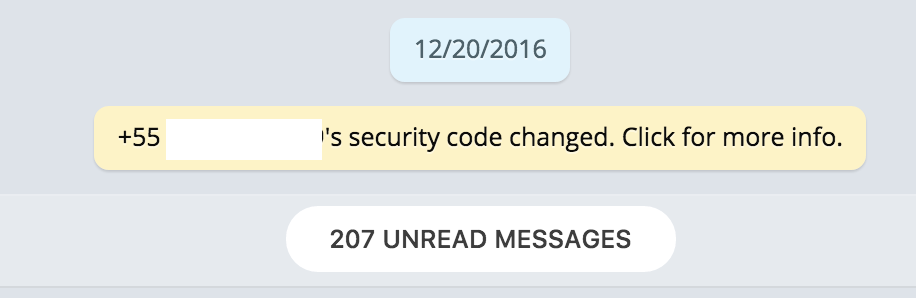
I don't think that's the case. AFAIK WhatsApp does warn people about key changes with this warning message by default: https://cldup.com/QdUQmjJoF9.png

In fact working with software, at least once a month someone will ask me "Hey, what is this 'Security code has changed' message that pops up every so often about? Do I need to worry about it?"

Re: WhatsApp Security Vulnerability

#55
post #29
post #17

Earlier quoted context omitted.

There is no "secure", it's a scale from "no security" to just "very high security".

Security isn't either a scale or a binary; from one point of view a large number of binary values. Either your security will or won't be compromised by a given threat model. This is binary, but there's lots of different threat models one could have. e.g. If you care about the Russian government impersonating you, it's a different threat model than if you care about the US government reading your communication, which…

Come on, a collection of binary values for all of the threat models on a product used by millions of people is a scale by any other name. How good is the product at covering each of the threat models?

Re: WhatsApp Security Vulnerability

#56
post #14

While people discuss about a possible state-actor stronghanding WhatsApp and the semantics of backdoor, the "design feature" of not showing the key changes are making real victims, at least in Brasil: The attacker first try to duplicate the mobile phone number of the first victim, probably by social engineering their phone company. This part may look difficult to do, but it is not hard if you realize you do not need…

People transfer money based on WhatsApp messages from acquaintances, without at least a phone call confirmation? Seriously, even for good friends and family, I'd expect a phone call when asked for money, not a message. It's basically a matter of respect.

People really rely on whatsapp here. Phone calls are becoming rare.

Also the messages implies that is not really a lending, just to pay someone else and the money will be transferred soon enough.

Re: WhatsApp Security Vulnerability

#57
post #14

While people discuss about a possible state-actor stronghanding WhatsApp and the semantics of backdoor, the "design feature" of not showing the key changes are making real victims, at least in Brasil: The attacker first try to duplicate the mobile phone number of the first victim, probably by social engineering their phone company. This part may look difficult to do, but it is not hard if you realize you do not need…

>As Whatsapp does not send any alert of key change by default I don't think that's the case. AFAIK WhatsApp does warn people about key changes with this warning message by default: https://cldup.com/QdUQmjJoF9.png In fact working with software, at least once a month someone will ask me "Hey, what is this 'Security code has changed' message that pops up every so often about? Do I need to worry about it?"

Apparently, this is not default behavior anymore. Must be set in account - > Security.

Re: WhatsApp Security Vulnerability

#58
post #39
post #25

The question for me is that posed by the hacker who discovered the vulnerability. Here's what he said [1]: "He (Moxie) said: “The choice to make these notifications ‘blocking’ would in some ways make things worse. That would leak information to the server about who has enabled safety number change notifications and who hasn’t, effectively telling the server who it could man-in-the-middle transparently and who it coul…

I think you're using a different meaning of "blocking" than Moxie is. I believe they mean "blocking" in the sense of waiting for the user to confirm that the message should be re-sent -- i.e. blocking on the user's input. Whereas you're using "blocking" to mean refusing to re-encrypt the message. Presumably any message which would be detectable enough as garbage to not be displayed on the reader's phone could be trea…

Resending and reencrypting the message mean the same thing here, I don't understand the distinction. Once the user okays the key change it can be resent by encrypting with the new key, before that it would be blocked from being resent.

I know nothing of the signal protocol, but whether the server can tell the message is garbage depends on what the receiver client tells the server. An ideal client would acknowledge receipt to the server but show the user an error (or silently drop the garbage message). From the quote it seems like this is the case, in which case the server can't tell a true message receipt from receipt of garbage and the correlation doesn't work.

Re: WhatsApp Security Vulnerability

#59
post #53

Earlier quoted context omitted.

Because you only have to block once, explain the consequences, and then allow them to unblock by default.

At which point 99% of people would immediately unblock by default and the supposed security would be lost.

Maybe a lot would it turn it off, but its better than the current situation because everyone would know exactly what they're getting themselves into. Most importantly, the people who are most at risk would get a chance to understand the issue and leave it on for their protection.

Re: WhatsApp Security Vulnerability

#60
post #58
post #39

Earlier quoted context omitted.

I think you're using a different meaning of "blocking" than Moxie is. I believe they mean "blocking" in the sense of waiting for the user to confirm that the message should be re-sent -- i.e. blocking on the user's input. Whereas you're using "blocking" to mean refusing to re-encrypt the message. Presumably any message which would be detectable enough as garbage to not be displayed on the reader's phone could be trea…

Resending and reencrypting the message mean the same thing here, I don't understand the distinction. Once the user okays the key change it can be resent by encrypting with the new key, before that it would be blocked from being resent. I know nothing of the signal protocol, but whether the server can tell the message is garbage depends on what the receiver client tells the server. An ideal client would acknowledge re…

> I know nothing of the signal protocol, but whether the server can tell the message is garbage depends on what the receiver client tells the server.

You're forgetting that the server is the one telling the sender what the new key is. If the key is under the control of the attacker/server, they can read the message and determine if it's garbage or not.

Post reply on HN