Live data from Hacker News

The 19th Century plug that's still being used

bbc.com

51–60 of 143 posts

Re: The 19th Century plug that's still being used

#51
I like that the 3.5 mm connector is fairly simple and is does not break easily.

I have seen many broken micro-usb connectors, and a couple of broken lightning connectors. I cant remember ever seeing a broken 3.5mm connector, the cables break before the connector.

Do i want a thinner phone? No, i want a phone with better battery life. Like phones had back in the day(2005) a week or two was not uncommon.

Re: The 19th Century plug that's still being used

#52

Earlier quoted context omitted.

> Bluetooth audio codecs do lossy real-time re-encoding of the audio Lossless transcoding is possible too. https://en.wikipedia.org/wiki/AptX#aptX_Lossless iPhones and Macbooks support aptX now. Surely this isn't just a hardware change — once Apple discloses the details, it won't be at all surprising if aptX Lossless (at minimum) is required for MFi licensing going forward. FWIW, the transcoding you mention isn't a r…

Yes, there are better codecs than the defaults. Now go to the specifications page for a random popular bluetooth audio device, and see if they even list which codecs are supported. If by some astonishing miracle they do say so, then work out which codec they would use with a random popular mobile device. It is all theoretically possible, but in practise regular folk are going to have a hard time! I looked up recommen…

> Now go to the specifications page for a random popular bluetooth audio device, and see if they even list which codecs are supported.

That's an excellent point.

Sadly, I don't think the average consumer knows or cares about the badness that is lossy-to-lossy transcoding.

For those who do, aptX support is pretty easy to find in the sense that vendors tend to make "aptX" searchable in the name and/or description. (If you Google "amazon aptx headphones", you'll see what I mean.)

Finally, this is a great example of how Apple gets to "own" the mindshare for tech they don't invent. If Apple decides to hang their hat on the aptX brand for the iPhone 7 launch, that'll be how most people hear about it for the first time. Since aptX isn't their brand, it's more likely that Apple will simply tout "perfect wireless audio" and make sure customers know to look for "Made for iPhone" headphones.

Re: The 19th Century plug that's still being used

#54
The BBC failed to mention that there is also a 2.5mm jack available. Quite a bit smaller, but I haven't seen one for a while (~5 years).

After replacing so many headphones because of cables breaking, I'm really happy Bluetooth headphones. Although when I want to enjoy music, you can't beat decent headphones with a half decent soundcard/ DAC.

Re: The 19th Century plug that's still being used

#55
post #11

Earlier quoted context omitted.

> Just as a reminder it was the EU who ended the BS of every company having a stupid proprietary charger. Did they? How did Apple get away with it?

They ship the phones with a small adapter that goes from micro USB to lightning. You're allowed a proprietary port into the phone as long as you provide the adapter for free.

They do? Not in Denmark.

Re: The 19th Century plug that's still being used

#56
> "Studying Moore's Law and the history of technology, it's clear we're not going to stick around with something analogue for long," he says.

The real world is still analogue, and as long as we have biological brains there will need to be a digital to analogue conversion somewhere to interface with it.

Phone manufacturers might want to move that conversion out of their devices, which is understandable because analogue electronics is expensive and good quality even more so, and that change would make it someone else's responsibility.

In the end if this does go through it might not be totally a bad thing if the new digital connector is also a standard (and provides power, I might add). That way it would be possible to get a good quality DAC and reuse it everywhere.

Re: The 19th Century plug that's still being used

#58
post #4

It's not quite 19th c. technology. It was .25 inches, but it had only two conductors, the tip, and the ring, separated by an insulator. Hence the "tip" and "ring" nomenclature for analog telephone wiring. Analog phone technology is remarkably back-compatible. You can use an 80 year old phone today. Not many, if any technology products could claim that level of compatibility. But, so what? Analog phones are going away…

> So should codecs and amps inside of mobile devices. Those things belong with the transducer, so they can be tuned to the characteristics of the transducer.

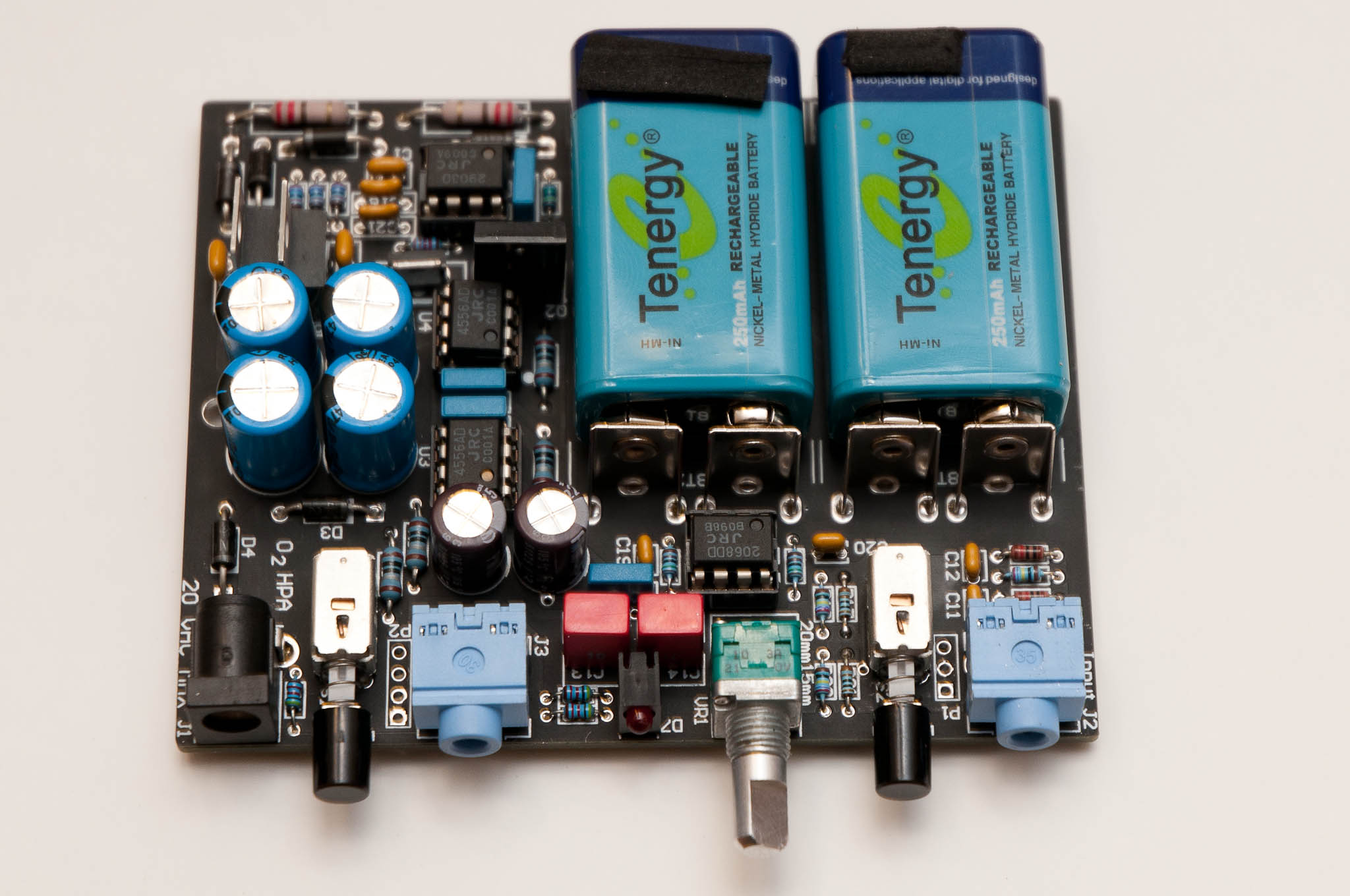
Amplifiers/DACs are not simple devices that can be crammed into a pair of headphones without significant compromises in audio quality. The DAC in an iPhone is acceptable for most uses but an amplifier requires a fairly large quantity of discretes and a large power source to drive many headphones. Here are some pictures of the inside of a minimalist audiophile headphone amplifier (Objective2), and with the DAC daughterboard added:

http://teribil-audio.com/wp-content/uploads/2012/07/D300-766...

http://4.bp.blogspot.com/-9lKWLE_sO84/UDUDtC2ApHI/AAAAAAAABB...

Furthermore, if the DAC/amp are internal to the headphones then the headphones themselves become significantly more expensive. For high-end usage most users will want to use their DAC/amp with multiple pairs of headphones, it's cost-ineffective to have a $200 DAC/amp unit built in to every single pair of headphones. Consumer gear is also cheaper, but you're still talking about the difference between a pair of headphones costing $30 and costing $50.

Also, there's not really any consensus on what "proper tuning" actually means with headphones. Some people like an absolutely flat "reference/analytical" sound, but this is only a small subset of high-end users, and consumer gear is not tuned anywhere near a flat response curve. And it's a highly perception-based area where different individuals hear totally different aspects of headphones, with a high degree of placebo effect.

The long-term fix for audiophile users is probably going to be to move to external DAC/amp units rather than integrating the DAC/amp into the headphones. This means yet another thing you have to carry around and keep charged (my Fiio X5ii lasts maybe 6-8h on a charge). I'm not currently aware of any that use Lightning, but if there's a market they will eventually exist. Consumer users probably won't care about the negative impacts on quality too much, but rather about how Lightning headsets are now going to be quite a bit more expensive.
Re: The 19th Century plug that's still being used

#59

"Thinner phone" is a stupid requirement. A thinner phone will be mechanically weaker. Yes, Apple retired Floppy disks and DVD readers, because those were replaced by something better. This is not the case here. A Bluetooth headphone will give you an inferior experience. A lightning converter will give you a worse experience because I can bet it doesn't stay plugged as firmly as a headphone in a high vibration situati…

Why will a thinner phone be mechanically weaker? What about if everything on the phone is flexible?

Can everything on the phone be rolled up into a taquito shape? Oh, 99% of all silicon chips are rigid, not flexible? Oh, bummer. I guess that'll take some serious semiconductor fab breakthroughs before it happens.

Re: The 19th Century plug that's still being used

#60

Earlier quoted context omitted.

Looks like the spec is 10,000 cycles: http://www.anandtech.com/show/8377/usb-typec-connector-speci... That's over 13 cycles/day for two years. Probably fine for most users. Edit: The official spec is only available via a zipped folder of PDFs, here's the particulars to save readers the effort. 5.7.1.3 Durability or Insertion/Extraction Cycles (EIA 364-09) The durability ratings listed in Table 5-16 are specified for…

That's what the spec says. It remains to be seen how connectors perform in the real world, with all its dust and dirt.

True. That thing has more pins in less space than anything previously exposed to consumer handling.
Post reply on HN