Earlier quoted context omitted.
Hot take - walkability is super overrated. I don't want to go to the same 5 resturaunts I can walk to. I like variety. I work from home and don't commute, but when I do go out I want to explore . Another hot take - Being in the middle of a city doesn't make one more social. Actually it can be more lonely ironically. You are surrounded by strangers. In my current suburb I am good friend with all of my neighbors. We sh…
I think with the popular conception/definition of walkability and the assigned importance of that conception is a little over-rated. I personally feel like it overvalues commercial activity (restaurants, retail, grocery, entertainment). Obviously, it depends on how often you want to partake in said commercial activities as far as how you would value it. I would love if the conception of walkability could also take in…
Too many Americans live in places built for cars – not for human connection
491–500 of 576 posts
Re: Too many Americans live in places built for cars – not for human connection
#492Earlier quoted context omitted.
>That subsidized city transit is why we can afford to maintain the highway system. I don't think this follows... Cities that don't have good public transit still generate tax revenue.
Yeah, but not on the level of NYC, Chicago, SF, and LA (which actually has decent public transport (for the US), despite the reputation). Yes, then there are cities like Houston, but they are paying for 16-lane urban freeways, which have to at least cancel out any cost savings from not having much public transport.
It seems like a chicken-and-egg problem. Spending on public transit means there's budget for infrastructure. Highways being built means there's budget for infrastructure.
Budget for infrastructure means infrastructure gets built.
It seems almost... Tautological.
Re: Too many Americans live in places built for cars – not for human connection
#493Earlier quoted context omitted.
Town around 50000 is a good bet then. If you can work remotely, find a college town and live outside the center, about a mile. You can bike to anything, take the bus, or just walk. I did this. I have 100 restaurants, too many bars to count, music and theatre (three!) and festivals and arts within trivial distances. No car needed.
Where? A town of 50,000 with 100 restaurants, many bars, and multiple theaters and festivals would be a highly desirable place to live for many, many people. What area were you referring to?
Re: Too many Americans live in places built for cars – not for human connection
#494Earlier quoted context omitted.
This just isn't at all true unless you define "house" as exclusively large lot single family homes with big back and front yards. Most dense and walkable places in the world are not full of high rises, they're a mix of high density houses and low to medium density apartments. This mix is really rare in North America, at least and especially north of Mexico, but it does exist.
> a mix of high density houses and low to medium density apartments Neither of which sounds very nice to me. I don't have a huge yard, but I do have enough yard to raise a few trees and firepit. If I lost that, I might as well be in an apartment. And that still wouldn't provide enough density to support a variety of restaurants and grocery stores (not to mention things like employment for non-techies).
But here's the thing: all those big spaced out houses with big yards leave less room for trees and parks that make everyone happy. Suburban spaces also tend to be bereft of trees overall because no one can stand to have their lawn 2m shorter so the street can have a boulevard.
Re: Too many Americans live in places built for cars – not for human connection
#495Earlier quoted context omitted.
Air pollution: Caused by what? Probably cars. Noise pollution: Caused by what? Probably cars. (Sure, some sirens here and there, but rural and suburban living doesn't make you immune to the sounds of train crossings, highways, jake brakes, motorcycles, etc). Annoying neighbors, smell/hearing through walls: 1. Easily mitigated through smart building design and practices, enforced by building code. 2. You can have comp…
Noise pollution: Caused by what? Probably cars . . . rural and suburban living doesn't make you immune to the sound of . . . Noise pollution in the city is just a fact of the population density. Speaking from experience, if you've lived there for some time your hearing won't even be sensitive enough to truly appreciate the difference in a rural area. It's just never going to be In the rural area I live in I can hear…
Re: Too many Americans live in places built for cars – not for human connection
#496Earlier quoted context omitted.
Manhattan has a lot of car traffic. Short of the urban core of Philly, DC, Chicago, SF, or my favorite parts of Brooklyn (which also have a lot of car traffic), nothing seems nearly as walkable in the US. Don't get me wrong, I'd love to see congestion pricing and fewer cars on the streets in Manhattan. The best walkable suburbs I've visited, Montclair and Red Bank in NJ and Ardmore, PA seem pretty sad, small, and bor…
Sometimes, people are looking for small and boring, like some parents who are raising kids and are no longer partying every weekend. (There are also pros and cons to raising children in cities; growing up in NYC I got a free transit pass in middle school and was able to take myself to places like the Met and the Guggenheim pretty effortlessly, and you certainly can't get amenities like those everywhere.) There's noth…
I grew up in a dense city outside the US, and even as a not-particularly-social child, I still had plenty of friends I played with and hung out with, and also had tons of interaction with adults. Meanwhile I’ve seen my cousins grow up in suburbs over the past 10 years, and they interact with maybe 3 non-family members outside of school, because everything is like a 15 minute walk away through winding suburb streets. That kind of isolation is not healthy at all.
Re: Too many Americans live in places built for cars – not for human connection
#497Earlier quoted context omitted.
Curious what you rate as "easy walking distance"? 15 min (one way), 30 min? Though I'd think it rather depends on how much you have to carry...
My office is close to 1.25 miles, takes about 30 minutes if I don't want to break a sweat. If I'm late, I ride a bike. That's probably the limit for me for regular/frequent trips. I can carry a mid-sized backpack that distance without problem, even with a laptop and a jug of milk or other moderately heavy items inside. With the number of signaled intersections, I can't drive it any faster than the bike. But definitel…
Re: Too many Americans live in places built for cars – not for human connection
#498Earlier quoted context omitted.
The fact that it is hard if not impossible to develop this style of neighborhood is still a problem. Every passing year is another one in which old buildings are redeveloped and the US population grows, increasing market pressure.
Sometimes that old building is a tire shop and the new building is a 5 story apartment with ground floor commercial space, though.
—-
There’s a separate issue with new modern mixed use in the US where retail tends to have low occupancy. Partially this is because there continues to be a massive glut of retail space in the US, and partly because the new spaces tend to be too large to be profitable for anything other than chain stores, and there are only so many chain stores to go around.
Re: Too many Americans live in places built for cars – not for human connection
#499Check out what we’re doing at Culdesac. We build cities for people, not cars. We’re building a 1000 resident car free neighborhood in Tempe, AZ. It is under construction now. Over 25 buildings are vertical and the first residents move in later this year.
Re: Too many Americans live in places built for cars – not for human connection
#500Earlier quoted context omitted.
My office is close to 1.25 miles, takes about 30 minutes if I don't want to break a sweat. If I'm late, I ride a bike. That's probably the limit for me for regular/frequent trips. I can carry a mid-sized backpack that distance without problem, even with a laptop and a jug of milk or other moderately heavy items inside. With the number of signaled intersections, I can't drive it any faster than the bike. But definitel…
That would be about what I'd expect (except I don't use miles!). But I'm wondering if that's typical for most Americans of your or older generations. I always figured the LA story gag of driving 5 metres to your neighbour's house was only a mild exaggeration of reality...
It's not far from reality. But mostly because so much of the US lacks sidewalks, so driving is the safest way to get A-to-B.
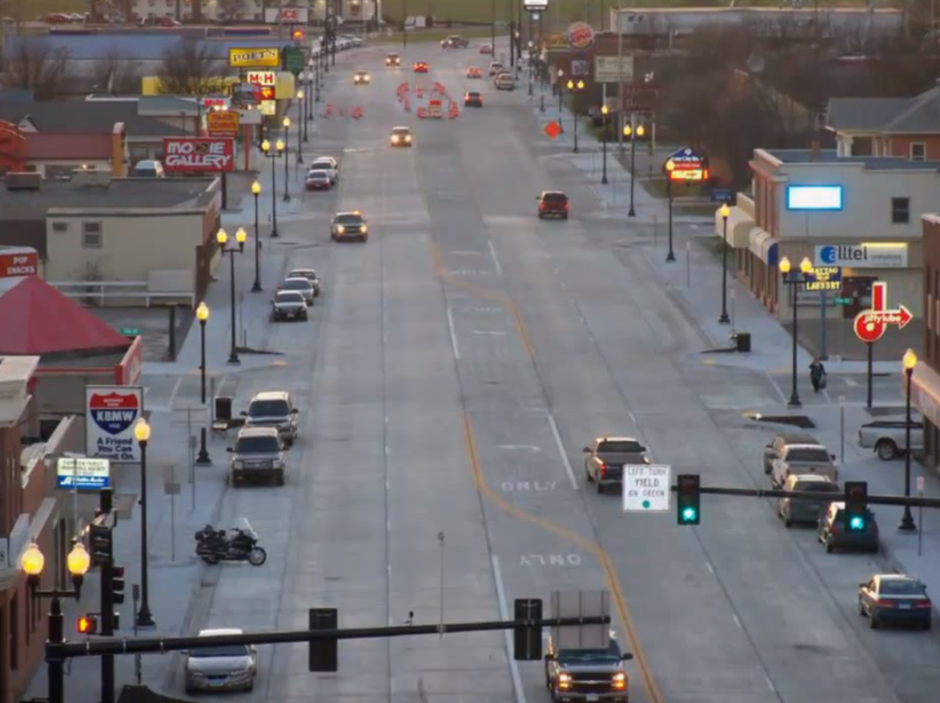
When getting anywhere useful requires navigating places like this [1], using the car for everything quickly becomes the default.
1 - https://assets.bwbx.io/images/users/iqjWHBFdfxIU/ijhV2hgcKaq...
Edit - yes, that photo has sidewalks, but there are so many intersections and road crossing, it's not a pleasant place to walk. Many places don't have sidewalks at all, or have some, but they're disconnected from each other block-to-block. Or you have to walk across a massive parking lot to get to the shops. Much of suburban US really is quite dystopian in this regard.
If this link works [2], it's the intersection to enter th nearest shopping center to my house. Note the lack of sidewalk on at least 2 corners. Crosswalk only on one side (if you live on the close left corner, there's no way to safely walk across the street in either direction). Lack of bike lans on the crossing street (the street has some, but they inexplicably end JUST before the shopping center). And even if you do manage to walk/ride into the shops, you have to dodge cars trying to park before you get to the actual shops. I wish this was unique, but it's extremely common in the suburbs.
2 - https://www.google.com/maps/@38.93839,-77.3287099,3a,75y,293...