Live data from Hacker News

The mid in fake midcentury modern

nplusonemag.com

471–480 of 512 posts

Re: The mid in fake midcentury modern

#471
post #75

Earlier quoted context omitted.

I would describe your second point as gaslighting. Tastes are different and many people dislike modern (and post-modern) architecture. Talking with architects about this, they told me that building differently today is too expensive, doesn't go well with industrialized construction. I argue that architecture is an academic shitshow. It's design for competition juries and not for the people using it. Which is btw very…

Tastes are different. The author could have written, some buildings are ugly. I don't like them. Yet, the author wrote, “everything” is ugly.

The author also cites polls that show the majority seems to agree with them.

Re: The mid in fake midcentury modern

#472
post #19

There is a bank near my house that has a façade second floor. It makes no attempt to look real from any angle, not from the street nor the parking lot. You can see right through the oversized glassless windows into the sky, beyond that the entire thing is wavy in an unpleasant way. It doesn’t even fit with the style of the rest of the building. My suspicion is it exists almost as a critique of the idea of façades? It…

Can you clarify what you mean by a "façade second floor"? To me, façade means front side of the building in general, regardless of how it's constructed.

Re: The mid in fake midcentury modern

#473

Earlier quoted context omitted.

Music produced by software that’s quantized and gridded has been some of my favorite stuff for decades and listening to it does the same thing any recorded music can do such: remind me of something, occasionally teach me something new, be a tool for growth or mourning or comfort. Something being virtuousic or analog or raw doesn’t necessarily make it good. Simplicity or rigidness is not inherently bad. sometimes you…

Haha speaking of barriers and Nine Inch Nails: have you heard the cover of "Head like an hole" by an improbable (but good!) Miley Cyrus? It was made for an episode of Black Mirror.

Yeah. Miley is actually a pretty good rock vocalist that got pigeonholed into pop and had a rebellious stage to break out of it.

Re: The mid in fake midcentury modern

#474
post #315
post #286

Earlier quoted context omitted.

Italy is old. It was founded in 7 bc by Augustus: https://it.wikipedia.org/wiki/Regioni_dell%27Italia_augustea... Sure it unified again only in the 19th century, but it has had a great degree of cultural union throughout its entire history. It is actually one of the most homogeneous countries in terms of language, religion and culture. Italians like to think otherwise for some reason. Sorry for the digression!

As an Italian, I would like to learn how you measured the level of homogeneity of language and culture (on religion I agree with you). The differences in language and in culture were definitely reduced only in very recent years AFAIK, and still remain noticeable. About language, you have to consider how many Italians are (still today) effectively bi-lingual, Italian and local dialect, with the latter ranging from ver…

All italian dialects derive from a single language, with very low influence from the outside. Most Italian dialects are actually intelligible to an Italian speaker in written form and become difficult to understand only because of pronunciation. Try reading a few Wikipedia articles in different Italian dialects and you'll realize you understand at least 90% of text for all of them, possibly with the only exception of Sardinian.

Additionally, dialects were never the language of higher culture anywhere in Italy, all intellectuals have always used a common language and had a nationwide audience even when the country was politically fractured in many states. Said common language being Latin for many centuries after the fall of the Roman empire and Italian from around year 1500.

Re: The mid in fake midcentury modern

#475
post #474
post #315

Earlier quoted context omitted.

As an Italian, I would like to learn how you measured the level of homogeneity of language and culture (on religion I agree with you). The differences in language and in culture were definitely reduced only in very recent years AFAIK, and still remain noticeable. About language, you have to consider how many Italians are (still today) effectively bi-lingual, Italian and local dialect, with the latter ranging from ver…

All italian dialects derive from a single language, with very low influence from the outside. Most Italian dialects are actually intelligible to an Italian speaker in written form and become difficult to understand only because of pronunciation. Try reading a few Wikipedia articles in different Italian dialects and you'll realize you understand at least 90% of text for all of them, possibly with the only exception of…

Dialects are rarely written, they are spoken and while (obviously) usually someone natively speaking a given dialect can talk with someone from another near region, dialects from the north (say Lombardia or Veneto) are so different from those of the south (say Campania or Sicilia) that they are effectively distinct languages.

The above is the hypothetical case of two unschooled people, as said before most if not all italians are bi-lingual with their own dialect and switch automatically to italian (possibly with some local peculiar forms or accent) that is the common language when talking to some "foreigner".

As you say, italians can usually understand (in written form) a dialect because of the common roots, but for what it matters an Italian with some good Latin knowledge can usually get the overall sense of written text in Spanish, Portuguese, Romanian and possibly French.

The unification of language to Italian has been a process that went on for decades, through schooling and later radio and television, when Italy was re-united in the decade 1860-1870 it was a tower of Babel.

Imagine the conversation between a (unschooled) soldier from Friuli attempting to interact with a (as well unschooled) farmer in Sicily in the early years of the unified state.

Re: The mid in fake midcentury modern

#477
post #15

I think the reason might be mechanisation and mass-production. Before that, everything was done by hand, so it wasn't that much more expensive to produce interesting architecture or say hand-crafted ornaments details on buildings. Right now, costs of that would be gigantic (which is shown in giant costs of renovation of historic buildings, which needs to be done using the older methods), compared to a standard boxy b…

But then modern tech allows manufacturing things like ornaments at a fraction of their handmade cost. 3D printing and CNC help a lot with that.

Still way more expensive than just laying cheap, factory-made bricks or pouring cheap concrete. Not to mention, at least in most of Europe, the buildings are expected to be thermally insulated, which is usually done with styrofoam on the outside walls (whereas, in the past we didn't have styrofoam so buildings just needed to have a lot of thermal mass (which in practice meant thick walls), which also made them more interesting and prettier). Placing the ornaments on top of it is not great solution, since the styrofoam has limited lifespan.

Re: The mid in fake midcentury modern

#478

It's worth mentioning that a lot of modern architecture (in single family & small-to-mid multifamily developments) is essentially dictated by money: what sells the best (typically the design that maximizes square footage), what is cheapest to build, and what is capable of passing for a given state and municipalities zoning and building code. People shop by location, price, and square footage as their primary search c…

> Consider a pre-war world with little-to-no television in the average household,

Maybe the lack of TV is why people made their homes beautiful (eg wallpaper is very unpopular today).

Re: The mid in fake midcentury modern

#479
On the subjectivity of "beauty" in modern architecture: - if you average the "subjectivity" of most people (in the USA at least), you get "we prefer traditional architecture": https://www.civicart.org/americans-preferred-architecture-fo... - when you study "composition" in painting or photography, it's obvious that there are some "rules" to make some pictures better than others. Of course there is intent, but there's also this aspect of making things pleasant to look at. Maybe it's the intent of harmony, I don't know. What these rules would be is subject to debate, but it's not unusual to think there aren't natural aesthetics rules in architecture. It ultimately stems from our interaction with the world and the patterns we see in nature. To me this untold magic is best shown in one of the most famous greek sculpture "Laocoon and His Sons". An upside down Chrysler Building would look incredibly off.

On survivorship bias: look at the buildings in this painting: https://fineartamerica.com/featured/view-of-washington-dc-ed... . Do they look exceptionally ugly? To be fair they look almost exactly like the ones in the "old town" part of the city where I live (just more red and less orange), which is the most-visited part of my city (because it's pretty and also walkable).

"It was WWI/WWII" -- Modern art debuted before WWI even happened. Marcel Duchamp's first oeuvre was in 1912, his famous Fountain is from 1917. The fracture didn't happen with WWI/WII even though people keep hammering these points. What started however at the start of the century was the rise of global ideologies: Communism mainly. This is not to say it's communism's fault, it's simply to say that the idea of a bright egalitarian future seem to have coincided with a general renounciation to beauty. And as the brilliant (communist) essayist Lukacz puts it, artistic expressions are reflections of the consciousness of a people at any given time. Modern aesthetics is modern ideology.

"Modern architecture is cheaper" -- It's really not. There's plenty of projects everywhere that were built "classically" and are still comparatively cheaper to their modern counterparts.

Some of you have mentioned Scott Alexander's piece (https://astralcodexten.substack.com/p/whither-tartaria and the very important follow-up https://astralcodexten.substack.com/p/highlights-from-the-co...). The only comment who did argue at length for an opposite case was from... an architect. (Yes I've read all of the comments on both articles, yes this topic is my pet-peeve). Of course, he argues that beauty is subjective ("that's your opinion man") and when challenged on the fact that most people seem to find the buildings he champions as frankly repulsive, he defers to the usual "well you have to understand the point of view of the architect"... And no, no I really don't, and in fact nobody ever needed to do that for any building, ever. Except a certain class of architects when it comes to modern buildings.

I could write an essay on this topic, but I've got to stop here.
Re: The mid in fake midcentury modern

#480

This feels less like it tells us anything about the world but more about how small the author's conception of it is. Reminds me of people who complain about how music is "bad these days" but they're only talking about what they hear on the radio and aren't really exploring what the landscape has to offer A lot of what gets created is for functional purposes, and it has always been that way. As time goes on, the funct…

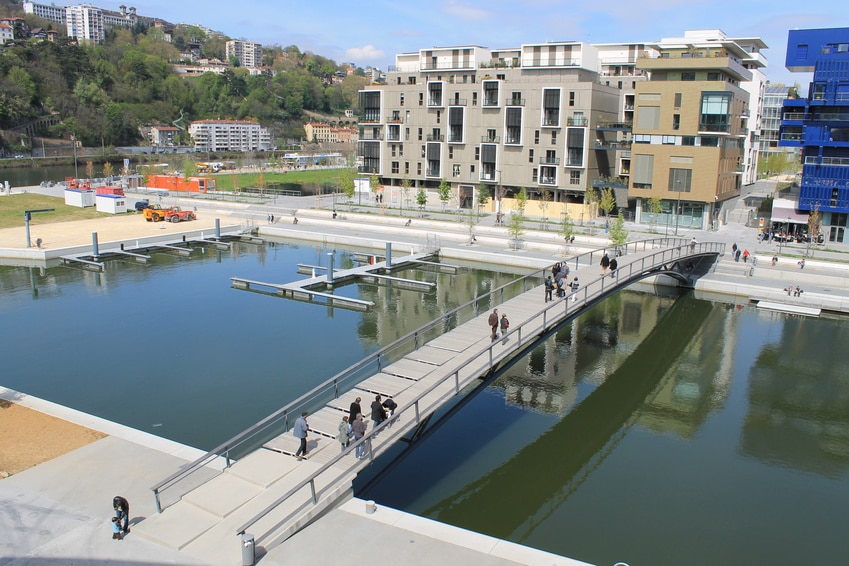
Look at the buildings in this painting: https://fineartamerica.com/featured/view-of-washington-dc-ed... . Do they look exceptionally ugly? To be fair they look almost exactly like the ones in the "old town" part of the city where I live (just more red and less orange), which is by far the most-visited part of my city (because it's pretty and also walkable). People take pictures right outside of the places were I live. There are photography events in my neighborhood all the time. The buildings in the painting sure look more appealing than the brand-new district in my town: https://www.lyon-entreprises.com/wp-content/uploads/confluen...

And yes, the past was much more ornate because architecture was a vector of communication -- administrative/state buildings and religious edifices in particular obviously. Which, as a side effect, produced beauty still revered millennia after its creation. So maybe we should ask: what's modern ideology saying? And what does it says aesthetically? The answer is for all to see, and for all to debate.

Post reply on HN