Live data from Hacker News

Labor market impacts of AI: A new measure and early evidence

anthropic.com

451–460 of 584 posts

Re: Labor market impacts of AI: A new measure and early evidence

#451
post #429
post #419

Earlier quoted context omitted.

Well, you should be terrified of those jobs vanishing I think. All of these people will consequently be on the job market competing for your opportunities. Yes you may feel superior to their capabilities - and may even be justified in your opinion (I know nothing about you beyond this comment)... But it'll still significantly impact your professional future if this actually happens. It would massively impact wages at…

Maybe I’m naive but I’m not terrified about the future at all. Every efficiency wave made life better for humans. Why should this one be different? Assume many people lose their jobs. This in turn means companies will have higher margins. Higher margins attract more competition. More competition means lower margins since some will use the lower costs to offer lower prices. Lower prices increase quality of life for ev…

> People who lost their job might be able to pick up doing something they actually enjoy…

It's more probable they lose everything before ending up with a worse job that pays less.
Re: Labor market impacts of AI: A new measure and early evidence

#452
The endgame will be workers competing with networks of AIs that can solve business problems at all levels.

I'm curious how the system will maneuver itself to deprive workers of pay so that they can stay competitive with the ever-decreasing cost of AI.

Conversely, I'm curious how disruptors will find ways to provide workers with pay (perhaps through mutual aid networks, grants and alternative socioeconomic systems) so that they can use AI to produce the resources they need outside of the contracting labor market.

Re: Labor market impacts of AI: A new measure and early evidence

#453

AI is coming for jobs—but the real risk isn’t where most people are looking. The leading AI exposure indices (Anthropic, Eloundou et al.) focus on which jobs get automated. They treat low exposure as “safe.” But the least exposed workers—cooks, roofers, dishwashers, construction laborers—are often in the worst jobs: low pay, high physical toll, short career spans, and little upward mobility. Safe from AI, but not fro…

What’s your reasoning for labeling lawyers as low-exposure?

My partner is a lawyer (prosecutor for a large city). The reason she is at low risk is simply because of the rate of adoption of AI tooling (or ANY tooling for that matter). IT in the public sector (particularly city government) is so much worse than I ever could have imagined before meeting my partner.

Our city just spent >$15MM on "case management software" that took 5 years to build by some fly-by-night outfit in California who won the contract, haphazardly bolted together MSFT Azure components, then vanished with zero support.

These teams can't in good faith freely adopt AI tooling into their workflow because they don't have the bandwidth to do it well, so they don't do it at all.

Re: Labor market impacts of AI: A new measure and early evidence

#454

Earlier quoted context omitted.

My employer is pretty advanced in its use of these tools for development and it’s absolutely accelerated everything we do to the point we are exhausting roadmaps for six months in a few weeks. However I think very few companies are operating like this yet. It takes time for tools and techniques to make it out and Claude code alone isn’t enough. They are basically planning to let go of most of the product managers and…

Why are you excited for this? They’re not going to give YOU those peoples’ salaries. You will get none of it. In fact, it will drag your salary through the floor because of all the available talent.

I’m excited as a computer scientist to see it happening in my life time. I am not excited for the consequences once it’s played out. Hence my comment about retiring, and empathy for everyone who is still around once I do. I never got into this for the money - when I started engineers made about as much as accountants. It’s only post 1997 or so that it became “cool” and well paid. I am doing this because I love technology and what it can do and the science of computing. So in that regard it’s an amazing time to be here. But I am also sad to see the black box cover the beauty of it all.

Re: Labor market impacts of AI: A new measure and early evidence

#455
post #430

Earlier quoted context omitted.

I often wonder what I am missing. Recently I wanted to wrap a low level vendor API with a callback API (make a request struct and request id, submit, provide a callback fn, which gets called with request IDs and messages received from vendor) to async Python (await make_request(...)). Kinda straightforward - lots of careful code of registering and unregistering callbacks, some careful thread synchronisation (callback…

Based on what I've seen and heard, you have the happy path working and that's what the pro-AI people are describing with huge speedups. Figuring out and fixing the edge cases and failure modes is getting pushed into the review stage or even users, so it doesn't count towards the development time. It can even count as more speed if it generates more cases that get handled quickly.

I'm not sure I agree with this approach, or at least it doesn't work in my area. It's like self driving cars. Having 90% reliability is almost as good as 0%. I have to be confident the thing is gonna work, correctly, or at worst fail predictably.

I can see that there's a lot of applications where things can just randomly fail and you retry / restart, that helps with crashes.

But the AI can't make it not crash, what's to say it does the right thing when it succeeds? Again, depends on the relative cost of errors etc.

Re: Labor market impacts of AI: A new measure and early evidence

#456
post #345
post #93

Earlier quoted context omitted.

Except this is the company that's been saying "We will cause cancer, please regulate us!"

Please regulate our competition! Challenging our monopoly is a national security risk!

Could you point me to a comment where anyone said regulation should only apply to their competition? Any talk has been for the entire AI industry.

If you claim regulation favors the incumbents, well take it up with parent commenter whose comment seems to imply that regulation is needed!

Re: Labor market impacts of AI: A new measure and early evidence

#457
post #429
post #419

Earlier quoted context omitted.

Well, you should be terrified of those jobs vanishing I think. All of these people will consequently be on the job market competing for your opportunities. Yes you may feel superior to their capabilities - and may even be justified in your opinion (I know nothing about you beyond this comment)... But it'll still significantly impact your professional future if this actually happens. It would massively impact wages at…

Maybe I’m naive but I’m not terrified about the future at all. Every efficiency wave made life better for humans. Why should this one be different? Assume many people lose their jobs. This in turn means companies will have higher margins. Higher margins attract more competition. More competition means lower margins since some will use the lower costs to offer lower prices. Lower prices increase quality of life for ev…

Throughout history, what were once middle class and artisan professions were increasingly automated and tons of people and their families ended up in poverty until they died.

We just gloss over them and villify the ones who tried to do anything about it (the ones that weren't executed also died in poverty).

Re: Labor market impacts of AI: A new measure and early evidence

#458

AI is coming for jobs—but the real risk isn’t where most people are looking. The leading AI exposure indices (Anthropic, Eloundou et al.) focus on which jobs get automated. They treat low exposure as “safe.” But the least exposed workers—cooks, roofers, dishwashers, construction laborers—are often in the worst jobs: low pay, high physical toll, short career spans, and little upward mobility. Safe from AI, but not fro…

I mean, if that's true, then the governments around the world better damn well be prepared.

There's a ton of millennials (myself included) turning 40, that have been in this field since 2005 or earlier. It's all we know, and at this point we're getting too old to just "go do physical labor for minimum wage so AI can write code instead." I'm certainly too old to go back to school and try to pass the bar example to be a lawyer at 50+, and I have zero interest in any kind of people management whatsoever.

IMO Anthropic, OpenAI, Google, etc. should all be helping governments work toward a plan and lobbying for regulation on it instead of just charging full steam ahead "damn the consequences, those are someone else's problem."

It's going to obliterate what little is left of the middle class and leave a massive amount of unemployed middle aged tech workers with no where to go. What then? We either get ahead of the problem now (Outlook not so good), or we collapse into massive civil unrest and chaos.

Re: Labor market impacts of AI: A new measure and early evidence

#459
post #407

Earlier quoted context omitted.

... you know what. Whilst I suspect the quality of these translations is probably not great. Fair play this is a valid example.

Of course they are not perfect, but no translation is even close to perfect. The floor is actually incredibly low. All I can say is that many doctoral-level scholars, including myself and some academic publishers, find them to be somewhere between serviceable and better than average.

Knowing the quality of LLM translations between the two languages I speak, hearing it used like this by supposed academics invokes a deep despair in me. "Serviceable" is a flimsy excuse for mass-producing and publishing slop. Particularly given that slop will displace efforts to produce human translations, putting a ceiling on humanity's future output - no one will ever aspire to do better than slop, so instead of a few great translations, we'll get more slop than we would ever even want to read.

I guess it does depend on the languages involved; one study suggests that it's even worse than Google Translate for some languages, but maybe actually okay at EnglishSpanish?

> There were 132 sentences between the two documents. In Spanish, ChatGPT incorrectly translated 3.8% of all sentences, while GT incorrectly translated 18.1% of sentences. In Russian, ChatGPT and GT incorrectly translated 35.6% and 41.6% of all sentences, respectively. In Vietnamese, ChatGPT and GT incorrectly translated 24.2% and 10.6% of sentences, respectively.

https://jmai.amegroups.org/article/view/9019/html

Re: Labor market impacts of AI: A new measure and early evidence

#460
post #125

Earlier quoted context omitted.

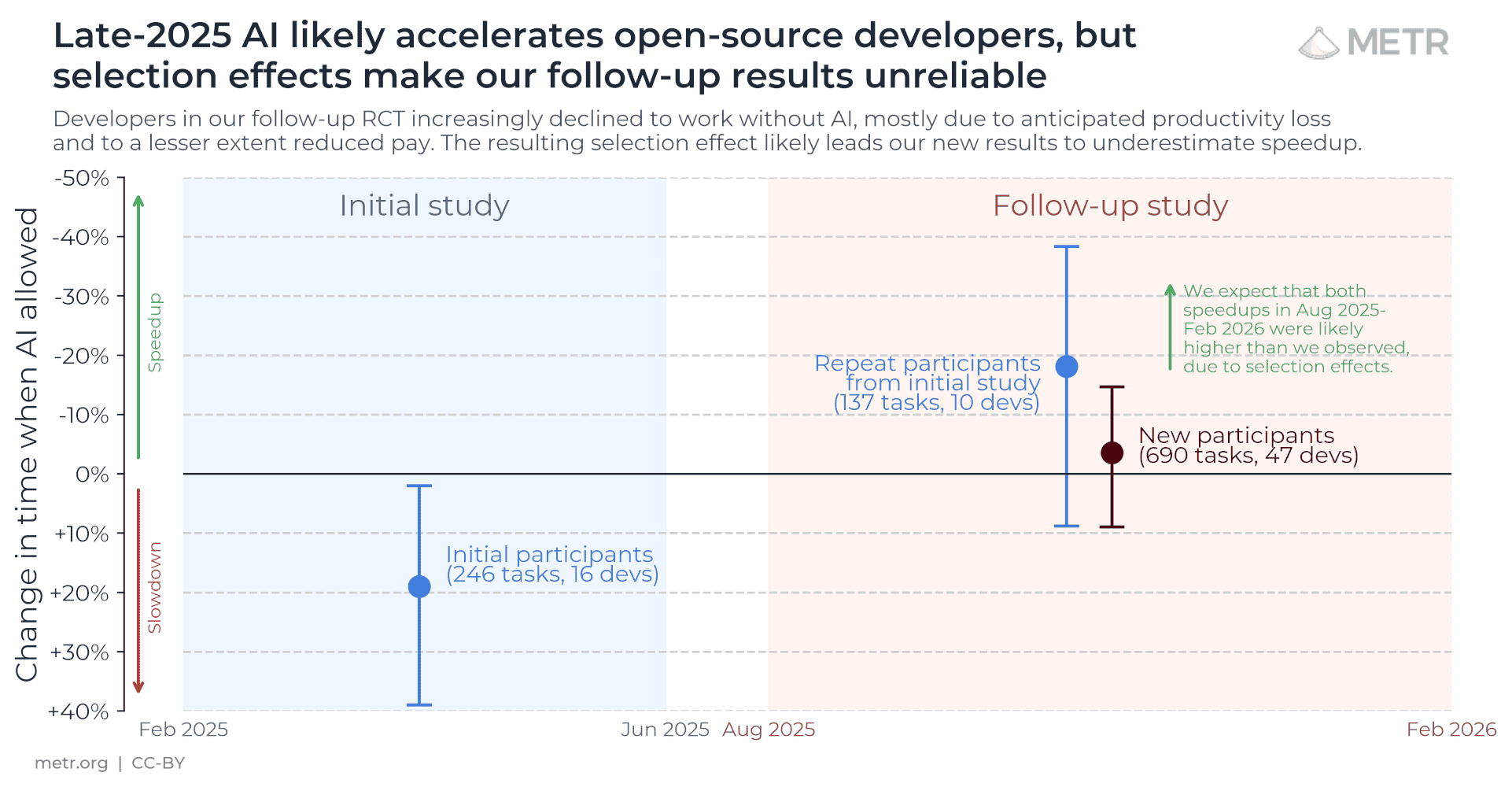
> No productivity studies of individual developers tackling tasks show a 10x speedup; results tend to be anywhere from +20% to minus 20%. The only study showing a -20% came back and said, "we now think it's +9% - +38%, but we can't prove rigorously because developers don't want to work without AI anymore": https://news.ycombinator.com/item?id=47142078 Even at the time of the original study, most other rigorous studie…

> we now think it's +9% - +38% If you are referring to the following quote [0], you are off by a sign: > we now estimate a speedup of -18% with a confidence interval between -38% and +9%. [0] https://metr.org/blog/2026-02-24-uplift-update/

My bad, I messed up by being lazy while switching from decreases in time taken (that they report) to increased in throughput. (Yes, it's not just flipping the sign, but as I said, I was being lazy!) The broad point still holds, their initial findings have been reversed, and they expect selection effects masked a higher speedup.

The language is confusing, but the chart helps: https://metr.org/assets/images/uplift-2026-post/uplift_timel...

Post reply on HN