> DST exists so that the sun doesn't rise around 5am.
No, DST exists so the sun doesn't set around 6pm.
> And that seems to be what the argument boils down to: "I don't want it bright too early".
No, it's not "I", it's about "we the people", and "we the people" don't care as much about "bright too early", rather they care about "dark too early".
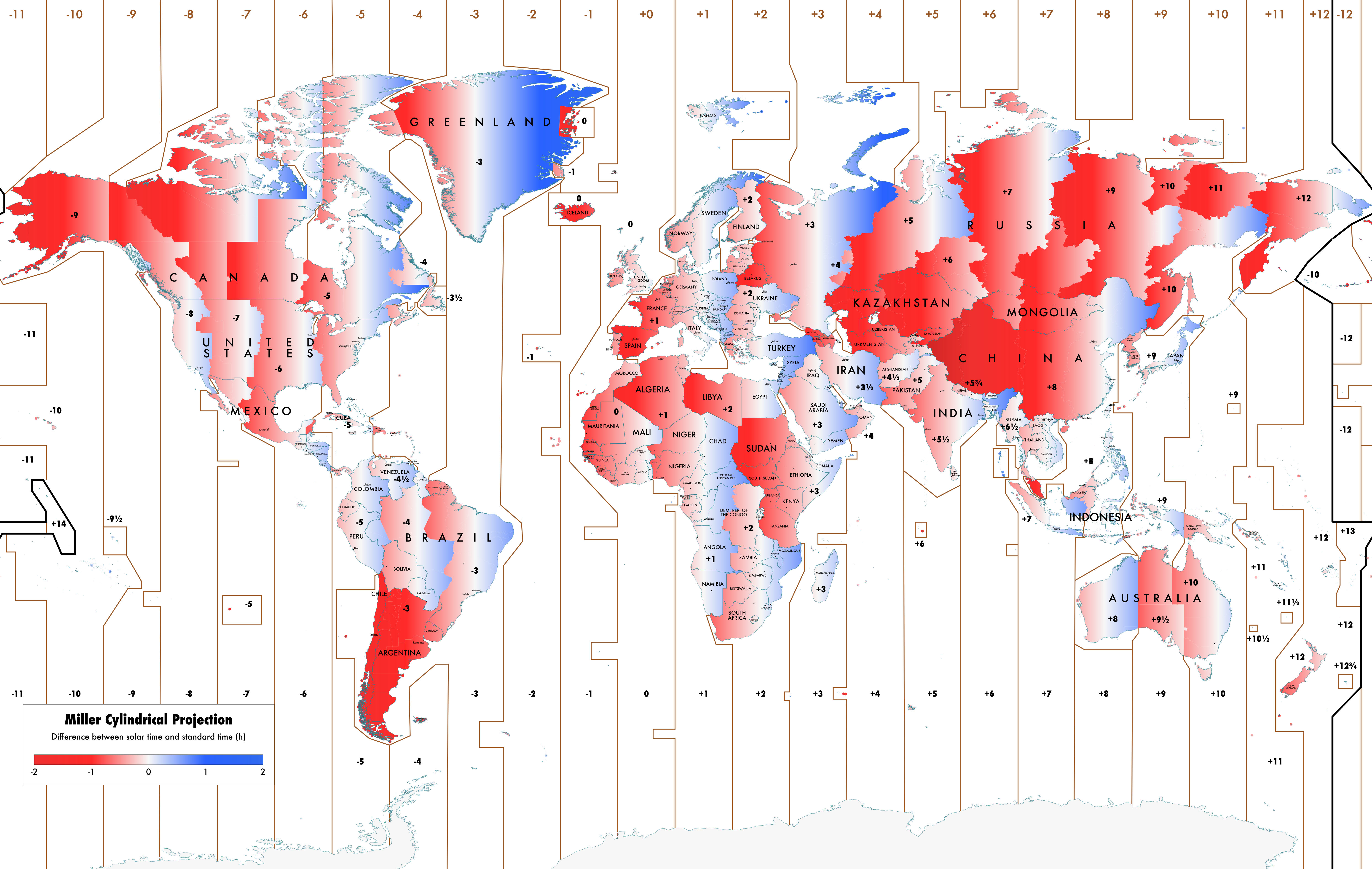
Here is a map of the offset between solar noon and civil noon[0]. The blue places have solar noon (sun in its highest position) before their local clocks show 12h00. The red places have solar noon after their clocks show that. The white places have it about the same time.
Several observations:
1. This is without DST. With DST, blue places turn red, and red places turn even more red.
2. The map is kinda outdated, the bluest most populous country -- Turkey -- moved an hour since, so now it's white at the east and red otherwise.
3. Greenland looks the size of Africa, which is a projection issue, in fact it's much smaller, and that's even before we talk about its minuscule population.
4. There are places like Recife in Brazil, where solar noon varies between 11h03 and 11h33, but they still have more than 12 hours of sunlight most of year, and never less than 11:45, so they hardly care.
5. The vast, vast majority of the world would rather have the solar noon after 12h00 -- meaning, more light in the evening than in the early morning. Santiago de Compostella has solar noon at 13h17 at the earliest and 14h40 at the latest, "relocating" around two hours.
6. The bluest city in the USA is probably Boston, and during standard time their solar noon is 11h30-11h59. During DST, it's 12h40-12h50.
[0] http://blog.poormansmath.net/images/SolarTimeVsStandardTimeV...