Live data from Hacker News

What Happened to the 100000 Hour LED Bulbs?

hackaday.com

441–450 of 519 posts

Re: What Happened to the 100000 Hour LED Bulbs?

#441
post #20
post #12

I've taken every single LED bulb that has failed on me to pieces and it's always the same failure mode. The heatsink compound isn't applied properly to the back of the LED board. The LEDs immediately in the gaps smoke out. Alas this isn't a problem. If a lightbulb goes, Amazon send me a new one out now free of charge and tell me to throw the old one in the trash. This is one manufacturer, prevalent on Amazon, the Lon…

Do not buy "bulbs," they are hopeless. Just buy a whole fixture with a big aluminium PCB and directly bonded chips.

It's a shame that ceiling light fixtures in the US are directly wired and screwed in.

In other countries (both in Sweden where I lived before and here in Japan where I live now) there are special ceiling power outlets, so replacing a light fixture is just a question of unplugging and plugging in again. Japan: https://farm5.staticflickr.com/4279/35698610491_8787f45eae.j... https://farm5.staticflickr.com/4230/35790814576_382943d360.j... Sweden: https://www.eldirekt.se/pub_images/medium/1890776__13222.jpg
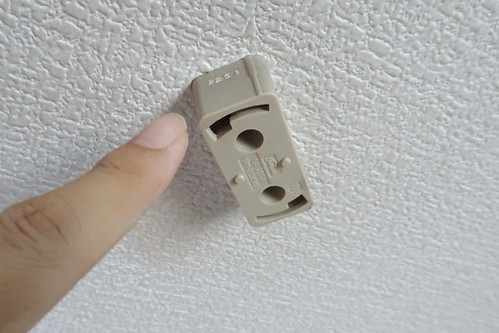
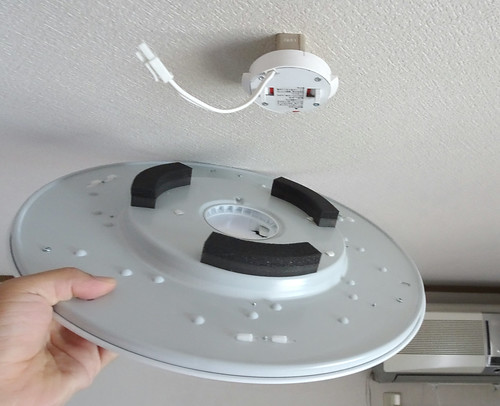
There's a wide range of quality ceiling light fixtures that you just clip into place, and the LED chips are on a huge metal heatsink so they run very cool https://panasonic.jp/light/led/products.html

Re: What Happened to the 100000 Hour LED Bulbs?

#442

Earlier quoted context omitted.

Just how likely is this to happen though, it would have to be the only light source and be flickering with exactly the same frequency as the machinery is traveling at (which i assume for most devices varies a lot). Not saying it can't happen but it does seem stupidly hard to achieve.

You would also have to ignore or miss any other signs of very fast rotation, such as noise or air movement or the power switch being on.

It's easy to miss those signs too. It's common to have earmuffs and sometimes a dust mask on when using power tools, and power switches often don't clearly indicate state. Many start/stop control boxes don't have any visual indication of state at all.

Re: What Happened to the 100000 Hour LED Bulbs?

#443

Earlier quoted context omitted.

Just how likely is this to happen though, it would have to be the only light source and be flickering with exactly the same frequency as the machinery is traveling at (which i assume for most devices varies a lot). Not saying it can't happen but it does seem stupidly hard to achieve.

This is uncommon but not rare. Have you ever seen wheel blur or other artifacting of such? It's very easy to make happen artificially under controlled conditions which means it can't be that hard to happen accidentally. Edited to add: Have you ever heard of a timing light for an engine? This works exactly the way you are describing.

Timing lights for engines work this way for clarity: The distributor on an engine has a spinning rotor and a number of points (one for each sparkplug) on the outside the circle the rotor forms while spinning are a series of contacts across which electricity jumps to send voltage to the spark plug.

The timing light is then pointed at the flywheel on an engine, which has numbers or marks stamped into it. Each time the spark plug fires the timing light (which is hooked into that same current via induction) lights up for a brief amount of time to show at what timing offset the engine is currently at. (this all happens at hundreds of rpms a minute).

so I'm not sure it's the same

Re: What Happened to the 100000 Hour LED Bulbs?

#444

Earlier quoted context omitted.

From the perspective of efficiency, defined as maximum perceived (by human eye) luminosity per watt used, what's the best color for LED bulbs? Is white as good as it gets, or is there any advantage with pure green LEDs?

Go look up scotopic vision, phototopic vision, and metamerism if you want a deeper dive on human vision. Our eyes are most sensitive in the green, but green LEDs are not necessarily the most sensitive

The green LEDs are not necessarily the most efficient in terms of amount of light emitted per watt of energy used, if I understand correctly. Hence the question - is the increased sensitivity to green enough to overcome that inefficiency, compared to white?

Re: What Happened to the 100000 Hour LED Bulbs?

#445
I personally haven't have a LED bulb last 2 years yet, most last 3-6 months. I get them from dollar stores, Walmart, and Ikea. Maybe there is some magical lighting store that sells good ones, but I think there are 3 burnt out ones in various places in my house as I type this.

Re: What Happened to the 100000 Hour LED Bulbs?

#447
post #235

Lifetime isn't even my #1 concern with LED bulbs. It's strobing/flickering. I film all the LED bulbs I buy in slow motion at 240 fps with an Android phone, and play the movie back on a PC with mplayer using the dot(".") key to move frame by frame. Here is a shot I made comparing 2 brands of LED bulbs: https://youtu.be/QbenId_F2RQ (Edit: yeah you don't have to transfer to a PC, just playing back in slow motion on the…

Have you tried this with incandescent bulbs? They flicker at 120Hz too... since they are P=I^2R and driven directly from 60Hz lines. I don't know the amplitude variation that bothers you, but then I don't mind LED bulbs.

Of course it's not the LEDs that do this but the cheap AC-DC conversion bridge rectifier.

Re: What Happened to the 100000 Hour LED Bulbs?

#448
post #429

Earlier quoted context omitted.

Why do they flicker? Are they AC powered?

You can dim LEDs by turning them on and off really fast using a process known as pulse width modulation (PWM). Ideally for something like brake lights you would use a constant current driver to control the light level to prevent flickering. I don't know why GM is using PWM, but I'm guessing they just use a cheap control circuit. I really hate their LED tail lights. Just moving your eyes from side to side is enough to…

Also, due to leakage for large LEDs they are more efficient at higher current. That means that for a given power, you're better off driving them at a higher current for a shorter duration. You can increase the effective luminance without violating the power spec.

Re: What Happened to the 100000 Hour LED Bulbs?

#449
post #447
post #235

Lifetime isn't even my #1 concern with LED bulbs. It's strobing/flickering. I film all the LED bulbs I buy in slow motion at 240 fps with an Android phone, and play the movie back on a PC with mplayer using the dot(".") key to move frame by frame. Here is a shot I made comparing 2 brands of LED bulbs: https://youtu.be/QbenId_F2RQ (Edit: yeah you don't have to transfer to a PC, just playing back in slow motion on the…

Have you tried this with incandescent bulbs? They flicker at 120Hz too... since they are P=I^2R and driven directly from 60Hz lines. I don't know the amplitude variation that bothers you, but then I don't mind LED bulbs. Of course it's not the LEDs that do this but the cheap AC-DC conversion bridge rectifier.

Yeah, but because incandescent bulb filament's retains enough heat to continue to glow between peaks, their flickering is almost negligible - especially compared to poorly designed LED and CF bulbs.

Re: What Happened to the 100000 Hour LED Bulbs?

#450
post #235

Lifetime isn't even my #1 concern with LED bulbs. It's strobing/flickering. I film all the LED bulbs I buy in slow motion at 240 fps with an Android phone, and play the movie back on a PC with mplayer using the dot(".") key to move frame by frame. Here is a shot I made comparing 2 brands of LED bulbs: https://youtu.be/QbenId_F2RQ (Edit: yeah you don't have to transfer to a PC, just playing back in slow motion on the…

I have electric heating and in the winter there is no energy benefit at all from LED bulbs. I want my incandescents back. They really feel comfortable in a way I can't explain.

They really do. I placed an incandescent on a floor lamp to use it for reading, and it's now the most pleasant light on my house by far. But it gives me anxiety to leave it on for a long period of time because I know it's a huge waste of energy. The second best are my Phillips SceneSwitches, which I really love but don't come in 100w.
Post reply on HN