Live data from Hacker News

Nvidia announces financial results for second quarter fiscal 2024

nvidianews.nvidia.com

431–440 of 444 posts

Re: Nvidia announces financial results for second quarter fiscal 2024

#431

Earlier quoted context omitted.

Companies are using both A100 and H100 for inference. The datacenter numbers include both, and I don't believe they break it down further. And no, by and large, large enterprises are not building out large clusters - but they are much of the demand for all those cloud provider build outs. No, no one is using CUDA directly. But if you are a vendor with a new equivalent, it's no small feat integrating it with a framewo…

It would be interesting to see what the breakdown is on H100/A100 users. I would expect most inference users are similar to my lab and max out at a DGX node rather than being the bulk of users. PyTorch has gotten a lot better on TPUs this year, I don’t believe there’s much of a performance hit now. Jax and TF (I don’t use the latter anymore) of course work. I never used Gaudi2 but it apparently works. All of this to…

You may well be right. It's going to be an interesting few years.
Re: Nvidia announces financial results for second quarter fiscal 2024

#432
post #419
post #417

Earlier quoted context omitted.

This is a very good point. It would be ideal to spend the budget rendering only fractional updates to the image, and allow those updates to happen much faster than what would be 60fps. This way we could get 1000hz updates without it costing 10x more than 100hz. While I’m skeptical about the supposed perceptual benefits of full frame rates above 120hz or 240hz outside of the latency argument, foveated fractional rende…

> DLSS is an interesting topic here. Do you see it eventually working for fractional updates? We’d possibly need a new style of NN or of inference? DLSS currently operates on a full frame, and the new version even hallucinates interpolated frames to boost fps artificially. This doesn’t help with control latency at all, in fact it makes it worse. Yeah I've been playing fast and loose with terminology here, there's sev…

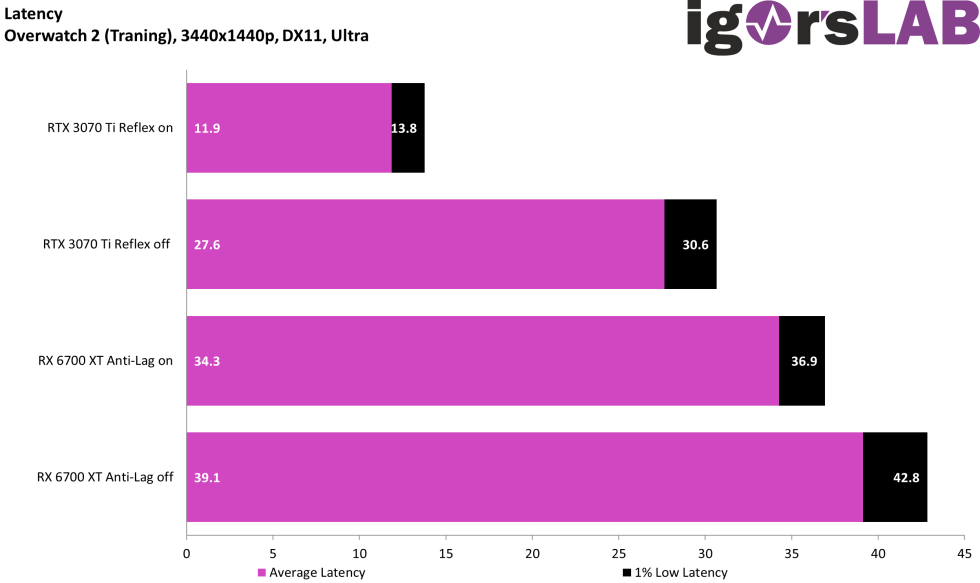
This is great stuff. I don’t have anything useful to add, just wanted to say thank you, TIL. You don’t have links to any write ups about the latency testing by Igor’s Lab & Battlenonsense do you? I’d be interested to learn more about what typical click-to-photon latencies are today for given refresh rates, and how the latency changes wrt refresh rate. The latencies must be absolutely horrendous if we’re talking about differences of 20-30ms? That would tend to justify super high frame rates (assuming they actually reduce latency!), but it’s funny to me that rendering frames faster and faster is seen as the solution, rather than attacking the issue of a render+display pipeline with insane and growing latency.

Re: Nvidia announces financial results for second quarter fiscal 2024

#433

Earlier quoted context omitted.

Yes, it's fine to have a large product line with different price points for different consumers, but I don't think it's quite fair to add the last generation's cards in there too (because they won't be around forever). Typically they only keep 2-3 generations alive in the marketplace at any given time, and if the prices keep going up, once the 30xxs disappear, so too will the affordability. Even an entry-level 4060 i…

Perhaps - but as long as they’re are profitable skus I don’t see that happening. The lower and mid range build scale for them. If they need more scale for the high end they can simply produce fewer, but by making as many as they can at any cost point they improve economics. Also often there is a probability distribution of quality of components, and by having a low end to saturate the excess that is below high end gr…

You mean things like binning?

But aren't most hardware producers these days fab-limited, with Apple, Samsung, Nvidia, etc. all competing for the same few foundries, especially at the smaller processes?

If they only have X amount of production available a year, it seems like they'd want to focus those on the super-high-margin high-end datacenter cards rather than the leftover low-end stuff. Or maybe the high/low stuff are manufactured on different pipelines altogether, that don't suffer from the same production limits? I'm not sure how that works...

Re: Nvidia announces financial results for second quarter fiscal 2024

#434

Earlier quoted context omitted.

This is the point. This is a textbook situation that would be perfect for a competitor to come in and undercut. However not only is that not happening, nobody is even trying. Making the “theory” pretty worthless if it’s not even applicable in cases that would naturally produce this market entrant. The reality is that private equity does not actually want to compete with large global brands.

> This is a textbook situation that would be perfect for a competitor to come in and undercut. Do you have any idea how much R&D it takes to make a GPU, let alone something that could possibly compete with NVIDIA? This is not something a dozen people in a large garage are going to do. > However not only is that not happening, nobody is even trying. AMD has been trying to compete for years. If you're a gamer that does…

> the barrier of entry into the GPU market is probably at least a couple billion dollars.

There are $BN Private Equity deals done everyday, there's plenty of money to fund a competitor.

No, I think people are just scared and don't care about the existence of monopolies.

Re: Nvidia announces financial results for second quarter fiscal 2024

#435
post #349
post #190

Earlier quoted context omitted.

Nvidia and really all chip designers are limited by the fab companies who are trying to scale as fast as they can. But all the cutting edge fabs are limited by one single supplier - ASML. ASML make the lithography machines and have a total monopoly. Even they cannot make lithography machines fast enough to satisfy demand - their lithography machines are sold out 2 years in advance

The current limitations are not about litho at all but actually about CoWoS stacking capacity.

``` CoWoS stands for Chip on Wafer on Substrate. It is a high-density packaging technology for high-performance chips. TSMC developed CoWoS in 2012. In CoWoS, multiple silicon dies are placed on a silicon interposer, which is an intermediate layer on the package board. The interposer acts as a communication layer for the active die on top. CoWoS is a 2.5D packaging technology. It is widely used in high performance computing. ```

Re: Nvidia announces financial results for second quarter fiscal 2024

#437
post #430
post #423

Earlier quoted context omitted.

Looks like you were specifically a console game dev? PC games have not aimed for 30fps either ever or at least for the last 2 decades. Consoles are hilariously far behind PC in this aspect. The whole "science says the human eye cannot see beyond 30fps :)" is actually a very old meme at this point. You are correct that high FPS/Hz is about decreasing latency, but you underestimate the importance of it. 144hz is a very…

Guilty as charged, yes you’re right I was a console game dev. Fair enough, yes PCs are way ahead of consoles and I overstated the perceptual limits of frame rates. I didn’t really mean to suggest that competitive twitchy PC games have no reason to go above 60fps, I meant that there’s a whole swath of other kinds of games that don’t need it (consoles, mobile, puzzle games, etc. etc.). I was reacting more to the idea o…

> Even with vsync there’s up to one frame to recognize inputs, then another frame to produce new game state & submit the render, then 1 or 2 more for double or triple buffering, then maybe supersampling and/or denoising, then whatever the monitor does, and I might be missing some steps that add latency.

VSync introduces latency, so it always gets disabled, same with double/triple buffering. I don't think gaming monitors do anything to process the image, they're usually advertised with ~1ms response times.

> Does CS:GO and do other modern games poll the controller at the display refresh rate?

Modern gaming mice and possibly keyboards use 1000hz polling.

> I know it’s pretty common for a lot of games to decouple rendering from game state.

I think all modern games do. Some old games have issues running at fps other than 60 due to this coupling.

> I’m curious where the perceptual limits really are, and what the max framerate we actually need is.

I don't know exactly; there are definitely diminishing returns, like you've mentioned:

- 30fps: 33ms / frame

- 60fps: 17ms / frame (2x cost for -16 ms)

- 144fps: 7ms / frame (2.4x cost for -10 ms)

- 240fps: 4ms / frame (1.6x cost for -3 ms)

- 500fps: 2ms / frame (2x cost for -2 ms)

- 1000fps: 1ms / frame (2x cost for -1 ms)

Just from looking at those numbers, 144fps is still a clear win and 240fps probably makes sense too, if you've optimized your setup for latency. Everything beyond is probably pointless, unless it's your job to play competitive FPS games ;)

Re: Nvidia announces financial results for second quarter fiscal 2024

#438
post #153

Earlier quoted context omitted.

My point is, 8% on earnings is hardly volatile. > Not if you understand what stocks are and how betting on biotech stocks is not a wise investment. So you're giving investment advice for putting money in NVDA stock at the top or all time highs, right now on earnings as a 'wise investment' to make 8% (after hours) when others are clearly taking their money out of the market. Unless you already invested in NVDA stock l…

If you think Nvidia isn’t a volatile stock then you have no business discussing stocks at all. By any standard industry measure, Nvidia stock is highly volatile and it can be seen mathematically by just looking at the IV over time.

> If you think Nvidia isn’t a volatile stock then you have no business discussing stocks at all.

After warning not to buy stocks like NVIDIA at the top when other investors with larger capital are taking their money off the table?

An 8% move in reaction to earnings is close to nothing to what I've seen as 'volatile' compared to the stocks shown in my original comment, which were up / down > 20% in ONE day without earnings. 8% is close to nothing for retail investors like almost everyone here and likely yourself.

Also I'm not the one giving advice over looking at the IV or telling retail investors to jump into Nvidia stock at the top as a 'wise investment' or to use 0DTE option gambling strategies, a popular favourite with lots of retail traders.

Now it is 10% down after the smart money started taking their profits off the top as I warned days ago whilst many retail investors who bought in at the top are now left stuck in the market.

Re: Nvidia announces financial results for second quarter fiscal 2024

#439
post #71

Earlier quoted context omitted.

Exactly. Nvidia is just one of many lottery tickets and 8% in one day is hardly volatile in stocks.

Volatility in stocks is measured in terms of “IV” (implied volatility) and Nvidia (and Tesla) have some of the highest IV in the stock market which is why they are so interesting for people trading in options making money from theta decay. Also I would add, volatility measures continued volatility over periods of time, not single days. Most pharma stocks are essentially static for months or years until they announce…

> which is why they are so interesting for people trading in options making money from theta decay.

Exactly, using the IV for supporting their highly risky 0DTE option trading strategies and gambling on earnings rather than investing long term?

> Most pharma stocks are essentially static for months or years until they announce one good result and the stock jumps 30% in a day.

That is the point on long term 'investing'.

A much lower risk and patient strategy to invest and buy such low priced stocks at the bottom for the long term and take profit after the price jump rather than gambling on ridiculous short term option trades or the retail favourite of 0DTE trading strategies which that is just plain gambling.

Re: Nvidia announces financial results for second quarter fiscal 2024

#440
post #432
post #419

Earlier quoted context omitted.

> DLSS is an interesting topic here. Do you see it eventually working for fractional updates? We’d possibly need a new style of NN or of inference? DLSS currently operates on a full frame, and the new version even hallucinates interpolated frames to boost fps artificially. This doesn’t help with control latency at all, in fact it makes it worse. Yeah I've been playing fast and loose with terminology here, there's sev…

This is great stuff. I don’t have anything useful to add, just wanted to say thank you, TIL. You don’t have links to any write ups about the latency testing by Igor’s Lab & Battlenonsense do you? I’d be interested to learn more about what typical click-to-photon latencies are today for given refresh rates, and how the latency changes wrt refresh rate. The latencies must be absolutely horrendous if we’re talking about…

https://www.igorslab.de/en/radeon-anti-lag-vs-nvidia-reflex-...

https://www.igorslab.de/wp-content/uploads/2023/04/Overwatch...

https://youtu.be/7DPqtPFX4xo?t=727

(highly pronounced in this game but)

Yes I agree that driver overhead+latency reduction in the pipeline matters a lot and that's the tool Intel just dropped (and has probably optimized their own driver for of course). Classic Tom Peterson, lol, just like FCAT.

https://www.youtube.com/watch?v=8ENCV4xUjj0

Post reply on HN