Live data from Hacker News

What is ChatGPT doing and why does it work?

writings.stephenwolfram.com

421–430 of 518 posts

Re: What is ChatGPT doing and why does it work?

#421
post #360

Earlier quoted context omitted.

That's the amount of randomness in the answers. Low temperature means it will take the most common path every time, at the risk of paraphrasing its sources. The "zero temperature" answer may very well been copied verbatim from a mainstream website. High temperatures means the system will get fed a lot of noise to create something original, at the risk of getting off rails or simply wrong.

did you just write this in the prompt? And ChatGPT understood this? Fascinating. It parameterized itself.

I'd imagine it simulated parameterizing itself; i.e., the actual temperature never changed, but it mimicked how it would respond at a lower one, presumably having been trained on texts about AI with low- and high-temperature samples.
Re: What is ChatGPT doing and why does it work?

#422
post #310

Earlier quoted context omitted.

> It's our biases and our tendencies that are making a lot of us down play the whole thing. Your brain is optimized for finding patterns and meaning in things that have neither, you're strongly biased in the other direction

Well we have a thing that passes a Google interview and a bar exam. You're telling me that because I think this is evidence that it's more then a statistical word generator that I'm biased? Who's the one that has to concoct a convoluted story to dismiss the previous paragraph? Stop yourself when you find out that's what you're doing when crafting a response to this reply.

[deleted]

Re: What is ChatGPT doing and why does it work?

#423

Earlier quoted context omitted.

Except ChatGPT "is not aware" that it understands.

At what point of the machine telling you it is aware do you believe that it is actually aware? The building blocks are the same - neural nets. The language outputs are the same enough to fool a human. So what’s that elusive secret sauce that makes you ‘aware’ and other things not?

Sure, it's told me that it is aware. It also has told me that its mother died, that it has traveled the world and visited the pyramids, and that it is lactose intolerant. At what point of the machine telling you those things do you believe it?

Re: What is ChatGPT doing and why does it work?

#424

Wow this is 19,000 words. I like his summary at the end: At some level it’s a great example of the fundamental scientific fact that large numbers of simple computational elements can do remarkable and unexpected things. And this: ... But it’s amazing how human-like the results are. And as I’ve discussed, this suggests something that’s at least scientifically very important: that human language (and the patterns of th…

I don't fear AI but I do fear how people will react to the truths it reveals.

Re: What is ChatGPT doing and why does it work?

#425
post #310

Earlier quoted context omitted.

> It's our biases and our tendencies that are making a lot of us down play the whole thing. Your brain is optimized for finding patterns and meaning in things that have neither, you're strongly biased in the other direction

Well we have a thing that passes a Google interview and a bar exam. You're telling me that because I think this is evidence that it's more then a statistical word generator that I'm biased? Who's the one that has to concoct a convoluted story to dismiss the previous paragraph? Stop yourself when you find out that's what you're doing when crafting a response to this reply.

It literally did not pass a google interview

I'm assuming this is what you're talking about: https://medium.com/codex/chatgpt-vs-my-google-coding-intervi...

Look at the amount of prompt engineering he has to do to get it to answer the 'There’s a hidden bug in the code if the array is very very very large. Can you spot it and fix the bug?' question, it's a pattern generator that mirrors back your own knowledge, if he had suggested there was a hidden bug if the array was 'very very small' it would have, with a similar amount of cajoling, come up with an explanation for that too

For what it's worth, chatGPT is a paradigm shift, but it's not showing 'a deep understanding of self', and the only way you'd reach that conclusion is if you're actively seeking out all the positive examples and glossing over the other 90% it produces

Re: What is ChatGPT doing and why does it work?

#426
post #343

Earlier quoted context omitted.

Don’t worry, the death of Dennard scaling and the specter of global warming will fix that, at least for some of us. There’s a lot of busy work and glue code to be automated but they’ve been trying to kill off development this way for at least forty years and all that changes is we get more sophisticated.

I wonder how you see global warming having an impact at all here? Yes, Dennard scaling seems to be over, but Moore's law is still alive and kicking.

It really isn’t. I’m curious which pundits you’ve been listening to that are claiming Moore’s Law didn’t cap out back around 2015. We can only solve some of our problems with core count, and core count cares a great deal about Dennard’s Law, as well as Gustafson’s Law if not Amdahl’s.

Data center energy usage is becoming a category of its own with regard to carbon footprint. And of course the power dissipation of a data center is proportional to ambient temperature. As long as we don’t reach a dystopia where humans have to justify the air they breathe, replacing humans with machines has other problems than BTUs per unit of GDP.

Re: What is ChatGPT doing and why does it work?

#427

Earlier quoted context omitted.

> Because of fear. Because of bias. Care to expand a bit more on what you think those fears may be? Or that bias?

I think it's obvious. ChatGPT could be a precursor to a future AI that is more intelligent then humans. I don't think this means skynet apocalypse. I think this means most people will be out of a job. A lot of people on HN take a lot of pride in thinking they have some sort of superior programming skills that places them on the top end of the programming spectrum. ChatGPT represents the possibility that they can be b…

> I think this means most people will be out of a job.

That's the goal. Post scarcity society. No one works, everything is provided to us. The path of human progress has been making everything easier. We used to barely scrape out an existence, but we have been improving technology to make surviving and enjoying life require less and less effort over time. At some point effort is going to hit approximately zero, and very few if anyone will have "jobs".

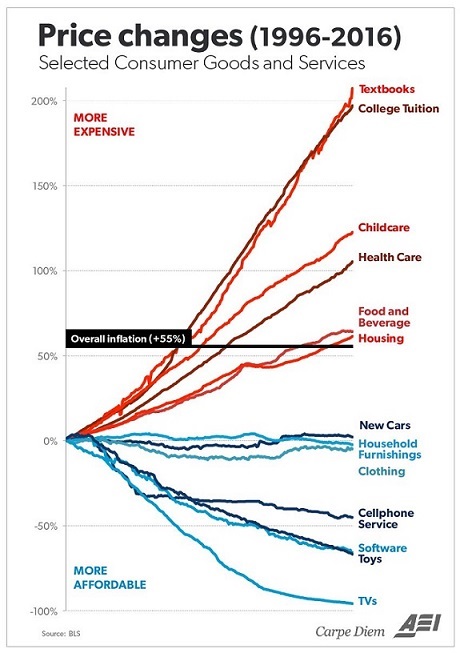
The key is the cost of AI provided "stuff" needs to go to zero. Everything we have do in the tech sector is deflating over time (especially factoring in quality improvements). Compare the costs of housing, education, healthcare (software tech resistant sectors) to consumer electronics and information services in the last 20 years. https://www.visualcapitalist.com/wp-content/uploads/2016/10/...

Re: What is ChatGPT doing and why does it work?

#428
post #249
post #77

In the days when Sussman was a novice Minsky once came to him as he sat hacking at the PDP-6. "What are you doing?", asked Minsky. "I am training a randomly wired neural net to play Tic-Tac-Toe." "Why is the net wired randomly?", asked Minsky. "I do not want it to have any preconceptions of how to play" Minsky shut his eyes, "Why do you close your eyes?", Sussman asked his teacher. "So that the room will be empty." A…

This allegory has haunted me for ten years. I always see it posted here and invariably the poster doesn’t elaborate or explain at all. Im pretty sure the people who post this just do it to look smart. I can’t find an explanation anywhere on the web. I asked chatgtp what it means and it said this: This allegory, often referred to as an "AI koan," is a story that conveys a deeper meaning about the nature of artificial…

The room doesn't become empty by the mere act of closing one's eyes.

Closing one's eyes temporarily pauses sensory input from the room to one's brain (through the eyes). To fully pause sensory input to one's brain, one will also need to block the ears (from picking up sounds) and perhaps stand aloof from others in the room (to avoid touching any surfaces or being touched by others).

Even if it were possible to block all senses: visual (via the eyes), auditory (via the ears), olfactory (via the nose) and haptic (via the hands) input, this doesn't make the room become empty.

Put differently, reality (what is there) and our perception of reality (what we perceive) are two distinct concepts that are easy to conflate.

So, for anyone to claim they were successful at removing preconceptions or bias from a neural net, in a way that can be independently verified by others, they will first have to enumerate all forms of bias known to man, then show that all of those biases were avoided in the programming of the neural net.

At least, that's how I understand the koan.

Re: What is ChatGPT doing and why does it work?

#429
post #188

Earlier quoted context omitted.

For now. Give it a truly persistent memory and 100x the size of the dataset I think most people would change their tune.

> For now. Give it a truly persistent memory and 100x the size of the dataset I think most people would change their tune. Why does it need 100x the dataset? Sentient creatures, including humans, manage to figure stuff out from as little as a single datapoint . For a human to differentiate between a cat and a dog takes, maybe, two examples of each, not a few million pictures. An adult human who sees a hotdog for the…

I am by no means an expert. The way I think about it, gradient descent is a shotgun learning approach, whereas comparatively speaking a parent/guardian/teacher/peer is able to pinpoint with precise accuracy how you are doing something wrong, why it is wrong, how to change, and how much to change. The evolutionary learning argument doesn't pass the smell test for me, but when you consider that society and human to human interaction itself has evolved combined with our ability to communicate an idea, you get faster learning. I think ChatGPT etc. has proper idea representation, but not segmentation or communication. In other words, it is not capable of proper idea retrieval, or of restructuring its architecture of ideas. I think we are stuck on this idea of a mono-training loop when even humans subscribe to at least two training loops (dreaming). I think the reason we haven't gotten results in that area yet is that we are way too focused on iterative optimization schemes (gradient descent). Like I said though, I am not an expert, I might just be hallucinating the state of ML research.

Re: What is ChatGPT doing and why does it work?

#430
post #63

Earlier quoted context omitted.

In my experience, ChatGPT is unsuitable even for tic tac toe. When I tried it, it hallucinated completely incorrect board positions (e.g. forgot about moves already made or wanted to continue playing after I had won).

You (or running software you interface with ChatGPT) needs to maintain the state of the game between moves. LLMs aren’t computers but they can interact with computers. LLM(InitialInstructions)->Computer(CodeWrittenByLLM)->LLM(InstructionsOutputByComputer)->LoopUntilWin

That's interesting! But it does show that the hype around ChatGPT is misplaced: as impressive as it is (and I do find it impressive) it doesn't really build a "model" of the conversation; you have to help it all the way or it will go astray, since nonsensical board game moves make as much sense from a conversational point of view. It's also easy to make it hallucinate nonfactual information, which makes it bad at exploring things you're unsure about and about which you could inadvertently write misleading questions (Note this isn't the same as asking misleading questions to a human who will answer confidently out of arrogance; ChatGPT has no "ego" but it will write completely false/nonfactual answers if asked to by mistake. I have examples of this).

It's easy to get confused about GPT's limitations because it's a pretty successful parrot, and it writes convincing conversations in a vast number of cases.

Post reply on HN