I browsed some online listings for ECC memory modules, and they seem to be sold one module at a time. Standard DDR4 modules are sold in pairs, to benefit from dual channel mode.
Does ECC memory support dual channel??
401–410 of 567 posts
Does ECC memory support dual channel??
Earlier quoted context omitted.
I have a TPMS programming tool (ATEQ QuickSet) and reader (Autel TS401), because I like to swap my winter / summer tires on my own. The TPMS light came on one day and inflating tires didn't help - I used the reader and found that one sensor's ID had changed. When I compared the ID (it was in hex) to the last programming - it was a single bit off. I couldn't reprogram the sensor itself, but I was able to update the EC…
Similar story, we saw that one particular IP address in a public cloud network had a 3% TLS handshake error rate. We diverted traffic and then analyzed with wireshark. We found one particular bit was being pulled low (i.e. 0 -> 0 and 1 -> 0). HTTP connections didn't notice but TLS checksum verifications would randomly fail. Had a hell of a time convincing the cloud provider they had a hardware fault- turned out to be…
I still remember Craig Silverstein being asked what his biggest mistake at Google was and him answering "Not pushing for ECC memory." Google's initial strategy (c. 2000) around this was to save a few bucks on hardware, get non-ECC memory, and then compensate for it in software. It turns out this is a terrible idea, because if you can't count on memory being robust against cosmic rays, you also can't count on the soft…
ECC memory can't eliminate the chances of these failures entirely. They can still happen. Making software resilient against bitflips in memory seems very difficult though, since it not only affects data, but also code. So in theory the behavior of software under random bit flips is well... Random. You probably would have to use multiple computers doing the same calculation and then take the answer from the quorum. I…
There is an OS that pretty much fits the bill here. There was a show where Andrew Tanenbaum had a laptop running Minix 3 hooked up to a button that injected random changes into module code while it was running to demonstrate it's resilience to random bugs. Quite fitting that this discussion was initiated by Linus!
Although it was intended to protect against bad software I don't see why it wouldn't also go a long way in protecting the OS against bitflips. Minix 3 uses a microkernel with a "reincarnation server" which means it can automatically reload any misbehaving code not part of the core kernel on the fly (which for Minix is almost everything). This even includes disk drivers. In the case of misbehaving code there is some kind of triple redundancy mechanism much like the "quorum" you suggest, but that is where my crude understanding ends. AFAIR Userland software could in theory also benefit provided it was written in such a way to be able to continue gracefully on reloading.
Earlier quoted context omitted.
> how do you ensure the computer that does the comparison is not affected by memory failures? You do the comparison on multiple nodes too. Get the calculations. Pass them to multiple nodes, validate again and if it all matches, you use it.
> validate again Recursion, see recursion.
Earlier quoted context omitted.
I've considered using an AMD CPU instead of Intel's Xeon on the primary desktop computer, but even low-end Ryzen Threadripper CPUs have TDP of 180W, which is a bit higher than I'd like. And though ECC is not disabled in Ryzen CPUs, AFAIK it's not tested in (or advertised for) those, so one won't be able to return/replace a CPU if it doesn't work with ECC memory, AIUI, making it risky. Though I don't know how common i…
Keep in mind that Intel lies about its TDP.
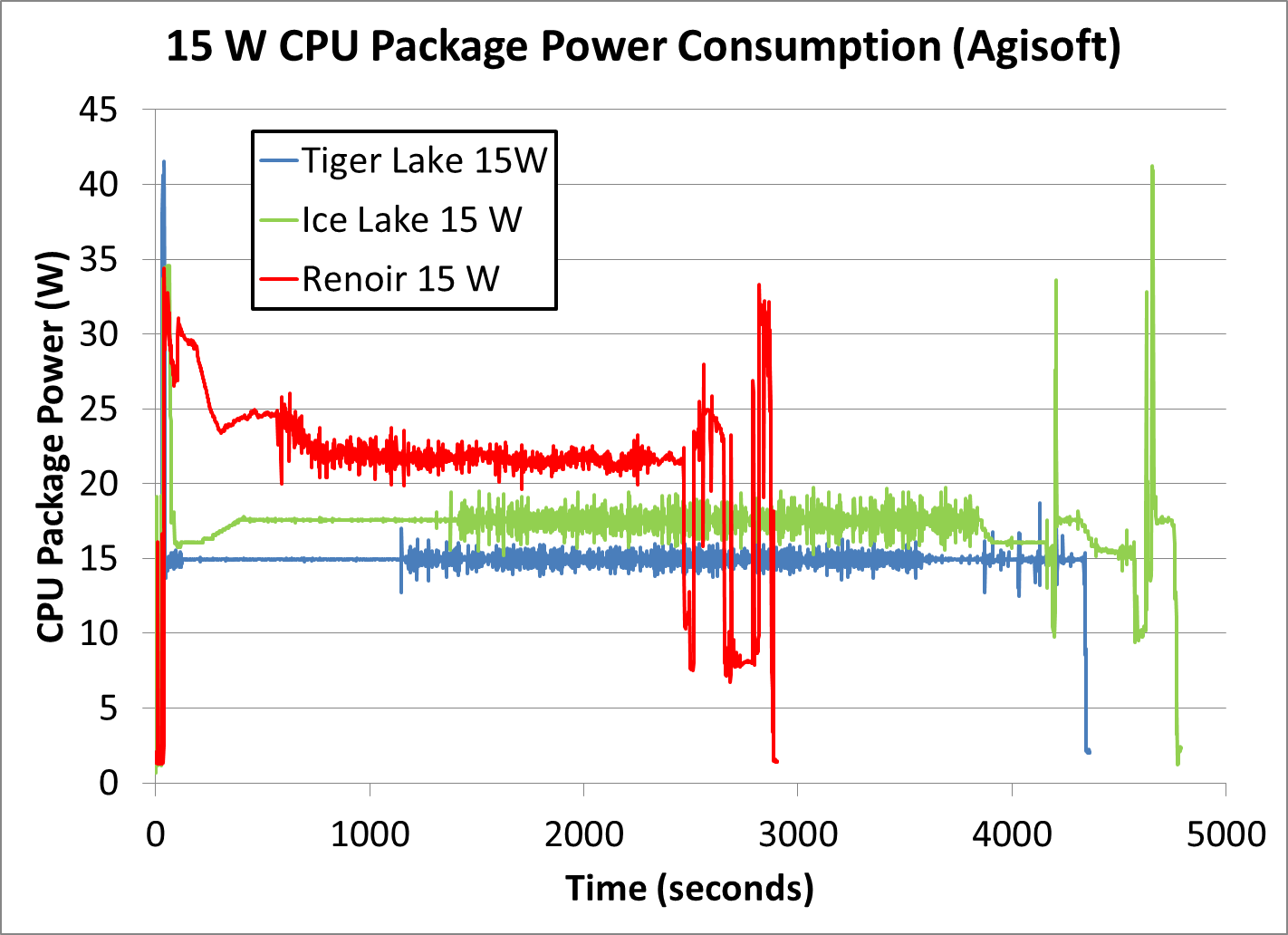
Intel mobile processors actually obey TDP better than AMD processors do - Tiger Lake has a hard limit, when you configure a 15W TDP then it really is 15W steady-state once boost expires, while AMD mobile products will pull up to 50% more than configured in steady-state operation. (the gap is larger than desktop)
https://images.anandtech.com/doci/16084/Power%20-%2015W%20Co...
"the brands measure it differently" is sort of theoretically true but not in the sense people think, and in practice it is not true.
On AMD it is literally just a number they pick that goes into the boost algorithm. Robert Hallock did some dumb handwavy shit about how it's measured with some delta-t above ambient with a reference cooler but the fact is that the chip itself basically determines how high it'll boost based on the number they configure, so that is a self-fulfilling prophecy, the delta-t above ambient is dependent on the number they configure the chip to run at.
In practice: what's the difference between a 3600 and a 3600X? One is configured with a TDP of 65W and one is configured with a TDP of 95W, the latter lets you boost higher and therefore it clocks higher. Configure them both to a 65W PPT limit and they will boost to pretty much the same place.
Intel nominally states that it's measured as a worst-case load at base clocks, something like Prime95 that absolutely nukes the processor (and even then many processors do not actually hit it). But really it is also just a number that they pick. The number has shifted over time, previously they used to undershoot a lot, now they tend to match the official TDP. It's not an actual measurement, it's just a "power category" that they classify the processors as, it's informed by real numbers but it's ultimately a human decision which tier they put them in.
So in practice, for both brands, it is just a number they pick. They have different theoretical methods for getting there but ultimately the marketing department looks at where the clocks would put them and pick a power number that they think represents that. It is not, in practice, a pure measurement from either brand, it is just a "category" they use.
Real-world you will always boost above base clocks on both brands at stock TDP, at least on real-world loads. You won't hit full boost on either brand without exceeding TDP, the "AMD measures at full boost" is categorically false despite the fact that it's commonly repeated. AMD PPT lets them boost above the official TDP for an unlimited period of time, they cannot run full boost when limited to official TDP.
Earlier quoted context omitted.
I went through this about a year ago, to build a low-TDP ECC workstation. I do not have stats on failure rates, just this anecdotal experience. Asrock and Asus seem to be the boards to get. For RAM, I got two sticks of Samsung M391A4G43MB1, and verified. The advice I remember from the forums was to stick to unbuffered ram (UDIMMS).
Did you consider any off-the-shelf ECC boxes? Found some here -- bottom of the EPYC product line starts at $2849 ...! https://www.velocitymicro.com/wizard.php?iid=337
Earlier quoted context omitted.
Performance/watt matters. You can just set TDP to what you want with throttling choices. If you want a 45W TDP from the 3700X, you can just pop into Ryzen Master and ask for a 45W TDP. Boom, you're running in that envelope. I think shopping based on TDP is not the best, because it's not comparable between manufacturers and because it's something you can effectively "choose".
Yeah but can I get a metric ton of benchmarks at that 45w setpoint? I don't really see the reason in paying for a 100w TDP premium if I'm just going to scale it down to 65w.
Yup, they're out there.
> I don't really see the reason in paying for a 100w TDP premium if I'm just going to scale it down to 65w.
You might want the core count or peak performance for the very short term. When I was looking, running 65W parts in the 45W envelope was only about a 7% penalty, so you get a bunch more performance/watt.
Earlier quoted context omitted.
While it's true that Intel only has ECC support on Xeon (and several other chips targeted at the embedded market) it's not true that ECC is supported well on AMD. We only use Xeons on developer desktops and production machines here precisely because of ECC. It's about 1 bit flip/month/gigabyte. That's too much risk when doing something critical for a client.
> it's not true that ECC is supported well on AMD ECC is supported on most Ryzen models[1], as long as the motherboard supports it. In fact, ASUS and ASRock (possibly others) have Ryzen motherboards designed for workstation/server use where ECC support is specifically advertised. [1] The only exception is the Ryzen CPUs with integrated graphics.
The latter is a big problem, one of the extreme-OC guys (Buildzoid) who interacts frequently with the OEMs (as he is pushing their stuff to the limit and he frequently needs their help) has commented that AMD has a really bad problem with their BIOS teams. The AGESA firmware (the low-level code that the processor actually runs) is buggy as all hell at a firmware level and the OEMs are forced to patch around it in BIOS, but the AGESA firmware also has a massive problem with code churn, so these BIOS fixups basically stop working all the time. And the driver teams at a lot of OEMs are literally one person, so there isn't enough staffing there to test everything all the time. Long and short of it is: stuff breaks in AMD BIOSs, constantly, and they don't notice it.
This is obviously a huge problem when ECC is not an officially supported feature, because it means nobody is testing it! You might update your BIOS (as you frequently have to do with AMD machines) and suddenly ECC stops working, it might be running ECC in non-ECC mode and no longer correcting errors. Or it might have screwed up reporting them to the OS.
The server/workstation boards are the only ones you should be trusting Ryzen with ECC usage on.
Earlier quoted context omitted.
I don't think ECC is going to give anyone a false sense of security. The issue at Google's scale is they had to spend thousands of person-hours implementing in software what they would have gotten for "free" with ECC RAM. Lacking ECC (and generally using consumer-level hardware) compounded scale and reliability problems or at least made them more expensive than they might otherwise had been. Using consumer hardware a…
consumer hardware... That's Intel's PR. Only "enterprise hardware", with a bigger markup, supports ECC memory. Adding ECC today should add only 12% to memory cost. AMD decided to break Intel's pricing model. Good for them. Now if we can get ECC at the retail level... The original IBM PC AT had parity in memory.
You can actually, most AMD consumer chips (except the ones with integrated graphics) have ECC support, even though it's not officially supported. See this Reddit thread for more details: https://www.reddit.com/r/Amd/comments/ggmyyg/an_overview_of_...