Live data from Hacker News

What I learned from reading a thousand emergency room bills

vox.com

401–410 of 592 posts

Re: What I learned from reading a thousand emergency room bills

#401
post #181

Earlier quoted context omitted.

We do not have a free market. Most people get their health insurance from their employer - you cannot reasonably get insurance elsewhere (the same plan I have now for $100/month would cost over $1000/month, but I can't take that $1000/month to anyone else if I don't like my insurance so I accept it). This keeps me from taking a long leave of absence to live off my savings - until I quality for retirement (medicare).…

> We do not have a free market. Most people get their health insurance from their employer - you cannot reasonably get insurance elsewhere What you are describing are in fact the freest parts of the health insurance market. Employers, quite rationally and of their own free will, choose to offer health insurance as a benefit because it attracts and retains talent better than other similarly priced incentives. The fact…

> quite rationally and of their own free will

Is this the magic phrase that means "free market" to you? Because the word "free" is in it?

We could say that the USSR, quite rationally and of its own free will, sent millions to the gulags and forced labor camps to create widgets. Cute, right? Hey, they did it quite rationally (after all, the labor is way cheaper when you're using prison camps) and of their own free will, therefore it's the free market!

Re: What I learned from reading a thousand emergency room bills

#402

Earlier quoted context omitted.

> Price discovery requires pricing some people out of the market. Period. There is no "free market" healthcare system that can or ever will deliver required health services to everyone. There is no economic system that can deliver all of the health care to everyone who wants it. Fundamentally, health care resources are limited: doctors, beds, MRI machines, etc. Desire for health care is much less limited. The questio…

"Don't let The Perfect be the enemy of The Good." We are overspending on the quality of health care we get today. Further there is a lot of fear mongering about socialized medicine. I've experienced medicine in both the UK and the US. I can tell you, there isn't a difference in quality. Further, when I got a cold and went in, wait time wasn't 6 hours or whatever other BS people claim. Wait time was ~10 minutes. In fa…

I've had different experiences from you. My experience in the UK was wait 90 minutes in a waiting room and when it was finally close to my turn I was told I could only see a nurse and she wasn't allowed to proscribe any medicine so if I wanted to see a doctor I should go down the street to the private doctor. This was in London near Soho.

In Japan the first time I went to a doctor it was for stomach pain. He gave me on ultrasound and declared I had hepatitis. My personel department at my company decided to take me to another doctor. Had to weight 2.5 hours in a room with around 250 other sick people. Was finally told I had food poisoning.

I am not defending the USA system but both the UK system and the Japanese system have issues as well. I've spent the most time in the Japanese system. What I like is it's easy to see a doctor and relatively cheap. Prices are apparently set by the government. Conversely a large percentage of Japanese doctors are quacks and would be unqualified to practice in the USA. It's a common topic of conversation for foreigners here to tell their horror stories of all the crazy experiences they've had with doctors here. Also, top doctors, or rather surgeons are known to require bribes in the $XXXX-$XXXXX range beyond the decided on fees.

Re: What I learned from reading a thousand emergency room bills

#403

Earlier quoted context omitted.

Not everywhere, though. In Denmark, private operators have been handling emergency services since 1926; currently one company (Falck) is handling 65 percent of municipal fire brigades and 85 percent of ambulance services. No particular nastiness has been reported afaik.

The US has lots services that are provided by regulated monopolies. My garbage company, power company are all regulated monopolies. A key thing is you're required to have garbage and power service but the rates are negotiated by a public utilities commission or the city or county. However Healthcare in the US isn't a regulated monopoly like that.

And there was an entire thread about how those regulated monopolies are not working well. In particular PG&E in California.

I think it was this one

https://news.ycombinator.com/item?id=18690916

Re: What I learned from reading a thousand emergency room bills

#404
The reason we don’t have universal healthcare is mostly racism and male supremacy. Racist white people dont want anyone with dark skin getting a “free ride”. And, supporters of patriarchy don’t want their stay-at-home wives to be able to get healthcare without going through them because it undermines the husband’s power and control. They will use the language of “personal responsibility” or “free markets” to describe it, but the same people who don’t want universal healthcare also wave confederate flags and think that a woman’s place is in the home.

Re: What I learned from reading a thousand emergency room bills

#405
post #346

Earlier quoted context omitted.

If two crews have to show up for a fire... That means higher prices because most of the time there is no fire, so they just sit around waiting -- more people higher cost. It also means it might be that nobody shows up, because it's a holiday, so nobody was on duty.

> It also means it might be that nobody shows up, because it's a holiday, so nobody was on duty. Well surely public services are more incentivized to display this behavior

Public services are often incentivized to create more work to protect their jobs. Famous examples include whatever department was enforcing prohihbition in the 20s to find other things to prohibit when alcohol prohibition was repealed. In Japan it's common to see unneeded road work because if the entire budget it not spent it will be reduced.

Re: What I learned from reading a thousand emergency room bills

#406
post #14

Exhibit A for why "free market healthcare" is an oxymoron. I have yet to hear a coherent explanation for how anyone can reasonably expect for price discovery to even pretend to function in a market where the consumers can't even guess the prices until after they've already purchased and frequently couldn't reasonably be expected to refuse service even if they did believe it was overpriced.

If it's such a free market, I implore HNers to explain what it might take to start your own free market hospital in the United States. Let me know what regulations you'll need to meet. Compare to opening a cafe.

And I'm not saying a hospital or a cafe ought to be at all similar. That's not the point. The point is how odd it is to pretend that health care is a "free market" in the current state as some rhetorical device to associate these surprise fees with free markets.

At a cafe, you don't get charged for using a stirrer or spoon or napkins. A cafe doesn't charge you for sitting on a stool. Free market health care would operate in the same way, if it existed. You get charged for your operation, they don't add in fees for specific items that you needed that would reasonably be expected as part of the process (a Tylenol pill, using a tissue, the gloves your surgeon wore). And again, I'm not suggesting this is how it ought to be, but let's not be disingenuous and pretend that absurd, opaque prices are somehow a result of a free market.

Re: What I learned from reading a thousand emergency room bills

#407

Earlier quoted context omitted.

Price discovery requires pricing some people out of the market. Period. There is no "free market" healthcare system that can or ever will deliver required health services to everyone. Furthermore when the alternative is death or debilitation, the price a "consumer" is willing to pay is effectively everything they possess and can borrow. That is both a massive distortion and non-optimal for the economy as a whole. The…

> Price discovery requires pricing some people out of the market. Period. There is no "free market" healthcare system that can or ever will deliver required health services to everyone. There is no economic system that can deliver all of the health care to everyone who wants it. Fundamentally, health care resources are limited: doctors, beds, MRI machines, etc. Desire for health care is much less limited. The questio…

But does it make sense to exclude coverage based on ability-to-pay or some other criteria?

Say, medical necessity and probable benefit?

We're a long way from those particular decision criteria, presently.

Re: What I learned from reading a thousand emergency room bills

#408

The reason we don’t have universal healthcare is mostly racism and male supremacy. Racist white people dont want anyone with dark skin getting a “free ride”. And, supporters of patriarchy don’t want their stay-at-home wives to be able to get healthcare without going through them because it undermines the husband’s power and control. They will use the language of “personal responsibility” or “free markets” to describe…

I was expecting to get downvoted for this, but it’s still true. In countries where women can get free childcare and free healthcare, they have more power. American men deeply fear this. In the end, like everything else, it’s all about power- who has it, who doesn’t. Big healthcare also makes a killing on the situation, but here in the states conservatives have always been willing to make the devils bargain of allying themselves with the ruling class in order to preserve white supremacy and male supremacy. It’s true no matter how many downvotes I get.

Re: What I learned from reading a thousand emergency room bills

#409
A question that frequently comes up in healthcare debates is "would you rather be alive now or alive with the medical technology of 1970".

You'd be giving up genetic testing, numerous advances in wound care, a number of advanced antibiotics, leaps in transplant technology, and a whole slew of joint-replacement innovations. Plus cancer treatments, and of course, AIDS therapies. Massive impacts, right?

And if today is better than 1970, 1970 was better than 1950, and 1950 better than 1920, and....

Right?

Not so fast.

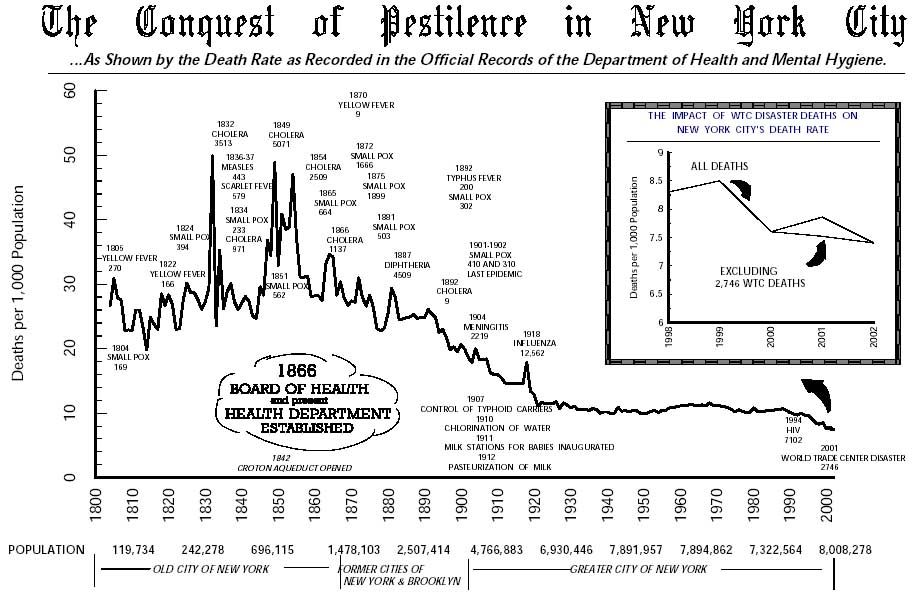
New York City have been tracking mortality rates since 1800, and there's a chart I love to pass around in these discussions, with the charming cocktail-party friendly title of "The Conquest of Pestilence in New York City ... as shown by the death rate as recorded in the official records of the Department of Health and Mental Hygiene".

The 20th century has seen a host of medical advances: antibiotics, vaccines, transplants, tailored drugs, implants. High-cost, yes, but huge impacts.

No, not really.

https://1.bp.blogspot.com/-uTWEATUzgxk/TXQoTibILtI/AAAAAAAAA...

The turning point in the chart -- where the increase in mortality as New York as it grew from a town of 60,515 (1800) to a city of 813,669 (1860), was the formation of the Department of Public Health itself, in 1866. Peak mortality hit 50/1,000 in the 1830s, 180s, and 1860s, with a sustained average above 35/1,000, and marked volatility as the city was rocked by epidemics. By the 1890s, it had fallen to 20, and 1920, about 12. The pre-WWII low was actually in 1939-40, at just over 10, and mortality rose through the early 1970s. There has been a further decline, to about 7.5, since 1990.

Analysis elsewhere suggests that this is almost wholly attributable to increased longevity among minority populations -- nonwhites generally, black women, and especially black men. My suspicion (though I've not researched in depth) is that this is largely attributable to increased access to medical care, either through improved socioeconomic status and access to the commercial healthcare market, or through public health programmes. There is little if any evidence that the gains come from medical technology itself.

This is a topic that's been much studied. Robert J. Gordon's epic assessment of US economic progress, The Rise and Fall of American Growth (2016) looks hard at medical advances, particularly since 1970, and finds them largely absent. Victor Fuchs, healthcare economist (heavily cited by Gordon) has found published similar results for the past few decades.

A personal anecdote is a close friend who'd died of an obscure cancer in the early 1990s. The (brutal) treatments they'd undergone were essentially unchanged since the early 1970s, or even 1960s, as I read the literature, and have changed little in the ensuing nearly three decades. Given that one of the questions and agonies we faced at the time was "what if some miracle cure emerges, or we weren't doing enough", this failure-to-advance is in some ways a bit of validation: we really try to do everything we could, and applied the best available knowledge, and no, even now, the outcome is virtually unchanged: four out of five patients with that diagnosis die within five years, often less.

(Other friends have survived their, mostly other, cancer diagnoses. And of the cancer-friends we'd made, some are still alive, others have died, in cases of complications from treatment, including blood- and tissue-donation related infections such as hepatitis. Life is not fair.)

Real healthcare improvement, as with so many other quality-of-life improvements, comes not from heroic measures, but by assuring adequate access. And the market is a terrible mechanism for assuring such adequacy.
Re: What I learned from reading a thousand emergency room bills

#410

Earlier quoted context omitted.

> without even getting a quote beforehand Reminds me of this really good article. TLDR: Man tried to call a number of hospitals to find out how much childbirth is going to cost him and received no answers. https://www.vox.com/2016/5/5/11591592/birth-cost-hospital-bi...

Realistically, no hospital is going to give out a price. They don't know what unexpected complication may arise that requires additional services.

My veterinarian manages to give quotes - before they do emergency treatment, they come up with a low, typical, and high quote, and I have to agree to pay up to the "high" price before they'll start the treatment (if I refuse, then they'll come up with an alternate, possibly less effective, treatment plan.

It's a little harder to do that with humans since they aren't going to pause an operation, keep the incision open, and tell the spouse "We found an unexpected tumor, so let's wait an hour while we generate a new quote and you can decide if you want to pay it".

But that should be part of the quote "Unexpected events can cause us to exceed the quote", and then they should have to document why it was unexpected.

Post reply on HN