Live data from Hacker News

How knowing Lisp destroyed my programming career (2006)

coding.derkeiler.com

401–410 of 433 posts

Re: How knowing Lisp destroyed my programming career (2006)

#401
post #300

Yeah, I totally agree with the sentiment of the article. While Lisp my have been cool in the 80s, it's not the 80s anymore and nobody wants to write AST directly. No matter how powerful the technique , it's way too low level for the modern world.

Pecking out the ASCII tokens and punctuation of mainstream languages isn't a 'high-level' experience either.

Syntax is way down the list of difficult things in the craft of programming, compared to properly understanding problem domains, internalising techniques for robustness, etc.
Re: How knowing Lisp destroyed my programming career (2006)

#402

Earlier quoted context omitted.

The great Lisp and Smalltalk systems are designed from the ground up with the assumption that a programmer may at any point inspect and possibly change absolutely anything in the dynamic environment of the running program. Everything is designed to facilitate doing that with the reasonable expectation that the program will continue to work correctly. Such systems are designed for writing software by modifying a progr…

Sorry to reply to myself, but when I awoke this morning, it occurred to me that above I am describing my daily-driver programming environment from early 1988, Coral Common Lisp (except that who-calls wasn't built in; it was a contrib). Besides the previously-mentioned features, I could build a windowing UI by dragging pieces together. I could build the resulting native-code app for delivery by choosing "Save" from a…

I haven't used Coral Common Lisp, but I've used SBCL. It does have much of what you're describing, and I do have to wonder why it didn't catch on with a wider audience.

There's a general belief in the tech community that better tech wins. When something works better, hackers will start using it, and if there are incidental barriers, they get solved. None of the explanations I've seen have been satisfactory; I reject the both the idea that Lisp isn't really that big an advantage and that the average hacker isn't smart enough to see it.

Re: How knowing Lisp destroyed my programming career (2006)

#403
post #395

Earlier quoted context omitted.

It seems to me that, out of ten graduates from a CS program, only one is going to go on to do academic computer science; the other nine are going to become computer programmers. CS programs are doing a poor job of preparing those nine. Now, in other areas, we have a distinction. We have physics departments that teach people theory, and we have separate engineering departments that prepare people for careers putting t…

So, you're suggesting that computer engineering be separated from computer science, with CS being in the Math department. And you would expect CS to be a relatively small major.

I think that would be reasonable, yes. It would parallel other science/engineering splits.

Re: How knowing Lisp destroyed my programming career (2006)

#404
post #402

Earlier quoted context omitted.

Sorry to reply to myself, but when I awoke this morning, it occurred to me that above I am describing my daily-driver programming environment from early 1988, Coral Common Lisp (except that who-calls wasn't built in; it was a contrib). Besides the previously-mentioned features, I could build a windowing UI by dragging pieces together. I could build the resulting native-code app for delivery by choosing "Save" from a…

I haven't used Coral Common Lisp, but I've used SBCL. It does have much of what you're describing, and I do have to wonder why it didn't catch on with a wider audience. There's a general belief in the tech community that better tech wins. When something works better, hackers will start using it, and if there are incidental barriers, they get solved. None of the explanations I've seen have been satisfactory; I reject…

SBCL is great. I use it often.

I don't think the proposition that better tech wins passes the laugh test. You could argue that I'm a cynical old curmudgeon, though. I've been writing software for a living for thirty years now.

It's not about hackers being smart enough to see Lisp's advantages. It's about them (1) being the sort of programmer who prefers programming-as-teaching over programming-as-carpentry, and (2) getting enough exposure to live-programming environments to see what the deal is. The important advantages are not immediately obvious. They're whole system synergies, and it takes time and experience to grasp the nature of stuff like that, regardless of how smart you are.

Plus, maybe there are just more carpenters than teachers.

Re: How knowing Lisp destroyed my programming career (2006)

#405
post #86

Earlier quoted context omitted.

What made it click for me is the nature of scheme: a few, very well thought out abstractions, that compose well to build a really neat language. I never really made friends with other languages. Where scheme composes the primitives for problem solving, I find that languages like python or ruby provide either one way for each different thing, or a very large hammer for every problem you might find, be it list comprehe…

> a very large hammer for every problem you might find, be it list comprehensions or generators or whatever OO voodoo you can come up with. List comprehensions, to me, are what makes Python a productive (or the most productive) prototyping language. It allows me to think and program in mathematical relations without much fuss. Add to that nice sets and dicts (needed for asymptotic efficiency), and I can easily forgiv…

>Code generation is mostly bad(...)C structs and enums,

C macros (or "C code generation" if you prefer) is very, very different from Lisp macros.

Lisp macros are built into the language, the whole language itself is designed around this capability.

Re: How knowing Lisp destroyed my programming career (2006)

#406
post #346
post #308

Earlier quoted context omitted.

>>Since only CL and Emacs Lisp can and do share actual Lisp code But what exactly is 'actual lisp'. I mean what is this strict definition? Forgive me, I understand calling Scheme and CL as same might feel like saying Java and C++ as same. But one would be right in saying Java and C++ both come from a C based paradigm. On the same lines one could say CL and Scheme come from lisp paradigm. At this point in time both co…

The problem is that both CL and Scheme communities have very little to do with each other. For practical purposes Lisp dialects are those directly inheriting back to Lisp I from McCarthy. You can run programs from 1960 in Common Lisp with very little changes (unless it uses machine interfaces). To port them to Scheme is possible. To port them to Logo, Clojure, Javascript or other languages considered to be dialects i…

>The problem is that both CL and Scheme communities have very little to do with each other.

At first I thought this was absurd, but after some time learning Lisp this was more obvious.

Scheme and Common Lisp are built around totally different philosophies, and thus not only the languages diverge, but also the way you program in them.

Re: How knowing Lisp destroyed my programming career (2006)

#407
post #375

Earlier quoted context omitted.

Why do you need the meta-capabilities of lisp? Well, language designers are human and can't predict all the features that you might find useful. Take, for example, list comprehensions. I added some basic ones to common lisp in a couple of minutes. (defun read-comprehension (stream char) (declare (ignore char)) (destructuring-bind (expr for var in list &optional if filter-exp) (read-delimited-list #\] stream) `(loop ,…

This looks impressive on the first sight (kudos!). But on the other hand it's still a pretty fragile and unreadable macro, no? And it supports only a very limited form of list comprehensions. Can "destructuring-bind" support them fully?

Anyone who would like to use list comprehension forms, or read about how Lisp enables them, might find these papers interesting:

Implementation of a "Lisp comprehension" macro by Guy Lapalme http://rali.iro.umontreal.ca/rali/sites/default/files/publis...

Simple and Efficient Compilation of List Comprehension in Common Lisp by Mario Latendresse http://www.ai.sri.com/~latendre/listCompFinal.pdf

Re: How knowing Lisp destroyed my programming career (2006)

#408

Earlier quoted context omitted.

I think this is going into the wrong direction. In my world "plumbing" means realizing ways to do things. When you want to write a simple web app that shows a Hello and has a contact form: even in 2018 that's still a reasonable amount of work. It's really not a lot of code but every line needs to be chosen wisely. That's what I call "plumbing". Most people new to Software Development become desperate at such tasks an…

> I'm not sure if you must be able to use strace to be productive You will be productive until whatever runtime/library you are using has a serious bug or performance issue. Then you either use tools like strace or your productivity drops to 0. It is not a matter of marginal or order-of-magnitude productivity differences. You don't "understand stuff" for sentimental reasons, you "understand stuff" because the alterna…

Wow nice. I want to do this one day too ;)

> It's called learning.

Haha

Re: How knowing Lisp destroyed my programming career (2006)

#409
post #74

Earlier quoted context omitted.

Your confusion will go away once you recognize that Scheme is not Lisp. For most purposes, Lisp means Common Lisp, or one of the Lisps that ended up merging into Common Lisp. That means that Lisp does all of these things and more, which you might not expect if you've only seen Scheme/SICP: * Multi-paradigm programming (functional programming in the immutable sense is not dominant, the Lisp OOP system is top class, mu…

I think this comment is unhelpful. The meaning of "Lisp" is a little bit complicated, but I think it can be explained better than this. "Lisp" has two meanings: (1) ANSI Common Lisp; and (2) the family of programming languages to which ANSI Common Lisp belongs, and which was called "Lisp" many years before ANSI Common Lisp was conceived; that family includes many other languages with quite a bit of variety, including…

I appreciate the feedback. Maybe my approach could have left out the claim of Lisp == Common Lisp, though I still am amused (as I mention near the end of my later comment) and slightly bothered that such a diverse set of languages (Python too, it's sometimes called an acceptable Lisp) can get called "Lisps" or "dialects of" or "members of the family" rather than an explicitly vague "Lisp-like".

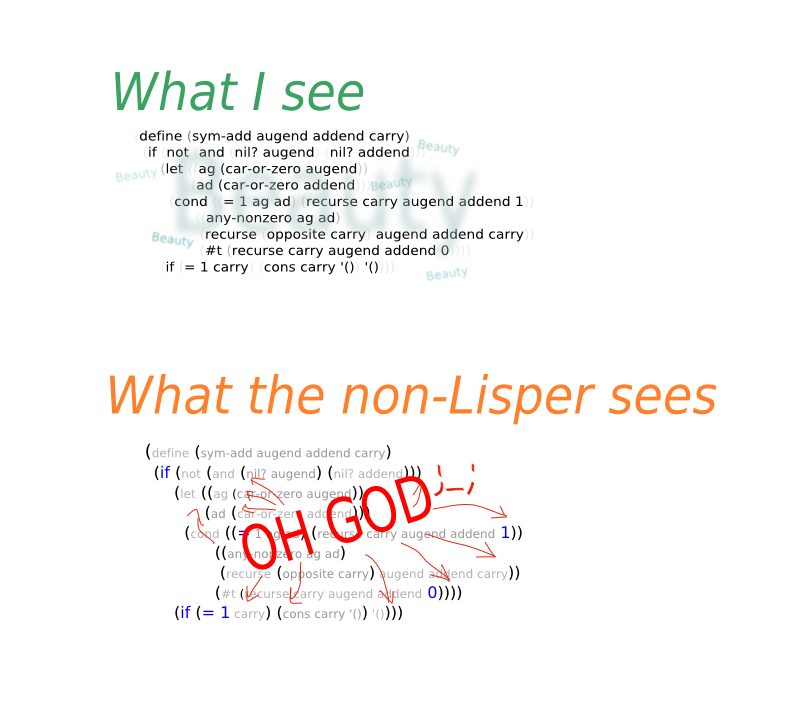
The main direction I was coming from though was that ~10 years ago I was just like the OP, I had read some of SICP and PG's essays and thought I knew Lisp, but no, I just knew a minimal subset of Scheme. Very pretty (https://www.thejach.com/imgs/lisp_parens.png), learned some neat things, but didn't pursue it in favor of practical workhorses like Python et al. I went with the "learn Lisp for the side effects of learning it but don't ever use it" crowd, but I never learned Lisp. It wasn't until much later that I found out Common Lisp was way more than just an ugly syntax change on Scheme that required #' in front of function names. So the features I listed in my comment are really a subset (but a strong one) of the features that would have convinced me ~10 years ago to take a much closer look into actually using Lisp and recognizing I learned something very different.

Re: How knowing Lisp destroyed my programming career (2006)

#410
post #66

Earlier quoted context omitted.

> The C and Perl style OTOH has changed less. A programmer of those language from 20 years ago that is transported to the present day will have much less problems fitting in than a programmer of C++ and Java would. This is categorically untrue for Perl.

Care to elaborate?

Compared to 98?

- DBIx::Class instead of DBI is a huge change; even DBI was reasonably new back then, with people still using MySQL.pm

- Moose and Moo over everything being hand-roled. I remember in 98 trying to convince people to use OO at all for anything.

- The testing ecosystem is very different / much improved, and people actually write them?

- People are really using strict, "use warnings" is a thing instead of -w

- Catalyst/Mojolicious/Dancer on Plack instead of mod_perl being cutting edge; even then, most stuff in '98 was CGI, with CGI.pm being luxury as opposed to people rolling parameter parsing by hand

- There were still many many many CPAN deniers in '98

- UTF8 and Unicode is actually a thing now, rather than an after-thought

etc

Post reply on HN