Earlier quoted context omitted.
Another interesting application: growing vegetables very efficiently (potentially in urban areas). " Plants mainly need blue and red light for photosynthesis and far-red, a colour not even visible to the human eye but visible to the plant….. " This makes LEDs very interesting for this purpose - the ideal light spectrum can be achieved with LEDs. This will make more and more sense over time as the world urbanises furt…
I can think of a large market for lighting suitable for growing vegetables in your home that doesn't produce a lot of waste heat...
The amazing progress of LEDs
41–50 of 52 posts
Re: The amazing progress of LEDs
#42Earlier quoted context omitted.
What sort of plugs and connectors are you going to use for this?
Could you be a little more specific?
Re: The amazing progress of LEDs
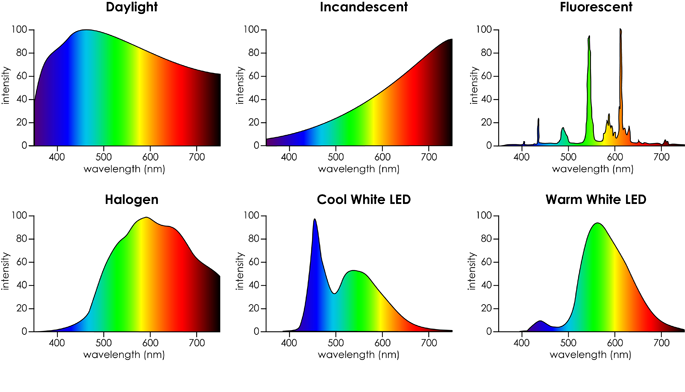
#43One problem with current popular LED bulbs: They emit more blue light than incandescent bulbs [1]. If people light their households with LED lights at night, it might shift their circadian rhythms [2]. Screwed up circadian rhythms can have all sorts of negative health/productivity effects. [1] http://www.designingwithleds.com/measuring-light-quality-phi... [2] https://justgetflux.com/research.html
I'd love to see more applications of LEDs providing the right color temperature and intensity for the time of day, as well as more applications that avoid the bulb form factor. I'd love for my ceiling to emit light like the sky...
Re: The amazing progress of LEDs
#44One problem with current popular LED bulbs: They emit more blue light than incandescent bulbs [1]. If people light their households with LED lights at night, it might shift their circadian rhythms [2]. Screwed up circadian rhythms can have all sorts of negative health/productivity effects. [1] http://www.designingwithleds.com/measuring-light-quality-phi... [2] https://justgetflux.com/research.html
I'll be trying my hand at some LED strip / arduino programming to build a dawn alarm that goes from dim red to bright white progressively. I have a Philips halogen dawn alarm which naturally goes from orange -> red as it ramps up, but unfortunately doesn't get quite as bright as I would like for that "wake up at the cabin" experience. I'd love to see more applications of LEDs providing the right color temperature and…
Re: The amazing progress of LEDs
#45One problem with current popular LED bulbs: They emit more blue light than incandescent bulbs [1]. If people light their households with LED lights at night, it might shift their circadian rhythms [2]. Screwed up circadian rhythms can have all sorts of negative health/productivity effects. [1] http://www.designingwithleds.com/measuring-light-quality-phi... [2] https://justgetflux.com/research.html
I'll be trying my hand at some LED strip / arduino programming to build a dawn alarm that goes from dim red to bright white progressively. I have a Philips halogen dawn alarm which naturally goes from orange -> red as it ramps up, but unfortunately doesn't get quite as bright as I would like for that "wake up at the cabin" experience. I'd love to see more applications of LEDs providing the right color temperature and…
http://www.maxspect.com/index.php?option=com_content&view=ar...
One of the models puts out UV, so be careful.
Message me (email in profile) if you want to chat!
Re: The amazing progress of LEDs
#46One problem with current popular LED bulbs: They emit more blue light than incandescent bulbs [1]. If people light their households with LED lights at night, it might shift their circadian rhythms [2]. Screwed up circadian rhythms can have all sorts of negative health/productivity effects. [1] http://www.designingwithleds.com/measuring-light-quality-phi... [2] https://justgetflux.com/research.html
Almost all the LEDs in my house are ~2700K, about the same an incandescent lights. Regarding circadian rhythm, light from near-sleep-time television watching is much more of a concern, but that's been a problem for at least 30 years.
Re: The amazing progress of LEDs
#47Earlier quoted context omitted.
I'll be trying my hand at some LED strip / arduino programming to build a dawn alarm that goes from dim red to bright white progressively. I have a Philips halogen dawn alarm which naturally goes from orange -> red as it ramps up, but unfortunately doesn't get quite as bright as I would like for that "wake up at the cabin" experience. I'd love to see more applications of LEDs providing the right color temperature and…
The best thing I've found so far are these lights meant for growing coral: http://www.maxspect.com/index.php?option=com_content&view=ar... One of the models puts out UV, so be careful. Message me (email in profile) if you want to chat!
Re: The amazing progress of LEDs
#48Earlier quoted context omitted.
The best thing I've found so far are these lights meant for growing coral: http://www.maxspect.com/index.php?option=com_content&view=ar... One of the models puts out UV, so be careful. Message me (email in profile) if you want to chat!
Those look like a very polished product! In my case, I'm looking to take advantage of the availability of $15 for a 300 RGB LED strip, as well as for the challenge writing my own control logic with an arduino. The SAD wake-up alarm is more of a side-benefit.
I like your project! How many watts is the LED strip?
Re: The amazing progress of LEDs
#49Earlier quoted context omitted.
Those look like a very polished product! In my case, I'm looking to take advantage of the availability of $15 for a 300 RGB LED strip, as well as for the challenge writing my own control logic with an arduino. The SAD wake-up alarm is more of a side-benefit.
I don't have any SAD issues, but I find that getting proper light in the morning helps stop me from going to bed too late. I like your project! How many watts is the LED strip?
Re: The amazing progress of LEDs
#50Earlier quoted context omitted.
Almost all the LEDs in my house are ~2700K, about the same an incandescent lights. Regarding circadian rhythm, light from near-sleep-time television watching is much more of a concern, but that's been a problem for at least 30 years.
2700K can still have a spike of blue in the wrong spot. this is a 2700K bulb: http://www.designingwithleds.com/wp-content/uploads/2014/01/...
Then again intensity towards blue-green still seems much higher in the LED, and maybe that matters more?