http://toastytech.com/guis/ns08.html NextStep 0.8, '88 vintage.
Even so, Atari GEM could have influenced NeXT, which then influenced Windows 95... it's a cool bit of retro-chic =)
41–50 of 204 posts
http://toastytech.com/guis/ns08.html NextStep 0.8, '88 vintage.
They mention X and O on the PS controller but usually in games O is for no and X is for yes. Completely opposite of the batsu/maru, incorrent/correct they were discussing.
I'd be curious to know what caused that convention to change in the west.
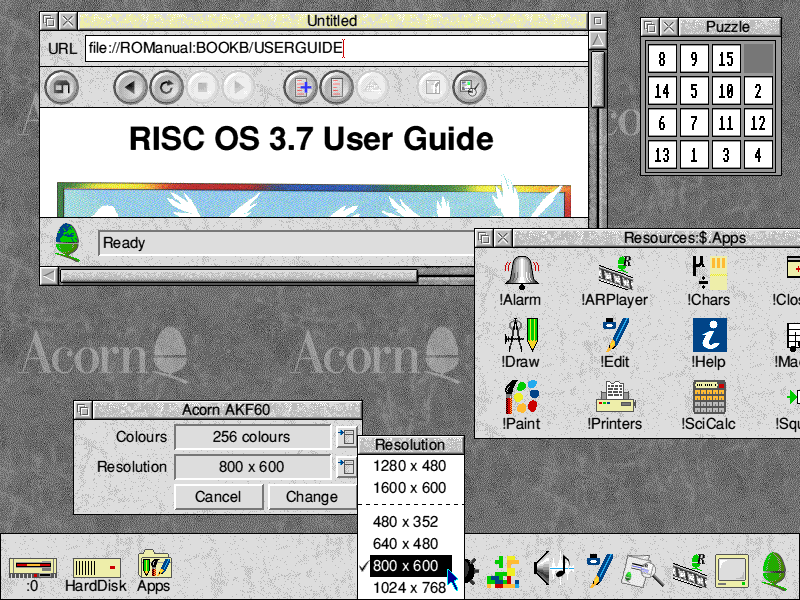
RiscOS had the x as well in the late 1980s edit - Here's Arthur, the precursor to RiscOS in ~ 1986 - http://www.rougol.jellybaby.net/meetings/2012/PaulFellows/10... - It has nice x icons.
Until the NewLook sprite set, it looks more like a weird flower shape than an X.
Here it is with NewLook: http://www.guidebookgallery.org/pics/gui/desktop/full/riscos...
Clearly now an X.
They mention X and O on the PS controller but usually in games O is for no and X is for yes. Completely opposite of the batsu/maru, incorrent/correct they were discussing.
On the PS1, Final Fantasy VII was O=yes, X=no, and so were a bunch of the less mainstream JRPGS; also, Metal Gear Solid games were O=yes, X=no at least into the PS2 era.
They mention X and O on the PS controller but usually in games O is for no and X is for yes. Completely opposite of the batsu/maru, incorrent/correct they were discussing.
In Japanese variants, he is correct. When Sony westernized the playstation controller, the O and X functionality was flipped. Sony is yet to comment on the reasons why.
Earlier quoted context omitted.
The Atari Gem thing is not an X, it's actually supposed to be a gem. It's just confusing because of the low-res image. Take a look at http://toastytech.com/guis/gem11menu.png
That's not GEMTOS, that's GEM for DOS... big difference...
http://en.wikipedia.org/wiki/Atari_TOS#mediaviewer/File:ST_D...
Looks pretty X-like. It seems GEM itself was licensed from Digital Research but their GEM didn't use X.
Edit: Fixed DEC to DR, as pointed out by reply comment below.
http://toastytech.com/guis/ns08.html NextStep 0.8, '88 vintage.
Even so, Atari GEM could have influenced NeXT, which then influenced Windows 95... it's a cool bit of retro-chic =)
They mention X and O on the PS controller but usually in games O is for no and X is for yes. Completely opposite of the batsu/maru, incorrent/correct they were discussing.
In Japanese variants, he is correct. When Sony westernized the playstation controller, the O and X functionality was flipped. Sony is yet to comment on the reasons why.
The Genesis' button layout was A,B,C arranged in a diagonal from bottom-left to top-right. A was usually 'accept'. The Dreamcast had a diamond with A at the bottom and B to the right.
Nintendo's Famicom buttons read A,B from right-to-left, and that trend continued with the Super Famicom's diamond, which had A to the right and B at te bottom. The N64 had a weird layout, but again B was to the left of A.
Sony probably focus tested the pad in the US and found that players were more used to Sega's layout.
Earlier quoted context omitted.
In Japanese variants, he is correct. When Sony westernized the playstation controller, the O and X functionality was flipped. Sony is yet to comment on the reasons why.
I thought the popular rumor was this was to help people with Nintendo 64 muscle memory, where the X corresponded (loosely) with where the A button was positioned, and the O corresponded to where the B was positioned.