Live data from Hacker News

Wealth Levels, Wealth Inequality, and the Great Recession [pdf]

web.stanford.edu

41–50 of 58 posts

Re: Wealth Levels, Wealth Inequality, and the Great Recession [pdf]

#41
post #3

Earlier quoted context omitted.

Not exactly. The 25th percentile's wealth was dropping even before the recession, which suggests some additional downward pressure, although I am not sure what that could be off the top of my head.

> some additional downward pressure, although I am not sure what that could be I'm not an economist, so these are speculative, but seem reasonable based on the fact that we're talking about loss of wealth from households below median: Loss of life (specifically heads of household) due to the wars (I'm guessing most military households, being young and having maximum education of high school to "some college" will be…

Those describe downward pressure on income, not wealth necessarily:

None of these would lead to a decrease in wealth so quickly, except for situations in which the wealth had to be consumed to make up for loss of job / disability / sickness / overconsumption.

Re: Military families: Most people getting killed/dismembered were too young to have any wealth to lose. Even still, their wealth would actually increase upon death as the military's life insurance policies are quite generous.
Re: Wealth Levels, Wealth Inequality, and the Great Recession [pdf]

#42
post #4

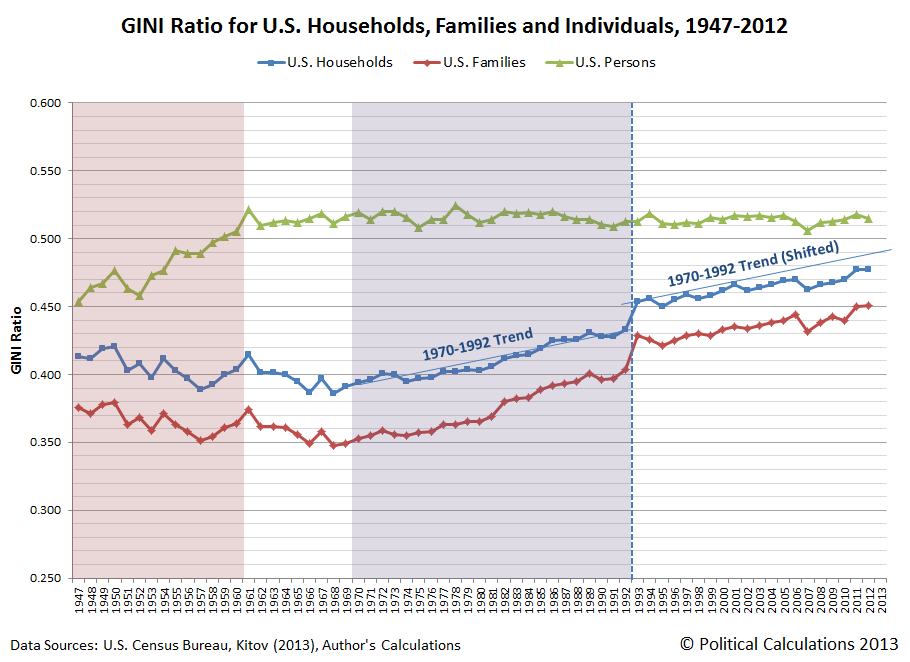
This study is misleading, because it uses 'household' wealth, instead of individual wealth, and may be incorrectly interpreted as showing a decline in the middle class, when it is really showing the results of changes in family structure over the past 50 years. This graph shows how this choice affects the results: http://1.bp.blogspot.com/-g3WZGpDibPM/Up3ZAPRtScI/AAAAAAAAJq... The following blog-posts go in to more d…

Very interesting reads, thank you for sharing them.

However, just looking at the time scale over which the net worth changes described in the original article occurred, and their magnitudes, it doesn't seem likely that the effect they describe can be explained so easily by social factors. Hypothesizing that it's just a social change related to shrinking households leads to some interesting questions about what that really means in practical terms: Did the bottom 5% go from an average net worth of -$9K to -27K over the course of a decade because, on average, three individuals in the red would get together to form a combined household with pooled debts? Did the 25th percentile go from an average of $10k to an average of $3k because of parents getting divorced and kids moving out en masse? Meanwhile wealthy people's family structures remain static.

I think the data you link and the data in the article are reconcilable. Income and wealth are different things, after all. Perhaps wealthier folks' net worth dropped less precipitously during the Great Recession because they experienced nothing worse than a drop in the valuation of their primary residence. Meanwhile less wealthy folks suffered a greater loss because they were more likely to get foreclosed on, therefore suffering a loss of all the equity they had built up in their homes. This trend wouldn't show up as much in the income numbers because losing your house doesn't necessarily coincide with losing your job, certainly not the way things were playing out in 2008.

Re: Wealth Levels, Wealth Inequality, and the Great Recession [pdf]

#43
post #27

Earlier quoted context omitted.

You are correct about the chart, but if you look at the second and third blog-posts, you will see how family structure has changed, and how it will have a similar impact on measured household wealth. I wish that I had a similar wealth distributions graph handy, but this was the best source I could remember, and I think it serves to adequately demonstrate the point.

It’s a fair critique, but it really doesn’t come close to explaining the 2003–2013 data. The ratio of 95th percentile household net worth to median household net worth doubled from ~9x to ~18x. That’s not just some artifact of changing family structures. That’s a massive increase in wealth inequality. Basically, your point is interesting, but in context it’s mostly a distraction. (But I agree that a chart showing ind…

I think you are right that those blogs do not fully explain what happened after 2003. It seems like the measured wealth dip (amongst all groups) from 2007-current is quite consistent with losses due to the drop in housing prices from the great recession (though I have no solid data to back this up). Lower income households tend to have a greater proportion of their wealth tied up in housing (and with less home equity due to a variety of factors including low down payments in those years), so they were likely disproportionately (negatively) impacted.

I am not sure what could explain the changes between 2003-2007, though I would be very interested to hear any ideas.

Re: Wealth Levels, Wealth Inequality, and the Great Recession [pdf]

#44
post #10

The wikipedia article on Income inequality in the United States is surprisingly detailed and I highly recommend it if you have any interest on wealth. It's such a polarized topic that the comments almost immediately turn into inaccurate or out of context talking points. http://en.wikipedia.org/wiki/Income_inequality_in_the_United...

Income and wealth are quite different topics...

On that note:

http://en.wikipedia.org/wiki/Wealth_inequality_in_the_United...

http://en.wikipedia.org/wiki/Affluence_in_the_United_States

Re: Wealth Levels, Wealth Inequality, and the Great Recession [pdf]

#45

Earlier quoted context omitted.

If you take a minute to consider the demographics involved and the nature of wealth, it is neither depressing nor surprising nor even "bad". Consider, for example, that many people have negative wealth.

Consider what factors, and in what way? Also, whether or not something is depressing, surprising, or bad is entirely subjective. Something you do not consider surprising may in fact be surprising to another individual, so without knowing them it's sort of silly to say "it isn't surprising". If they say it is surprising, it means to them it was. If you do not think others should be surprised, it may be useful for you…

To be wealthy means that one possesses sufficient wealth (stuff) to live comfortably even after they quite their job.

The bastardized term of "wealth" used here, however, refers simply to material possessions even when not in sufficient quantities to provide any passive lifestyle advantages; suddenly a paid off car worth $5,000 is "wealth." The estimated $30,000 in equity I possess on my $200,000 home is "wealth". It's all a bit frivolous.

By definition, the poor and middle classes don't possess true wealth. Their value is their human capital and time, which they exchange for money. Even the "working rich" - doctors and lawyers - don't routinely possess "wealth" in the traditional sense of the term.

Then we compare the $30,000 equity I possess to actual wealth... such as the land under a shopping mall. What is the use in such an exercise?

NEWS FLASH: People who own really valuable stuff possess really valuable stuff. The rest of us don't. Let's write books about this and study the shocking phenomenon?

You simply can't compare actual wealth - such as the land under a shopping mall, which generates sufficient revenue for many people to live comfortably - to "wealth".

Now, demographically... Why would anyone be surprised that a significant portion of the population has zero wealth? Honestly I'm surprised it's only 25% who have zero. How much "wealth" should a university student have? How about someone who's been working for a few years? How about someone who's been retired for twenty years and expects to die within the next ten?

Middle class people gradually build up a small stock of "wealth" (we used to call this "savings") throughout their working careers. Then after retirement they gradually draw it down until they die.

So yes, it is not surprising that many people have zero or negative wealth.

Re: Wealth Levels, Wealth Inequality, and the Great Recession [pdf]

#46
post #4

This study is misleading, because it uses 'household' wealth, instead of individual wealth, and may be incorrectly interpreted as showing a decline in the middle class, when it is really showing the results of changes in family structure over the past 50 years. This graph shows how this choice affects the results: http://1.bp.blogspot.com/-g3WZGpDibPM/Up3ZAPRtScI/AAAAAAAAJq... The following blog-posts go in to more d…

Very interesting reads, thank you for sharing them. However, just looking at the time scale over which the net worth changes described in the original article occurred, and their magnitudes, it doesn't seem likely that the effect they describe can be explained so easily by social factors. Hypothesizing that it's just a social change related to shrinking households leads to some interesting questions about what that r…

The wealthier folks were simply less leveraged:

1. If you own 10% equity in a home which declines in value 20%, you now have negative wealth. A 200% decline.

2. If you own 50% equity in a home which declines in value 20%, you have suffered a mere 40% decline.

Re: Wealth Levels, Wealth Inequality, and the Great Recession [pdf]

#47
post #4

This study is misleading, because it uses 'household' wealth, instead of individual wealth, and may be incorrectly interpreted as showing a decline in the middle class, when it is really showing the results of changes in family structure over the past 50 years. This graph shows how this choice affects the results: http://1.bp.blogspot.com/-g3WZGpDibPM/Up3ZAPRtScI/AAAAAAAAJq... The following blog-posts go in to more d…

That's interesting, but it makes me wonder about the value of GINI as an indicator if it hides the obviously horrifying effects the 2008 crash had on the bottom quintile and the very bad effects of driving median wealth into negative territory, where it remains stagnant.

I suspect a lot of people reading this board and living in Silicon Valley and other tech boom towns don't feel what that graph is saying in terms of day to day impact.

Re: Wealth Levels, Wealth Inequality, and the Great Recession [pdf]

#48

Earlier quoted context omitted.

Consider what factors, and in what way? Also, whether or not something is depressing, surprising, or bad is entirely subjective. Something you do not consider surprising may in fact be surprising to another individual, so without knowing them it's sort of silly to say "it isn't surprising". If they say it is surprising, it means to them it was. If you do not think others should be surprised, it may be useful for you…

To be wealthy means that one possesses sufficient wealth (stuff) to live comfortably even after they quite their job. The bastardized term of "wealth" used here, however, refers simply to material possessions even when not in sufficient quantities to provide any passive lifestyle advantages; suddenly a paid off car worth $5,000 is "wealth." The estimated $30,000 in equity I possess on my $200,000 home is "wealth". It…

"Middle class people gradually build up a small stock of "wealth"" That's part of the point. As the chart in this study shows, the middle class is not building anything. In fact, it's declining.

Re: Wealth Levels, Wealth Inequality, and the Great Recession [pdf]

#49

Earlier quoted context omitted.

On the other hand, 1 person with x income pays less income tax than 2 people with 2x income.

The US has joint filing for married couples so that's not the case, whereas it would be in e.g. the UK.

It most certainly is the case in the US... http://en.wikipedia.org/wiki/Marriage_penalty

Re: Wealth Levels, Wealth Inequality, and the Great Recession [pdf]

#50
post #4

This study is misleading, because it uses 'household' wealth, instead of individual wealth, and may be incorrectly interpreted as showing a decline in the middle class, when it is really showing the results of changes in family structure over the past 50 years. This graph shows how this choice affects the results: http://1.bp.blogspot.com/-g3WZGpDibPM/Up3ZAPRtScI/AAAAAAAAJq... The following blog-posts go in to more d…

This study is misleading, because it uses 'household' wealth, instead of individual wealth (...)

Perhaps, but there is no hard data at the individual level because, as it happens, basically every comprehensive dataset on income or wealth relies on tax or census data, which are aggregated at the household level by design. So any empirical claim about individual-level data should be taken ex ante with a big grain of salt and evaluated carefully; especially in a heavily politicized field like economics where data is scarce and motivated reasoning reigns.

Take, for instance, the graph you cite [1], which cites Kitov and Kitov (2013) [2] along with the US census bureau as a source. The problem is, what that paper provides is not an empirical dataset but a microfounded model for predicting individual income --with all the problematic epistemological/overfitting caveats that they come with. Presenting that graph as an empirical fact and not as a debatable modeling exercise is quite misleading.

Besides, as others have pointed out, all the links you provide discuss income, not wealth (and no, their arguments/reasoning about income do not readily/trivially translate to wealth, as you commented below). If you are interested, check out the work of Cheryl Doss [3], who has conducted actual empirical work about the differences between household and individual equality in Ecuador, Ghana and India.

(PD: Oh wow even their claims about changing family structure in that blog [4] is disturbingly model-dependent. Much is made about the percentage of single-person households following an S-shaped curve, inflecting at 1968. However, they fit a sigmoid to what is a patently linear trend in the total number of single-person households beginning in 1950, and extrapolate back to 1900 despite having only two data points for that period. This wouldn't pass even a cursory peer-review, sorry.)

[1] http://1.bp.blogspot.com/-g3WZGpDibPM/Up3ZAPRtScI/AAAAAAAAJq...

[2] http://www.ecineq.org/ecineq_bari13/FILESxBari13/CR2/p177.pd...

[3] http://www.genderassetgap.org/sites/default/files/Doss%20-%2...

[4] http://politicalcalculations.blogspot.ca/2013/12/the-widows-...

Post reply on HN