Live data from Hacker News

The Sierpinski triangle page to end most Sierpinski triangle pages

oftenpaper.net

41–50 of 61 posts

Re: The Sierpinski triangle page to end most Sierpinski triangle pages

#41

This is amazingly cool and stimulating to think about. It's also a compelling reason to take another look at Mathematica. The code is clearly dense and hard to understand, but I wouldn't even know how to go about performing some of these computations in another language.

I really wish the licensing for Mathematica weren't as strict; it's a fantastic language that would be everywhere if it had a free "community version" or something. I used it very extensively in college and then took advantage of the $500 lifetime professional upgrade for new graduates. Now I do server-side development and data science at a startup, and I often work on problems that could solved efficiently with a few lines of Mathematica code. I'll use it for one-time internal scripts, but due to Wolfram's licensing you can't just bake it into your server code. Not to mention, it's nearly impossible to find engineers who have much experience with it since you can't exactly download it and hack on it like you can with the alternatives.

Don't get me wrong, it's a powerful tool and well worth it's price. But adoption is extremely low outside of academia, and I don't see that changing anytime soon unless Wolfram adopts more developer-friendly licensing. Which is a pity because it's definitely the "right tool for the job" in a lot of cases.
Re: The Sierpinski triangle page to end most Sierpinski triangle pages

#42
post #40

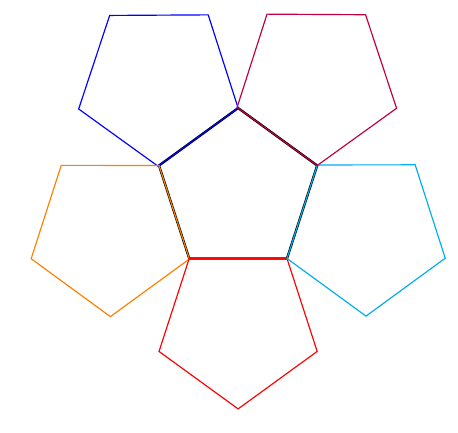
I was thinking about Sierpinski triangles recently, and trying to relate it to the 3 4 5 triangle. The 3 side has a Sierpinski triangle, with 9 segments, equaling 3^2. The 4 side has an equivalent "Sierpinski square", with 16 segments, equaling 4^2 (basically four squares touching at the corners with an empty square space in the middle, forming a cross shape). Then I was going to show how the two shapes could be comb…

Regular Pentagon does not tile the plane.

[deleted]

Re: The Sierpinski triangle page to end most Sierpinski triangle pages

#43
post #40

I was thinking about Sierpinski triangles recently, and trying to relate it to the 3 4 5 triangle. The 3 side has a Sierpinski triangle, with 9 segments, equaling 3^2. The 4 side has an equivalent "Sierpinski square", with 16 segments, equaling 4^2 (basically four squares touching at the corners with an empty square space in the middle, forming a cross shape). Then I was going to show how the two shapes could be comb…

Regular Pentagon does not tile the plane.

http://i.stack.imgur.com/bGpfy.png You're right, thanks. So if the inner space is shaded, it produces the "Sierpinski pentagon", and this can be iterated indefinitely.

Re: The Sierpinski triangle page to end most Sierpinski triangle pages

#44
post #18
post #5

That's amazing. It just goes on and on with beautiful plots. About halfway down, there's a section on understanding the Riemann sphere: > From what I can tell, one of the settings used to deal with division by 0 is the so-called Riemann sphere, which is where we take a space shuttle and use it to fly over and drop a cow on top of a biodome, and then have the cow indiscriminately fire laser beams at the grass inside a…

I'll attempt a layman's explanation of a Riemann sphere for anyone who has no idea what this is about: The Riemann sphere lets you deal with dividing by 0 by adding one more point to the complex plane: ∞[1]. Imagine putting it in the air above the origin, 0, and folding the midpoints of the four sides of your graph paper to meet there. (Yup, put all 4 points of the arrows in the same spot!) That's the Reimann sphere[…

the geometric rationale - the axiom of parallel lines.

On classic, Euclid, plane a pair of parallel lines would never intersect. Given a line and a point outside of the line, there can be only one line through the point which would be parallel to the first line.

If one modify the axiom to allow for many such lines through the point (the lines which would never intersect the first line) - that would result in hyperbolic plane geometry.

If one modify the axiom to state that no such line through the point is possible (i.e. any line through the point would intersect the original line) - that would result in the Riemann sphere geometry.

Re: The Sierpinski triangle page to end most Sierpinski triangle pages

#45
post #18
post #5

That's amazing. It just goes on and on with beautiful plots. About halfway down, there's a section on understanding the Riemann sphere: > From what I can tell, one of the settings used to deal with division by 0 is the so-called Riemann sphere, which is where we take a space shuttle and use it to fly over and drop a cow on top of a biodome, and then have the cow indiscriminately fire laser beams at the grass inside a…

I'll attempt a layman's explanation of a Riemann sphere for anyone who has no idea what this is about: The Riemann sphere lets you deal with dividing by 0 by adding one more point to the complex plane: ∞[1]. Imagine putting it in the air above the origin, 0, and folding the midpoints of the four sides of your graph paper to meet there. (Yup, put all 4 points of the arrows in the same spot!) That's the Reimann sphere[…

[deleted]

Re: The Sierpinski triangle page to end most Sierpinski triangle pages

#46
post #7

Another cool thing about the Sierpinski gasket is that it's possible to more or less do calculus on it. You can even define a Laplacian operator. There's actually a whole class of fractal-like sets on which this is possible, but SG has always been the prototypical one.

I also thought about implementing a language that bases on this, a language that sees the world in all it's shapes as raw numbers, a matrix, renderable as graphs. This is so freaking awesome, that I cannot stop thinking about the crazy new ideas this injected into me and suspect that I'm probably becoming a numberphile.

Interestingly, I was just reading the Book (hardcover) with the recursive Title: "The Fractal Geometry of Nature" by Benoit Mandelbrot. And this brings an entirely new meaning into my world view after combining the ideas behind this and http://en.wikipedia.org/wiki/Multifractal_analysis#technique...

Re: The Sierpinski triangle page to end most Sierpinski triangle pages

#47

That is truly impressive and mostly all over my head. I feel that somewhere on that page we should be able to find a graphical solution to the factorization of large primes unless maybe that code would need to run on a computer residing in the fourth or fifth dimension?

>That is truly impressive and mostly all over my head. Glad i am not alone

Re: The Sierpinski triangle page to end most Sierpinski triangle pages

#48
post #15

Is is just me or is the code source really hard to understand? It's cool that you can represent such complex shapes with just a few lines of code in Mathmatica, but without comments and with all the single letter variables, it's hard for me to follow what's going on.

I agree, but do realize this is written for a mathematical audience, not a CS audience. It's reductive, but it's not that reductive to your average math major/grad student. Code by/for mathematicians is particularly ugly to a professional programmer. There is significant historical (pencil & paper) precedent for what single-letter variables represent in a given context. For a mathematician, ConstantArray[0, {m,n}] re…

But why pick two letters, m and n, which are pronounced almost exactly the same way? That broke my brain so badly at uni on so many occasions, especially with non-native-speaking lecturers :(

Re: The Sierpinski triangle page to end most Sierpinski triangle pages

#49
post #21

Uh, wow, I think they earned that claim. There's so much in here, they even have a cow which fires lasers being dropped from a space shuttle. http://www.oftenpaper.net/img/understandingtheriemannsphere.... seriously going to have to look more closely at this some time, it's fascinating in a "look what you can do with math/programming/mathematica" kind of way.

"This cow does not cower. Infinity cannot bully this bull, cannot bloviate this bovine. By all appearances this cow is wearing infinity on its mane."
Post reply on HN