As a study in starting an airline, Richard Branson's biography is well worth a read.
Starting an Airline
41–50 of 234 posts
Re: Starting an Airline
#42Earlier quoted context omitted.
It's very strange given how necessary air travel is. It still surprises me how need and margins are inversely related (luxury goods have high margins, commodities low), but it makes sense. It's the price. The price of travel is so high for most consumers that they're going to optimize on price at the sacrifice of everything else. The cost of flying and operating an airline is so expensive that airlines also optimize…
>> "It's very strange given how necessary air travel is" I haven't given this much thought but a lot of it isn't necessary at all. 1. Vacations abroad - vacation in your own country or take a boat 2. Business - a lot of business can now be conducted online which previously required air travel I'm sure those two things alone make up a vast portion of the consumer air travel market.
On point 2), humans are still very much "social animals", and time and time again I see that business works a lot better face to face, and trust is much more easily gained.
That has been repeatedly established, and there are very strong reasons why people with very limited time still travel a lot of hours to conduct their business.
Not everyone is the same, but it is the norm rather than the exception.
http://www.iacconline.org/content/files/WhyFace-to-FaceBusin...
From the paper: "From a psychological perspective there are a number of positive features about faceto-face meetings that cannot always be achieved as well via other forms of communication.
Face-to-face meetings allow members to engage in and observe verbal and nonverbal behavioral styles not captured in most computer mediated communication devises. There are nuances associated with hand gestures, voice quality and volume, facial expressions, and so forth that are simply not captured in email discussion, chat rooms, and the like. Even videoconferencing does not capture all of the dynamics of group members (e.g. the expression of others while one member is talking, etc.).
A further advantage of face-to-face meetings is that they occur in “real time” as opposed to non-synchronized time. Computer mediated communications often are delayed because of a variety of reasons, not always received, and sometimes disrupted because of technical problems.
Another feature is simply the fact that face-to-face business meetings provide human contact among members. Human contact is a primitive need among human beings.
We are social creatures and isolation is harmful. A recent article in the New Yorker magazine8 discussed the impact of social isolation and concluded that “simply to exist as a normal human being requires interaction with other people” (p. 36). There is much psychological research affirming this proposition—that individuals need personal contact with others to satisfy deep primitive psychological needs. Face-toface business meetings help meet these needs. Emailing and even teleconferences are not as likely to meet these needs, notwithstanding the enormous popularity of Facebook which basically provides electronic connections between social “friends”. However, the popularity of this website suggests that people might be even hungrier for social friends than can be satisfied in their present day-to-day work and personal lives.
Similarly, business meetings allow participants opportunities to develop important exchange relationships among themselves. These exchanges can be in the form of business negotiations, personal favors, promises, understandings, etc. that cannot often be achieved via other forms of communication because of their personal and informal nature. One psychological theory that emphasizes this notion is “social exchange theory” where human relations are viewed as an exchange of rewards among individuals or achieving equity between “what you put in” compared to “what you get out” of relationships."
http://www.forbes.com/forbesinsights/Business_Meetings_FaceT...
Re: Starting an Airline
#43The airline industry has the lowest return on invested capital of any industry: http://centreforaviation.com/images/stories/2013/jul/05/ROIC... This analysis from McKinsey is worth a read: http://www.iata.org/whatwedo/Documents/economics/Profitabili...
It's very strange given how necessary air travel is. It still surprises me how need and margins are inversely related (luxury goods have high margins, commodities low), but it makes sense. It's the price. The price of travel is so high for most consumers that they're going to optimize on price at the sacrifice of everything else. The cost of flying and operating an airline is so expensive that airlines also optimize…
Food is also necessary, but the margins on staple foods are razor thin. It's Econ 101: profits in competitive industries tend towards zero. The only way to make consistent economic profits is to focus on industries where there is (relatively) little competition. One way to do that is ride the wave of a new industry before the competitors have time to pile in. Another is to enter industries where product differentiation plays a major role. E.g. wheat is wheat, but an iPhone and an Android phone aren't totally fungible.
Just look at the posted chart: http://centreforaviation.com/images/stories/2013/jul/05/ROIC....
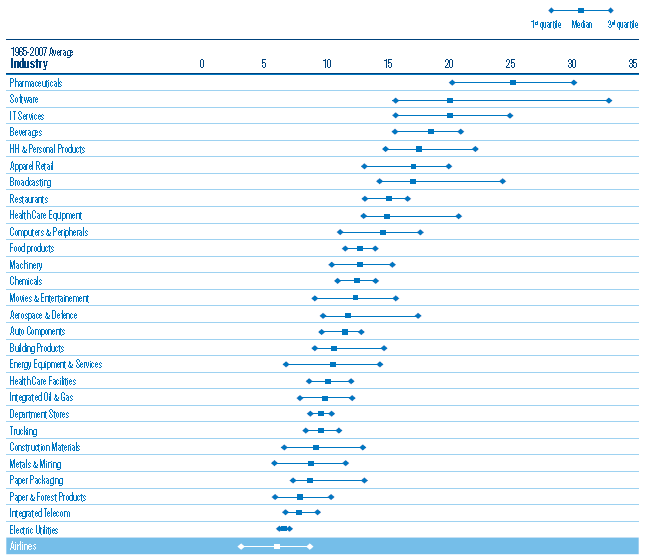
What's at the bottom? Airlines, electrical utilities, paper, metals, construction materials, and trucking. These are all products that are highly standardized and fungible. You're never going to sell trucking services for 10x cost by making it a "lifestyle brand" the way Ralph Lauren sells jeans for huge margins.
Re: Starting an Airline
#44Earlier quoted context omitted.
> You must build an airport Most definitely not. You do need to rent or buy space (and ideally slots) at a bunch of airports. You can also lease planes.
I mean, it's hard to say that getting terminal real estate is any easier than building an airport would be :-)
Good point. Which is evidenced by the fact that many airports aren't really 'in' the cities they are named for. Example: Cincinnati's CVG airport is actually in rural Kentucky. Cheaper land.
Re: Starting an Airline
#45Although going big is interesting, I am surprised no one has brought up http://www.surfair.com when thinking about starting an airlines. They seem to be doing well and although i do not have a membership (live on the east cost) I think it would be interesting to do the same thing from DC to NYC to Boston as I would be down for that!
Re: Starting an Airline
#46Earlier quoted context omitted.
Actually it's commoditization. There is very little differentiation in airline flying - particularly domestic in the US. So they get stuck competing on price. Imagine you're flying from NY or BOS to SFO. You have two choices. Pay around $500 per ticket with some price shopping. Have a horrible experience of cattle herding, no food choices, small seats. Or spend $2500 or something insane for slightly larger seats. Wei…
Do they not do economy plus (or equivalent)? I mostly fly internationally (not a lot of domestic flying in England) and there's usually the option of spending an extra ~£100 on a LHR-EWR return for extra legroom seats. I couldn't justify the jump to Business/First, but £100 over 15hrs of flying is a no-brainer.
The legacy carriers in the United States (American, Delta, United, US Airways) all have some sort of improved-economy seat with more legroom and/or more recline, and charge a varying premium to book those seats.
Re: Starting an Airline
#47As a study in starting an airline, Richard Branson's biography is well worth a read.
I love that quote of his, where he says the easiest way to become a millionaire is to start out a billionaire and go into the airline business.
Re: Starting an Airline
#48Earlier quoted context omitted.
Problem with this is that airplane configurations are not easily changed; and accomodating 3 different sizes of seats with the risk of having to sell bigger seats for lower prices.... is not worth taking for most airlines (especially low-cost carriers)
Looks like a market opportunity for quickly-reconfigurable seats.
A lot of people think that, there are a ton of FAA regs related to seats. Everything has to be tested in crashes. That also why it takes airlines so long to change seats to the new entertainment ones with power and everything. Your seat is your number one safety in the event of a crash. You are actually supposed to use the seat in front of you to brace yourself. It has a certain give to it so you don't run in to a brick wall when you land hard. If seats were easily configurable, every possible combination would need to be tested. Also whenever you do any work on a plane, you must have all of the supporting documentation, just think how long that would take to turn around. Document each bolt that was removed, when it was replaced, where it was..etc.. a lot of hassle.
Re: Starting an Airline
#49Earlier quoted context omitted.
> You must build an airport Most definitely not. You do need to rent or buy space (and ideally slots) at a bunch of airports. You can also lease planes.
I mean, it's hard to say that getting terminal real estate is any easier than building an airport would be :-)
[deleted]
Re: Starting an Airline
#50Earlier quoted context omitted.
It's very strange given how necessary air travel is. It still surprises me how need and margins are inversely related (luxury goods have high margins, commodities low), but it makes sense. It's the price. The price of travel is so high for most consumers that they're going to optimize on price at the sacrifice of everything else. The cost of flying and operating an airline is so expensive that airlines also optimize…
Actually it's commoditization. There is very little differentiation in airline flying - particularly domestic in the US. So they get stuck competing on price. Imagine you're flying from NY or BOS to SFO. You have two choices. Pay around $500 per ticket with some price shopping. Have a horrible experience of cattle herding, no food choices, small seats. Or spend $2500 or something insane for slightly larger seats. Wei…
Weird how there isn't an option for $500, $800, $1500
There is, sort of. It's easy to look at the interior of, say, a 737 and conclude there are only two or three "classes" (economy and first, and possibly some sort of premium-rate economy with extra legroom), but fare-wise there's enormous variation.
On -- to take an example legacy carrier -- United, the "economy" cabin is actually made up of fourteen different fare classes. Deciding how many seats to offer in each fare class on a given instance of a given flight on a given day is a stupendously complex task which largely gets hidden from the customer (for completeness' sake, "first class" and "business class", on planes which have them, have three additional fare classes each).
A big part of it is that there's more to it than just the seat, which is obvious since all those different "economy" fare classes end up in the same or very similar physical things-to-sit-on. The number of factors, though, is frighteningly large.
For example, your origin and ultimate destination factor into the fare, as do whether it's one-way or round-trip, and how far in advance you booked, and whether you wanted a refundable ticket, and whether it was booked by a corporate travel department on your behalf, and whether it was a seat offered to third-party travel-booking and search sites, and what day of week and time of day the flight is operating, and whether it's a seasonal offer to a popular vacation destination, and... that's the tip of the iceberg.